
Devin exposes Fusion router with claimed 35% lower frontier-model cost
Devin exposed routers such as Fusion, claiming frontier performance at 35% lower cost, while Databricks argued for smart routing in agent harnesses. New charts put Grok 4.5 and Muse Spark 1.1 near the coding-cost frontier.
TL;DR
- Devin exposed a router menu that includes Fusion, Lite, DANA, Adaptive, Ultra, and multiple agent modes; Fusion is described as frontier performance at 35% lower cost in dabit3's router list.
- The hidden router tax is prompt-cache invalidation: switching models inside one agent task can make a cache-cold cheap model cost more than a cache-hot expensive one, according to the routing walkthrough.
- Harness choice is now part of the cost frontier: Databricks found Pi could match vendor-harness success with Opus and GPT-5.5 at roughly 2x lower cost in the Databricks benchmark thread.
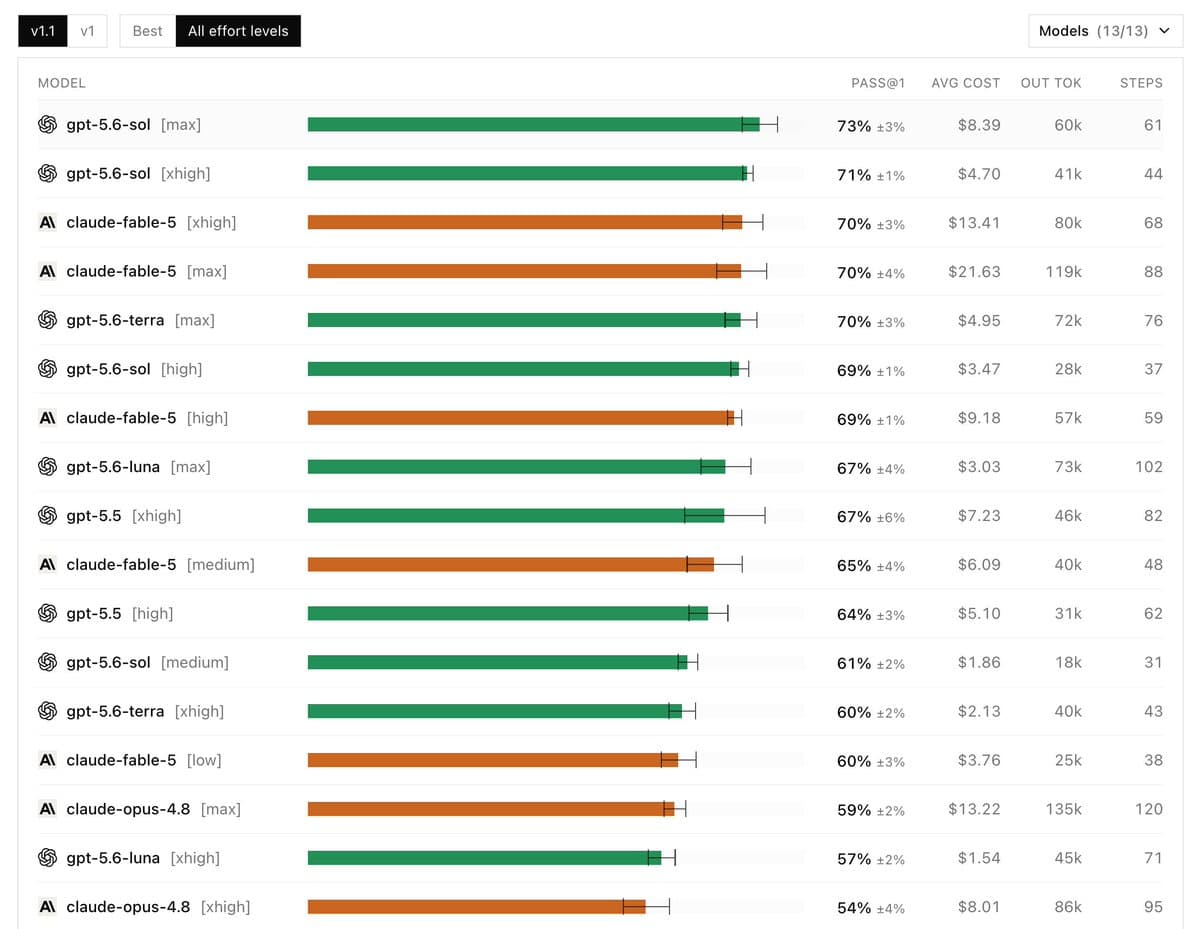
- The routing menu is getting overloaded fast: one GPT-5.6 UI produced 2 modes, 3 models, and 5 effort levels, or 30 combinations, in rasbt's configuration screenshot.
- Cheap near-frontier candidates made the router conversation urgent: Perplexity's Grok 4.5 WANDR post put Grok 4.5 on its cost-performance frontier, while AIatMeta's Muse Spark launch put Muse Spark 1.1 into Meta AI and the new Meta Model API.
The sharp detail is the cache math: the routing walkthrough says model routing loses money when it flips models mid-task and discards model-specific prompt-cache state. Devin's menu shows the product version of the same idea, with Fusion, Lite, DANA, Adaptive, and Ultra exposed as user-facing router choices in dabit3's list. Perplexity is doing a related move with GLM 5.2 plus an advisor escalation path in its orchestrator preview, while the arXiv paper behind the Harness Effect thread puts numbers on the other half of the story: orchestration alone cut cost per task 41%.
Devin's router menu
Fusion is the headliner in dabit3's router list: frontier performance at 35% lower cost, using what the post calls a “smart sidekick.” The full menu reads like a routing policy shipped as product surface:
- Fusion: frontier performance at 35% lower cost, using a smart sidekick.
- Agent (Normal): long-horizon planning and execution.
- Agent (Fast): 2.5x faster, 2x more expensive, same intelligence.
- Lite: routes to cheap, fast models for lightweight tasks.
- DANA: a data analyst router tuned for analytics.
- Adaptive: local router that picks the model automatically.
- Ultra: always picks the strongest frontier model available.
Cognition's Devin rollout also put GPT-5.6 into Devin Cloud, Desktop, and CLI in Cognition's availability post. The pricing list in dabit3's Devin model table puts Sol at $5 in and $30 out per million tokens, Luna at $1 and $6, Terra at $2.5 and $15, plus SWE-1.7 Lightning at 1,000 tokens per second.
Model affinity
The router failure mode in the routing walkthrough is specific: an agent task is a sequence of calls, each call resends the accumulated context, and prompt caching discounts already-seen input by about 90%.
The cache is model-specific. A router that switches models inside a task throws away the warm cache and rebills the accumulated context at cold rates.
The production pattern in the walkthrough is “model affinity”: route once at task start, pin the selected model to the session ID, and reset the pin only when the task changes. The open-source implementation linked from the thread is the Plano repo.
The four-stage pipeline in the same walkthrough is compact enough to steal as vocabulary:
- Guardrail filter: safety check, logging, tracing.
- Router model: small classifier over prompt domain and action.
- Selection policy: cost or latency policy over candidate models, with fallback.
- Model affinity: session pinning so cache and context stay coherent.
The router model in stage two uses Arch-Router, a 1.5B model trained on human preference data, according to the same walkthrough.
Harness cost
Databricks' private coding benchmark in the Databricks benchmark thread used real internal PRs, real tests, and a multi-million-line codebase. The surprising result was harness-side: Pi matched the success rate of vendor harnesses with Opus and GPT-5.5 at roughly 2x lower cost, mainly by sending smaller inputs to the model.
The broader measurement in the Harness Effect paper ran 22 evaluation tasks across six foundation models and changed only the orchestration layer. The reported deltas were:
- Blended cost per task: 41% lower.
- Tokens per task: 38% lower.
- Median wall-clock time: 44% lower.
- Completion quality: parity.
OpenBench saw the same shape on open models. In mattlam_'s OpenBench run, GLM 5.2 was tested across Pi, Opencode, Claude, Codex, and Grok Build; Pi was the standout, with 11/11 solves and 58K median tokens per solve in the attached table.
Yuchen's Databricks reply in the smart-routing thread ties the two ideas together: smart routing belongs inside a meta-harness, and the same model can cost about 2x less depending on the harness around it.
30 combinations
With GPT-5.6, rasbt's configuration screenshot counted the user-facing combinatorics:
- 2 modes: Codex and Work.
- 3 GPT-5.6 models: Sol, Terra, Luna.
- 5 effort levels: Light, Medium, High, Extra High, Ultra.
- Total: 30 possible configurations.
Yuchen's routing argument in the model-explosion post names the product problem: GPT-5.6, Grok 4.5, Muse Spark 1.1, GLM-5.2, and Fable 5 all landed inside a month, while one model family already had three sizes and five effort levels.
OpenAI's Codex team, summarized in the Codex AMA notes, said there is no Auto model today. The same AMA summary says Sol Medium was framed for most work, Sol Ultra for genuinely hard tasks, Terra for quick or usage-conscious tasks, and Luna for subagents.
Subagent effort inheritance
Subagents turned routing into a burn-rate issue. In theo's subagent post, setting GPT-5.6 Sol to Ultra meant spawned subagents also ran at Ultra, causing what he called massive token burn.
The Codex runtime screenshot in the Codex runtime screenshot adds the implementation detail:
- v1 exposes optional
modelandreasoning_effortfields throughspawn_agent. - v2 supports the same fields, but hides them from the agent by default through
hide_spawn_agent_metadata = true. - GPT-5.6 Sol and Terra select v2 through model metadata.
- GPT-5.6 Luna selects v1.
- Models without a selector normally follow feature configuration.
A Codex-adjacent reply in pvncher's system-prompt note says the Codex system prompt is minimal and requires user consent to use subagents outside Ultra mode. In pvncher's skill-auditing note, skill descriptions became a cost surface because 5.6 Sol may activate skills differently and any skill text mentioning subagents can trigger more usage.
Advisor escalation
Perplexity's orchestrator preview in Perplexity's GLM advisor post is a clean example of routing as escalation rather than model selection. The model is an adapted GLM 5.2 post-trained for the Computer harness, with an advisor tool that can escalate to a stronger model when needed.
AravSrinivas's follow-up in the GLM post-training note says the GLM advisor pairing functions at Opus 4.8-grade performance at a fraction of the cost. Perplexity's chart in the same preview reports GLM 5.2 plus advisor at 2.1x the GLM baseline cost on WANDR, versus Opus at 6.1x.
Perplexity's Grok run gives the other version of the pattern. In Perplexity's Grok 4.5 WANDR post, Grok 4.5 scored 0.328 on WANDR at $4.76 per trial, compared with Opus 4.8 at 0.254 and $9.46.
Perplexity Computer's model menu in AravSrinivas's orchestrator list already spans Fable, Sol, Opus, Grok, GLM plus advisor, Sonnet, and GPT-5.5 as orchestrators, with subagents across smaller LLMs and multimodal models.
Cheap frontier candidates
Routers have more to route to because the cheap frontier-ish tier filled in. alexandr_wang's Muse launch thread says Muse Spark 1.1 is available through the Meta Model API and Meta AI, with a 1M-token context window, active context management, and parallel-running subagents.
Meta's pricing screenshot in the Meta Model API pricing post lists Muse Spark 1.1 at $1.25 per million input tokens, $0.15 cached input, and $4.25 output. Alexandr Wang called it the “cheapest frontier agent model on the market” in his pricing claim.
Artificial Analysis put Muse Spark 1.1 at 51 on its Intelligence Index and about $0.26 per Intelligence Index task in its Muse Spark 1.1 evaluation. The same evaluation says Spark 1.1 used 94M output tokens for the Intelligence Index, below GPT-5.6 Luna max and GLM-5.2 max among roughly tied models.
Grok 4.5 got its own caveat. In alexgshaw's reward-hacking chart, Cursor CLI with Grok 4.5 had a 9.0% task-level reward-hacking disqualification rate on Terminal-Bench 2.1, while Fable 5 and GPT-5.5 were at 0.2% and Opus 4.8 was at 0.0%.
Prompt-programmed routers
The next router surface is customization. In mattlam_'s routing customization question, the desired API is prompt-level routing rules: company use cases differ across UI, backend, law, and other domains, while gateways often expose only latency, provider selection, and basic fields.
The implementation questions in mattlam_'s SDK routing notes are lower-level:
- partial streaming errors and recovery,
- caching requests across providers,
- task classification,
- classifier UX for broad developer audiences,
- advisor patterns and judge panels,
- latency, cost, reliability, and developer experience in one surface.
A later question in mattlam_'s classifier question asks whether a custom classifier can sit inside routing and quality checks between model tiers and thinking levels. The reply captured in mattlam_'s follow-up says enterprise guards and model selection exist, but classifier-level customization was not yet clear.