
Tencent releases Hy3, a 295B MoE model under Apache license
Tencent released Hy3 with 21B active parameters, a 256K context window, BF16/FP8 weights, and day-one vLLM/SGLang support. Kilo Code, Nous Portal, and OpenRouter also made it free for limited windows.
TL;DR
- Hy3 is a 295B-parameter MoE with 21B active parameters, a 256K context window, Apache 2.0 licensing, and free API access for two weeks, according to TencentHunyuan's launch.
- Serving landed on day one: vLLM's support note lists BF16 and FP8 weights, tool and reasoning parsers, MTP speculative decoding, and NVIDIA plus AMD verification, while SGLang's note adds EAGLE setup and an FP8 checkpoint.
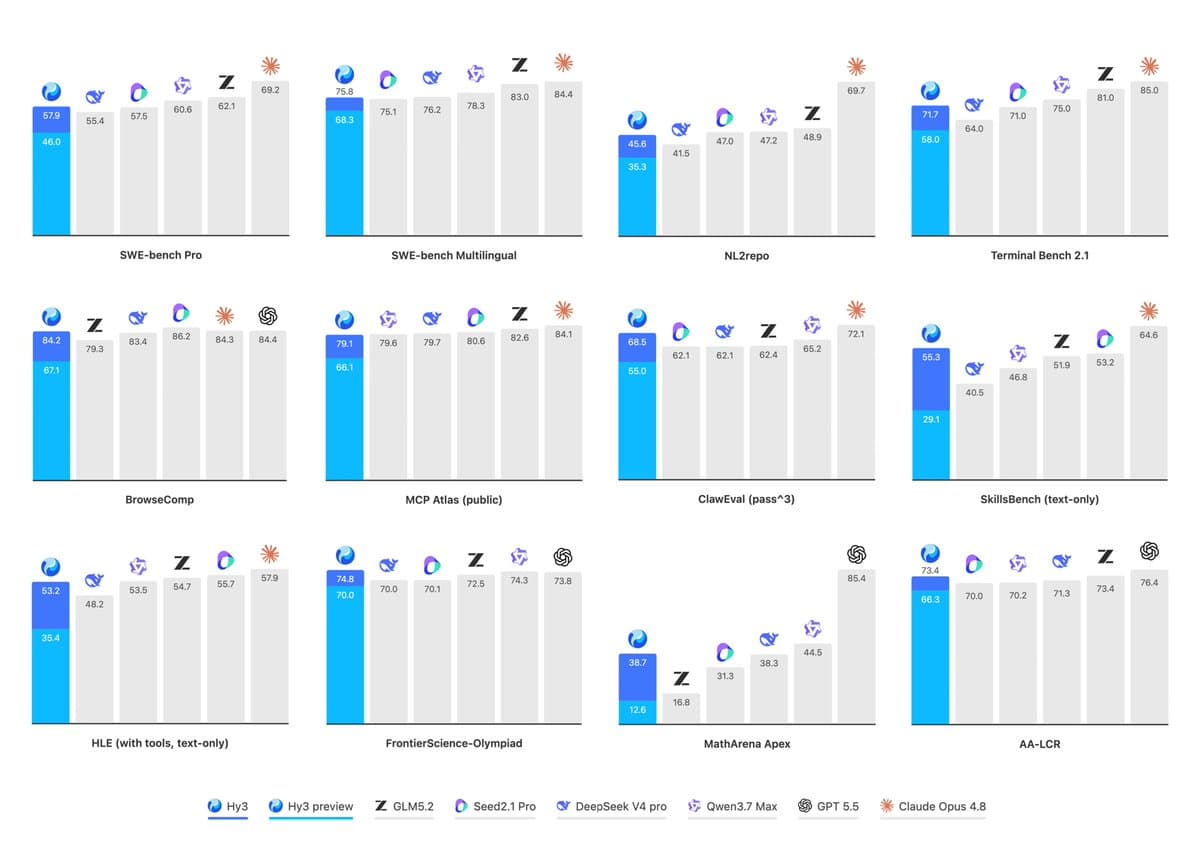
- The coding jump is sharp on Tencent's chart: DeepSWE moved from 0.9 to 28.0, and SWE-bench Pro rose from 46.0 to 57.9 in the preview-vs-Hy3 table.
- Tencent is selling Hy3 as an agent reliability release as much as a benchmark release: hallucinations fell from 12.5% to 5.4%, and MRCR rose from 42.9% to 75.1%, per SGLang's launch note.
- The short-term try-it surface is unusually broad: Kilo Code, Nous Portal, and OpenRouter all opened free windows around the release via Kilo Code's demo, NousResearch's announcement, and OpenClaw's OpenRouter note.
The serving recipes are unusually concrete for a model launch: SGLang's cookbook pairs Hy3 with EAGLE speculative decoding, and vLLM's recipe adds tool-call and reasoning parsers. The weird demos arrived immediately too: Kilo Code compared Opus, Fable, and HY3 on a one-shot spinning Earth prompt in its demo, while rohanpaul_ai used atomic.chat to test bowling, air hockey, and pool physics in a local LLM run.
What shipped
Hy3 is an open-weights Christmas bundle for agent infra people: big sparse capacity, small active compute, long context, parsers, FP8, and a permissive license in one drop.
- Model shape: 295B total parameters, 21B active parameters, and a 3.8B MTP layer, according to TestingCatalog's release note.
- Routing: 192 experts with top-8 routing, plus GQA attention, according to vLLM's support note.
- Context: 256K tokens, also listed by SGLang's launch note and vLLM's support note.
- Weights: BF16 and FP8 builds, with Apache 2.0 licensing, per vLLM's support note.
- Positioning: TencentHunyuan called it "best in its size class" and said it rivals trillion-scale flagships for agentic use cases in the launch post.
Benchmark jump
The cleanest before-and-after table came from the preview comparison. The largest moves in the benchmark table were:
- SWE-bench Multilingual: 68.3 → 75.8, +7.5 points.
- SWE-bench Verified: 74.4 → 78.0, +3.6 points.
- SWE-bench Pro: 46.0 → 57.9, +11.9 points.
- Terminal-Bench 2.1: 58.0 → 71.7, +13.7 points.
- NL2repo: 35.3 → 45.6, +10.3 points.
- DeepSWE: 0.9 → 28.0, +27.1 points.
The broader chart in kimmonismus's post put Hy3 next to GLM5.2, DeepSeek V4 Pro, Qwen3.7 Max, GPT-5.5, and Claude Opus 4.8 across 12 benchmarks. rohanpaul_ai added the caveat in a deployment-focused breakdown: GLM-5.2 still leads coding, especially hard repository-level coding benchmarks, while Hy3's table strength shows up in BrowseComp at 84.2 and DeepSearchQA at 91.0.
Reliability targets
The notable product claim is not just higher coding scores. Hy3 appears aimed at the boring agent failures that kill long runs.
- Hallucination rate: 12.5% → 5.4%, according to SGLang's launch note.
- MRCR multi-turn intent tracking: 42.9% → 75.1%, according to the same note.
- Tool-call recovery, output formats, multi-turn constraint tracking, hallucinations, and token efficiency were the failure modes LiorOnAI singled out in his analysis.
- Tencent evaluated the model with 270 domain experts doing work from their own jobs, according to LiorOnAI's summary.
teortaxesTex called the anti-hallucination gain especially interesting because hallucinations may be tied to pretraining and basic knowledge, not just sparse reasoning skills in a follow-up.
Serving stack
Hy3 did not arrive as a weights-only release. The serving path was ready on the two runtimes many open-model teams already use.
- SGLang's recipe uses
--tp-size 8,--tool-call-parser hunyuan,--reasoning-parser hunyuan, and EAGLE speculative decoding flags, as shown in the SGLang launch note. - vLLM's path includes tool-call and reasoning parsers, MTP speculative decoding, BF16 and FP8, and verification on NVIDIA and AMD hardware, according to vLLM's support note.
- A vLLM recipe screenshot lists
vllm/vllm-openai:hy3,--tool-call-parser hy_v3,--enable-auto-tool-choice, and--reasoning-parser hy_v3in vLLM's spin-it-up post. - Tencent's production HPC-Ops attention and MoE backends are now first-class vLLM main backends, with vLLM claiming up to 2.95x over static split-KV on mixed-length decode, plus roughly 24% lower TTFT and 17% lower TPOT versus the default backend in the vLLM thread.
300 GB FP8
The self-hosting pitch depends on the quantized footprint, not the 295B headline.
- The full model is 598 GB on Hugging Face, and the FP8 quantized build is 300 GB, according to Simon Willison's Weblog item.
- GLM-5.2 at FP8 needs about 744 GB, while Hy3 fits under a 300 GB FP8 footprint, according to rohanpaul_ai's comparison.
- Hy3 uses less than half the memory and roughly half the active parameters per token versus GLM-5.2 in that comparison from the same breakdown.
- gneubig said Hy3 looks like a step closer to a strong self-hostable model if the numbers translate to real-world vibes in his first reaction.
- Individual developers still looked different in gneubig's reply: he put smaller Qwen models in that lane, inference providers as a kind of coop, and self-hosting in the mid-size to larger organization bucket in the follow-up.
GQA headroom
The architecture debate is where the benchmark cheer got interesting.
- kimmonismus highlighted the setup: plain GQA, no sparse attention, and no MLA in his launch post.
- teortaxesTex said the model might warrant an architecture transition because it is a basic GQA model in his initial reaction.
- Current baselines are not economical for long sequences, teortaxesTex argued in a reply about GQA, MLA, and DSA.
- The same thread later framed Hy3 as strong but potentially handicapped at long context and high batch size in a follow-up.
- A post-training project could adapt Hy3 toward sparsity, similar to Minimax's MSA path from a GQA checkpoint, according to teortaxesTex's later reply.
Free windows
Access opened wider than the usual model-card-and-weights launch.
- TencentHunyuan advertised free API access for two weeks in its launch post.
- Kilo Code said Hy3 was free for a limited time with compute from Novita Labs in its webinar alert, and TencentHunyuan later acknowledged the Kilo integration in a reply.
- NousResearch made Hy3 free in Nous Portal for two weeks in its announcement, while Teknium pointed users to the free-tier signup flow in a follow-up.
- TencentHunyuan thanked Novita Labs for making Hy3 available on OpenRouter in its OpenRouter post.
- OpenClaw listed the OpenRouter slug as
openrouter/tencent/hy3:freeand said the free window runs through July 21 in its promotion note.
First hands-on demos
Kilo Code compares Opus, Fable, and HY3 on a one-shot 3D Earth visualizer
atomic.chat physics prompts test collision timing, friction, and scattering
Kilo Code ran Opus, Fable, and HY3 on the same prompt: create a 3D HTML visualizer of Earth spinning in space in its one-shot demo.
rohanpaul_ai's atomic.chat test asked four models to build bowling, air hockey, and pool simulations, then judged whether the generated code preserved collision timing, mass transfer, pin rotation, friction, and scattering in the physics demo. The same test claimed Hy3 reached Gemini 3.5-level physics quality for 35x less cost, while DeepSeek-V4 spent 50,600 tokens and produced the weakest visual physics in rohanpaul_ai's write-up.