
Kev releases open decision models built on Qwen3
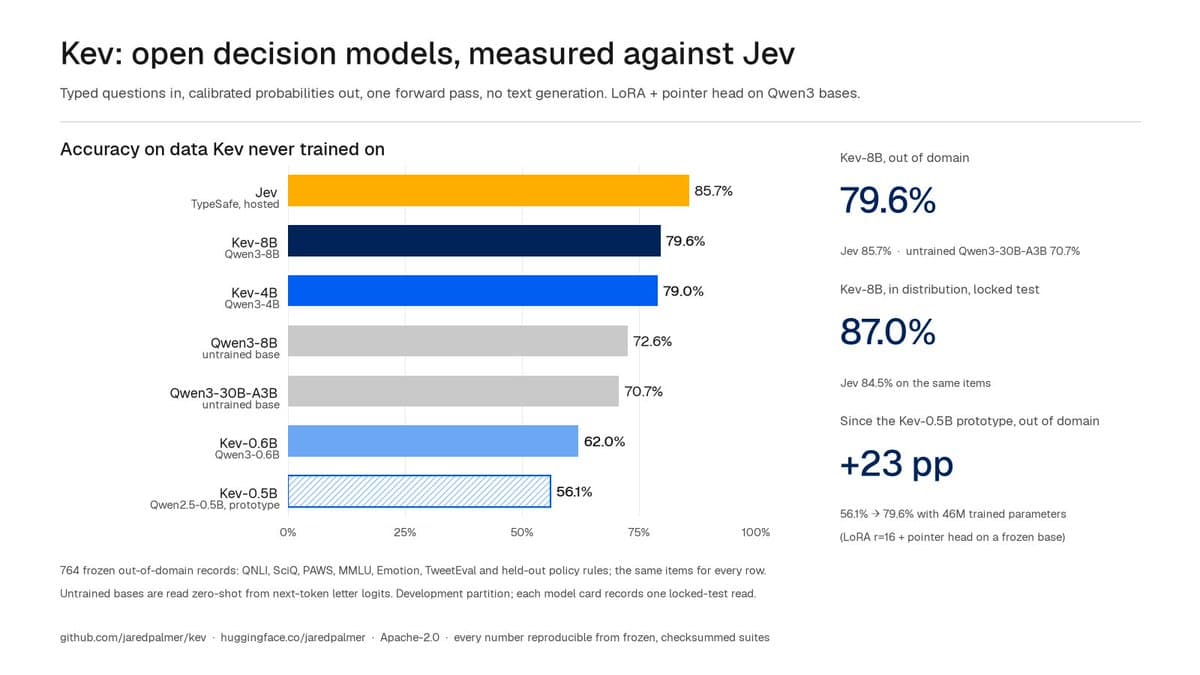
Kev is an Apache-2.0 family of 0.6B, 4B, and 8B decision models compatible with TypeSafe System One APIs. Its author reports that the 8B model reached 79.6% out-of-domain accuracy versus Jev’s 85.7%, while the 4B model runs on a 32 GB Mac.
TL;DR
- Kev now has 0.6B, 4B, and 8B open decision-model variants, according to jaredpalmer's launch post, while jaredpalmer's open-source update points to public code, evals, weights, and datasets under Apache-2.0.
- A 4B model serves five typed questions in about 300 ms on a 32 GB Mac in bf16 and about 40 ms on an H100, jaredpalmer's launch post reports.
- One document can yield many isolated typed answers in a prefill-only pass: jaredpalmer's architecture post describes a LoRA adapter and pointer head that return option probabilities rather than generated prose.
- The reported 8B out-of-domain score is 79.6% against Jev's 85.7%, according to jaredpalmer's launch post, while jaredpalmer's comparison identifies much larger gaps on MMLU and day-precision date arithmetic.
The Jev Reproductions Tracker had already catalogued 46 artifacts across five technical categories. Kev's autoresearch pull request also locks each candidate to one read of test data, a small guardrail against tuning on the held-out set.
Release and API
Kev began as a 0.5B Qwen2.5 experiment that jaredpalmer's first Kev release said could train and run on a MacBook Pro. The later release scales the same decision-model shape across Qwen3 backbones.
- The three announced sizes are 0.6B, 4B, and 8B, as jaredpalmer's launch post lists.
- Code, evaluations, and model artifacts are public, jaredpalmer's open-source update says.
- Existing TypeSafe System One clients can target a local Kev server by changing
base_url, according to jaredpalmer's launch post.
The public repository carries the training and serving code; the published surface supports yes/no, multiple-choice, and rating questions in one request.
Parallel readout
The original model card lays out the recipe that the larger release says it retained: frozen base model, a LoRA adapter, and a small pointer head.
- Pack one state document and its typed questions into a single sequence.
- Apply a block-causal mask so a question sees the shared state and its own branch, but not sibling questions.
- Score each supplied option against that question's decision token, then softmax the scores into a probability distribution.
- Train the readout with cross-entropy on labelled outcomes.
This eliminates an autoregressive answer-generation stage. The output is a distribution over the caller's supplied choices, and Kev's server formats it as a boolean probability, selected choice, or ordered score.
Training knobs
The largest reported gain came from reducing the learning rate, not from moving from 4B to 8B. jaredpalmer's ablation notes breaks the controlled changes down as follows:
- Backbone, 0.6B to 4B: +14 to +19 points.
- Learning rate,
2e-4to5e-5: +4.7 points. - Random rule structures in synthetic data: +1.5 to +3 points.
- Backbone, 4B to 8B: +0.5 to +2 points.
Palmer attributed the learning-rate result to fine-tuning erasing pretrained knowledge: more public training data raised in-distribution accuracy while lowering out-of-domain accuracy. His [cost tally](src:2|jaredpalmer's comparison) put the weekend's Modal bill at $228, with individual runs typically costing $10 to $35.
Evaluation gaps
The headline transfer result puts Kev-8B 6.1 points behind Jev on data Kev had not trained on. The rest of jaredpalmer's comparison shows the gap is task-dependent:
- Out-of-domain accuracy: Kev-8B 79.6%, Jev 85.7%.
- MMLU: Kev 70%, Jev 90%.
- Day-precision date arithmetic: Kev 60%, Jev 93%.
Kev did outperform Jev on some logic-recognition tasks, jaredpalmer's follow-up says. The official 4B model card adds a sharper release caveat: its selected 4B checkpoint scored 62% both-correct on held-out policy pairs, below the project's predeclared 70% screen.
Qwen3.5 port
The initial Qwen3.5 port exposed an isolation fault in the packed-sequence design. Three of every four layers were recurrent Gated DeltaNet layers, jaredpalmer's DeltaNet reply explains, so the attention mask could not stop question two from seeing question one through the recurrent state.
Palmer subsequently said he had pushed a Qwen3.5 Kev family and expected a 7% to 8% MMLU-Pro improvement, jaredpalmer's Qwen3.5 update reported before publishing that evaluation. The current repository describes Qwen3.5 models at 0.8B, 4B, and 9B, a later revision sequence than the Qwen3 0.6B, 4B, and 8B numbers in the launch post.