
MiMo reportedly streams V2.6 Pro and Flash RL training metrics
MiMo is reportedly livestreaming RL training for its V2.6 Pro and Flash models, publishing batch data, harness composition, reward curves, and infrastructure metrics. Reported cost figures list the trillion-parameter Pro run at about $493,000.
TL;DR
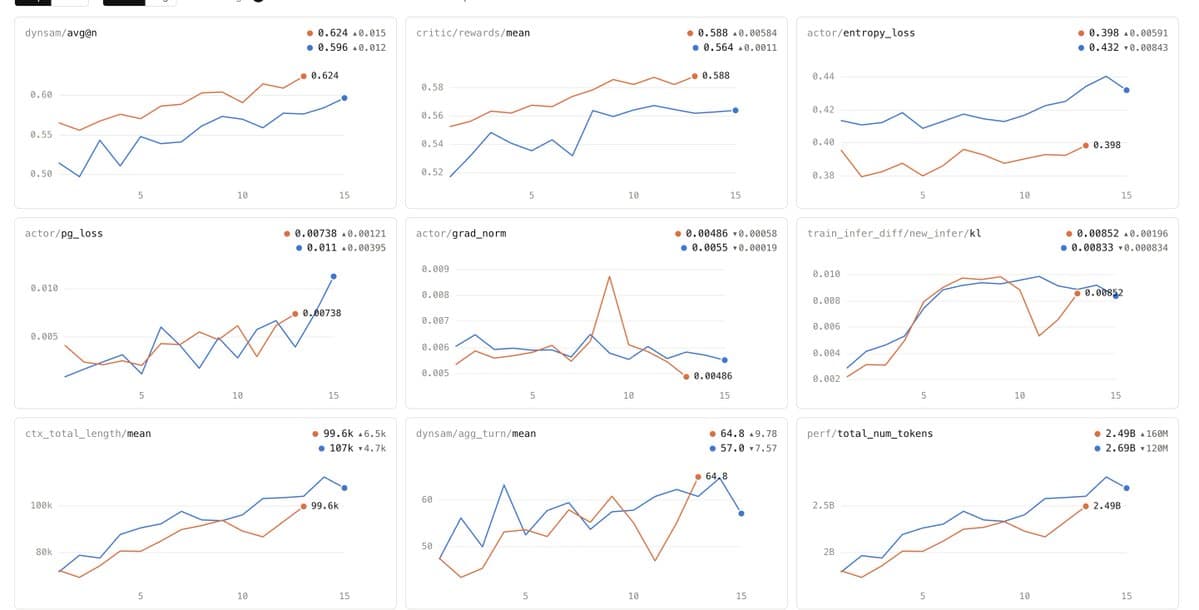
- Xiaomi’s MiMo team has put an in-progress V2.6 agentic RL run in public view, with two jobs, per-batch composition, reward curves, benchmark plots and infrastructure telemetry, according to the first dashboard report.
- The run uses about 2 billion tokens per step, 1,568 prompts and 16 rollouts per prompt, while the MiMo announcement screenshot describes a fully asynchronous pipeline, multiple harnesses and in-group credit assignment.
- Cost has become a first-class training metric: eliebakouch’s cost breakdown puts Pro at $493,000 per day and Flash at $247,000 per day.
- The dashboard also exposes evaluator conflict. A public chart ends at 60.3% probe disagreement for Pro and 57.9% for Flash, as documented in the disagreement chart.
The official dashboard carried a notice that Pro was restarting after a VRAM issue, visible in a later dashboard snapshot. Xiaomi’s April V2.5-Pro release described the previous Pro as a 1.02T-parameter MoE with 42B active parameters and a 1M-token context window.
The two jobs
V2.6 Pro is listed at 1.02T total parameters with 42B active, while Flash is 309B total with 15B active. Both are being trained concurrently.
One later capture placed Pro at step 10 with 20.6B total tokens and 251,000 samples, and Flash at step 15 with 35.2B tokens and 376,000 samples. That same capture lists the batch as 1,568 prompts times 16 sequences for each run.
The training loop
MiMo describes three things it is scaling:
- Compute: roughly 2B tokens per step, from 1,568 prompts times 16 rollouts, or 25,088 trajectories before their variable-length agent work.
- Environments and harnesses: multi-task agentic RL mixed in one run. The training-mix chart reports code, general, cyber, visual and chat categories.
- Grader compute: agentic in-group credit assignment, with test-case and rubric-based rewards.
The fully asynchronous design allows completed trajectories to proceed through grading and training while slower tasks are still executing, according to Qbit’s configuration walkthrough.
Costs and offline scores
The public totals move with the run. A dashboard-based calculation from eliebakouch’s cost breakdown estimated $70,000 per Pro step and $21,000 per Flash step, or $2.78 and $0.86 per sampled trajectory respectively.
A later UI capture showed total cost above $1.03 million, including $719,132 for Pro and $310,888 for Flash. It also recorded the Pro VRAM restart in the notices panel.
The DeepSWE chart is not presented as a fully live evaluator. The dashboard says it updates offline results for specific steps, and Qbit’s September 17 report recorded 62.24 for Pro and 60.77 for Flash on DeepSWE v1.1 at that point.
Grader disagreement
One exposed metric is penalty/stage_credit_group/select_v4/select_probe_disagree_rate. Its latest points show 0.603 for Pro and 0.579 for Flash.
The accompanying dashboard analysis raised two possible explanations for the rising Pro disagreement: behavior becoming harder to judge, or the model becoming better at fooling a judge. The public chart establishes the disagreement rate, not which mechanism caused it.
The promised artifacts
MiMo says it will open-source the underlying details piece by piece over the coming weeks, the announcement screenshot says. An account posting as c_valenzuelab framed the pledge more broadly as sharing “every single detail and secret.”
The public reaction has already included requests to interpret the raw telemetry: nrehiew_ asked readers for ideas, while EMostaque circulated the link without adding a technical claim. eliebakouch called the effort a welcome transparency initiative in a post that also referenced OpenAI’s misalignment reports.