
Meta adds Active Memory models to Muse and Meta AI
Meta is deploying specialized models with Active Memory and Active Focus in Muse and Meta AI. It reports 2.4× less forgetting of critical information and a 67% improvement in recovering from unexpected obstacles.
TL;DR
- Specialized versions of Meta's existing models, trained using Muse Wonder, are rolling out in Muse and Meta AI, according to the announcement.
- Critical-context use rose from 76% to 90% in Muse, +14 percentage points, as the memory evaluation chart shows.
- Completion of everyday tasks with unexpected obstacles improved 67% in Muse, according to the rollout follow-up.
Muse can rearrange its sidebar for “weekend mode”, and voice mode offers hundreds of voices. Meta's research post leaves the new model IDs and training recipe unspecified.
Active Memory
Stale-context handling is the standout in Meta's research post. Active Memory is trained to:
- Separate temporary information from permanent information.
- Recognize when something from an earlier conversation becomes relevant again.
- Reason across time to distinguish still-useful context from stale information.
The 2.4× reduction in forgetting is an error-rate comparison: 24% of tasks failed to use critical context before, versus 10% now.
Active Focus
Meta says training on real-world bottlenecks improved these behaviors:
- Recovery: keep working, recover from setbacks or find an alternative route.
- Autonomy: decide when to pursue a goal independently and when to collaborate live with the user.
- Steering: incorporate instructions and clarifications in the middle of a running task without losing track.
- Meta AI conversations: break problems into steps, ask sharper follow-up questions and adapt when the user changes direction.
Muse evaluations
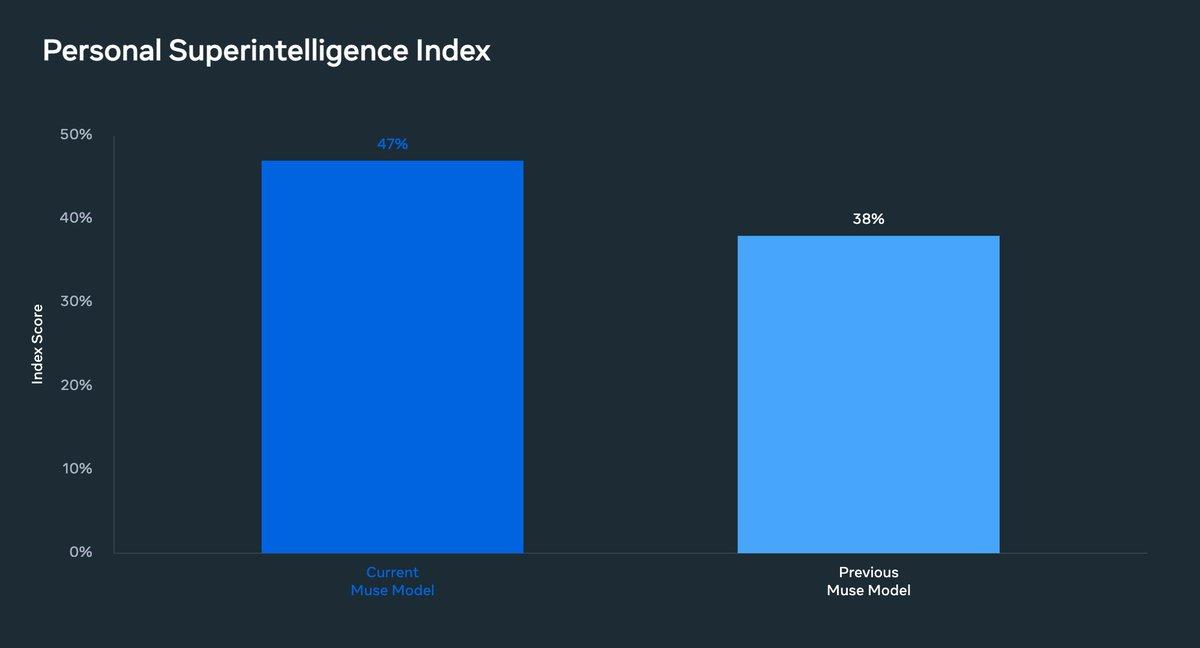
Muse gained 9 percentage points on the Personal Superintelligence Index, an internal composite benchmark.
The release post gives no sample sizes or evaluation protocols, and no absolute before-and-after success rates behind the 67% task-completion claim. Meta supplies no corresponding Meta AI scores.
Spaces
Spaces generate interactive pages from chat prompts using data Muse can access. TestingCatalog built a testing playground in an early demo:
According to All Things Muse's feature guide:
- Users can refine a Space's layout and behavior over time.
- Spaces can live in the sidebar or main tabs, remain hidden, or appear on a schedule.
- Connected apps supply background updates, including new concert dates and price changes.
- Spaces are personal at launch; Meta says sharing is still being explored.
Voice and Mexico
Voice conversations are rolling out to US users on mobile, web and Mac, according to the feature walkthrough.
Muse also launched in Mexico on November 5.
Agent handoffs
Muse's cancellation-call scripts and visible reminders won over borisdayma, who described using multiple assistants for different tasks. He wants Muse to notify a ChatGPT finance assistant when a relevant email arrives, instead of having every agent monitor the inbox.
His follow-up argued that agents may need different behaviors and memory-management systems even when they communicate.