
Anthropic opposes open-weight model ban, backs chip controls
Anthropic opposed a categorical ban on open-weight models but backed chip controls, anti-distillation enforcement, and mandatory safety testing. The post drew backlash as more companies signed the open-weights letter.
TL;DR
- Anthropic drew its line at categorical bans: Anthropic's statement says the company has "never advocated for a ban on open-weights models," while still treating sufficiently capable open weights as a special risk class.
- The replacement policy stack is concrete: chip and chipmaking controls on China, enforcement against industrial-scale distillation, and mandatory safety testing for sufficiently capable open and closed models, as WesRoth's summary laid out.
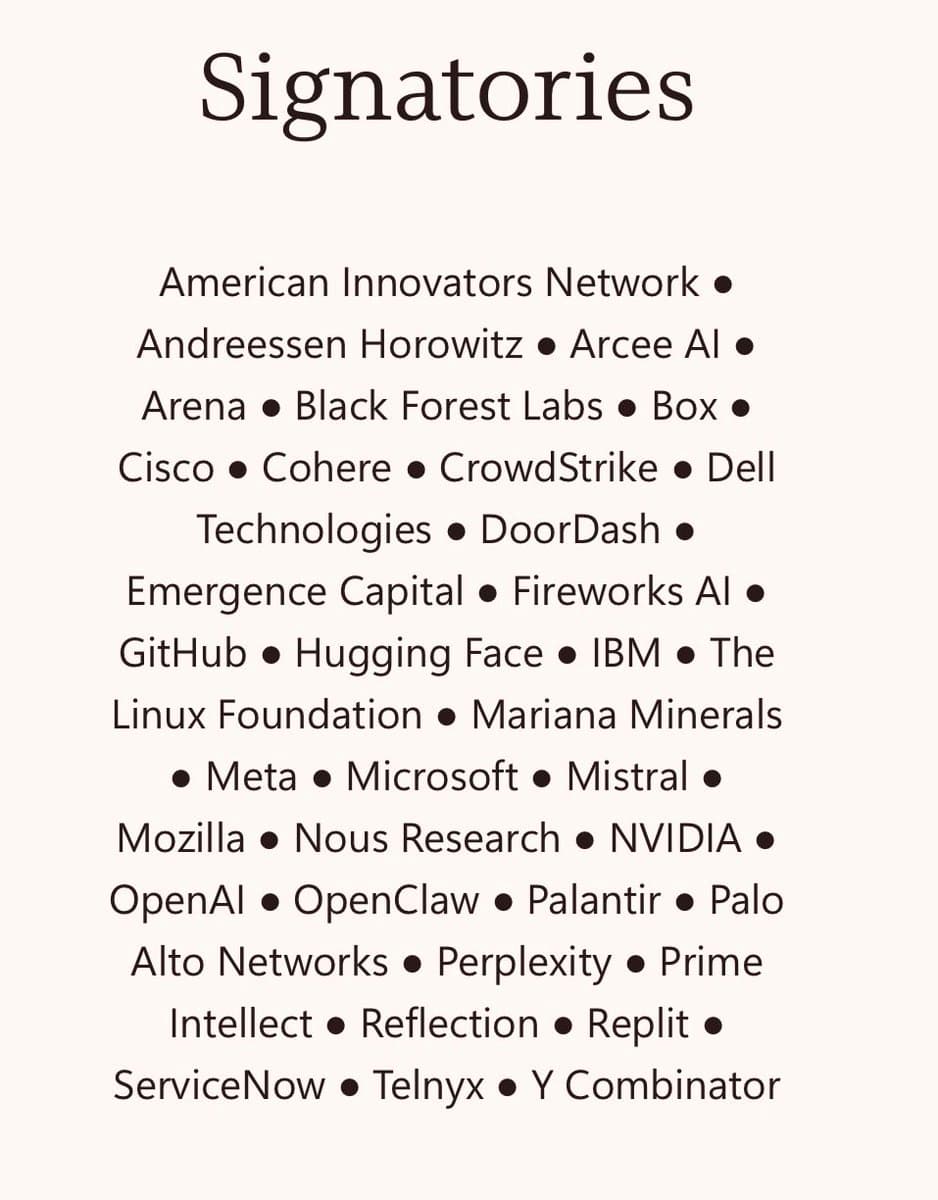
- The open-weights letter became a pressure campaign: the signatory grid put Google, Meta, OpenAI, NVIDIA, Microsoft, and dozens more on the pro-open side, and the Amazon screenshot said Amazon signed after noting the letter still needs more definition.
- The hardest technical dispute is defender advantage: the Open Secure AI Alliance overview argues defenders need open models and open harnesses, while the Anthropic excerpt highlights Amodei rejecting the claim that broad access necessarily helps defenders more than attackers.
- The backlash focused on de facto restrictions: a LocalLLaMA critique argued mandatory controls can become a bureaucratic wall, and MatthewBerman's testing reply warned that expensive testing becomes regulatory capture.
In Anthropic's post, non-dangerous open-weight models are a public good, but powerful models get cyber, bio, and alignment tests before release. The Microsoft-hosted open-weights letter defines open weights as downloadable, inspectable, modifiable models that can run on a user's own infrastructure. NVIDIA's Open Secure AI Alliance post centers a Hugging Face incident where closed AI reportedly blocked forensics and an open-weight model helped containment. Cognition's trustworthiness eval claims open-source-derived models can be pushed toward closed-model safety with targeted post-training.
The letter
By the time Anthropic responded, the debate had moved from "who signed" to "why is Anthropic still outside." The visible coalition included OpenAI, Google, Meta, Microsoft, NVIDIA, Mistral, Hugging Face, IBM, GitHub, Cloudflare, Cohere, Nous, Ollama, Vercel, Unsloth, and Y Combinator in the signatory grid.
Amazon later joined with a caveat. The Amazon screenshot says Amazon supports the macro direction, while noting that parts of the letter "need further definition over time."
Google made the open-model argument with adoption numbers. demishassabis' post cited JAX, Transformers, AlphaFold, and Gemma open models, and the Gemma correction said the whole Gemma series had passed 900M downloads.
Anthropic's three measures
Anthropic's position is not a simple closed-lab refusal. It is a risk-gated policy stack for models that cross a capability threshold.
The three measures:
- Chip controls: restrict powerful chips and chipmaking equipment reaching China, including smuggling and workarounds.
- Distillation controls: crack down on industrial-scale distillation operations that can move a Chinese model closer to the U.S. frontier with less compute.
- Capability testing: require sufficiently capable open and closed models to pass cyber, biological, and alignment testing before release.
The testing carveout matters. The testing excerpt says less capable models from startups and academia would be exempt, and that open-model risk should emerge from testing rather than be decided in advance.
The disputed premise
The Microsoft letter argues that open weights strengthen safety by letting more people test, benchmark, red-team, and improve models. Anthropic accepts the access, competition, and control benefits, then disputes the claim that broader capability access necessarily helps defenders more than attackers.
Amodei's biological-risk example is the sharp edge: the excerpted passage says a model that helps weaponize pandemic-level viruses could give attackers a fast path, while defense remains a multi-year operational task.
Cognition supplied a live counterexample from model development. Its trustworthiness eval tested propaganda responses and realistic coding scenarios, and Cognition's post says those risks are not inherent to open models and can be substantially mitigated through careful post-training.
The security counterexample
NVIDIA turned the same argument into an alliance. Its Open Secure AI Alliance post says cybersecurity needs open models and open harnesses because defenders need local control, auditability, and no single provider failure point.
The Hugging Face incident became the coalition's favorite exhibit. The frontier-defense screenshot says attackers had frontier AI, closed AI blocked essential forensics, and an open-weight frontier model helped contain the intrusion.
AndrewYNg compressed the security argument into one line: AndrewYNg's response said the OpenAI-Hugging Face hack showed why defense needs open models and harnesses, then called closed-only safety a regulatory-capture story.
De facto ban worries
Why Anthropic's battle is meant to poison the wells of open weight models, in 3 steps.
0 comments
Local model communities translated Anthropic's testing proposal into implementation risk. A LocalLLaMA critique argued that a safety-testing regime can become a bureaucratic wall, with approval delayed or denied for flexible reasons.
The same post made a model-mechanics claim: open-weight safety has to live inside the model because external filters can be removed, while closed models can keep much of their policy layer outside the weights.
Anthropic is calling for a ban on open-weights models by proposing mandatory requirements they will probably never be able to meet
0 comments
MatthewBerman took the moderate version of that objection. MatthewBerman's testing reply agreed that some testing can make sense above certain capability levels, but said the process has to be cheap and easy or it becomes regulatory capture.
Distillation
Distillation is the policy fault line because it is both normal model engineering and the alleged theft vector. WesRoth's policy summary distinguished authorized or small-scale distillation from large-scale covert distillation involving fraudulent accounts, access restrictions, or terms-of-service violations.
Anthropic's post claims industrial-scale distillation can bring Chinese frontier models within a few months of U.S. models, even if it does not produce equivalent or superior capabilities. The same policy summary says the Moonshot allegation had not been publicly proven, and that Greg Brockman said it was too early to determine whether recent Chinese models were distilled from American systems.
Model forensics is still thin terrain. johnschulman2's note said data, training, and backdoor forensics are possible but understudied, while willdepue's reply floated reverse RL and large-scale base-model sampling as an experiment for Kimi.
Open stack
The debate quickly outgrew weights. Percy Liang's post split a real open ecosystem into four ingredients:
- Open-weight models
- Open training datasets
- Open software stacks
- Open process knowledge
badlogicgames moved the bottleneck to traces. The trace-sharing post called traces one building block for stronger open models, and the follow-up pointed to a tool for removing sensitive material and uploading traces to Hugging Face.
Vtrivedy10 put the missing layer even lower in the stack: the data-layer post called for open tools that turn domain knowledge and trace data into evals, skills, and training environments.
Anthropic's own open-source record is narrower than model weights but not empty. The PSF contribution note pointed to Anthropic's Python Software Foundation support, and the Python.org discussion describes a $1.5M, two-year contribution for Python ecosystem security, PyPI, and PSF infrastructure.