
Glean says runtime routing cuts enterprise-agent token costs by 81%
Glean says its runtime routes enterprise-agent work across more than 40 models using company context. It reports $0.58 per query and 78% user preference over Claude Cowork in a 180-person benchmark.
TL;DR
- Glean says its Assistant averaged $0.58 per task against Claude Cowork's $2.98, an 81% token-cost reduction, according to rohanpaul_ai's chart.
- The same vendor benchmark says Glean was preferred on 78% of 180-plus enterprise tasks, while rohanpaul_ai frames the result as context and routing rather than a fixed-model comparison.
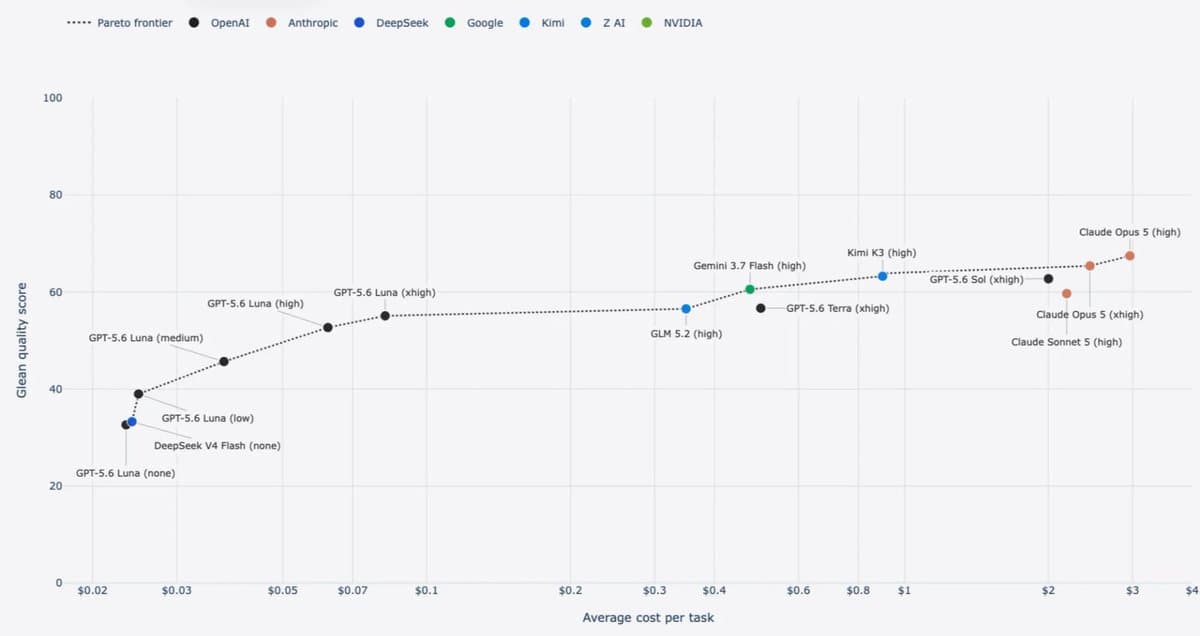
- Glean's wider cost-quality map spans 37 model and reasoning configurations over 1,000 enterprise tasks; testingcatalog's report highlights a 36x cost spread across its Pareto frontier.
- The runtime makes separate model and reasoning-effort choices, using Waldo, a small model post-trained on NVIDIA Nemotron 3 Nano, as testingcatalog's routing summary describes.
Glean's architecture description says it keeps tool output and intermediate state in sandbox files, then progressively loads only the tools, skills, and schemas a task needs. Its Glean Intelligence announcement puts that harness behind a model hub with 40-plus open and frontier models.
The 180-task comparison
Glean evaluated two enterprise agent stacks. Its methodology ran Glean Assistant with auto routing and native or MCP connectors, while Claude Cowork used off-the-shelf MCP connectors plus local MCP servers for Salesforce, GitHub, and GCP, held on Claude Sonnet 5 with high reasoning.
The input set used synthetic queries against Glean's own production data. Departmental subject-matter experts reviewed task representativeness, and graders scored more than 180 side-by-side answer pairs on a five-point preference scale. That setup scores retrieval, connector coverage, harness behavior, and routing together.
Glean attributes the $0.58 result to both blended model pricing and a 70% token reduction, 1.3 million tokens versus Cowork's 4.4 million.
Glean's Pareto frontier
For routing decisions, Glean says it evaluated 37 model and effort configurations over 1,000 enterprise tasks using secure evaluation of production traffic. Its cost-quality analysis used an agentic judge for correctness, task completion, and output readiness, then applied Bradley-Terry scoring to 81 model-pair matchups across 11 families and adjacent effort levels.
The five frontier points Glean published are:
- GPT-5.6 Luna, xhigh: quality score 55, $0.0819 per task.
- GLM 5.2, high: quality score 57, $0.3489 per task.
- Gemini 3.7 Flash, high: quality score 61, $0.4748 per task.
- Kimi K3, high: quality score 63, $0.8995 per task.
- Claude Opus 5, high: quality score 67, $2.9605 per task.
Glean characterizes the jump from Luna to Opus as 36x more cost for a 22% quality-score gain.
Waldo's routing layers
Glean divides auto routing into three runtime actions:
- Select a model from its 40-plus-model catalog.
- Set the chosen model's reasoning effort.
- Hand off to a specialist model when the task calls for one.
Its benchmark post says Waldo determines the reasoning level before a handoff, and gives Claude Opus 4.8 for visual artifact creation as an example of a specialist selection.
Model affinity and KV reuse
Glean's public account says it maps a task to a model and effort level, but does not describe a session-pinning or cache-transfer policy. That detail changes the economics of routing inside long-running agent tasks: Teknium's cache warning says switching to a different model invalidates the prompt cache, and Teknium's reply puts a fresh cache write at 1.25x to 2x input-token cost.
The counterproposal is task-level affinity. dzhng says routers can switch when a user begins a new task or during an explicit cache-invalidating event such as compaction. _avichawla's Plano explainer describes an OpenAI-compatible proxy that pins the first chosen model with an X-Model-Affinity header for 10 minutes, with Redis support for multi-replica deployments.
A harness comparison linked by _avichawla's post reports 2.7x lower token use across 14 tasks by changing the surrounding harness. A separate KV-cache-transfer paper reports 2.7x to 25x faster handoffs than re-prefill for compatible pairs within the same model family; it does not establish cross-family reuse.