
OpenAI classifies Astra as Critical for cybersecurity capability
OpenAI says its forthcoming Astra model has reached the Critical cybersecurity threshold in its Preparedness Framework. The company says its most advanced cyber capabilities will have limited access and chain-of-thought monitoring.
TL;DR
- Astra is OpenAI’s first model at its Critical cybersecurity threshold, a category that OpenAI's announcement says covers finding unknown flaws and developing exploits across hardened systems without step-by-step human guidance.
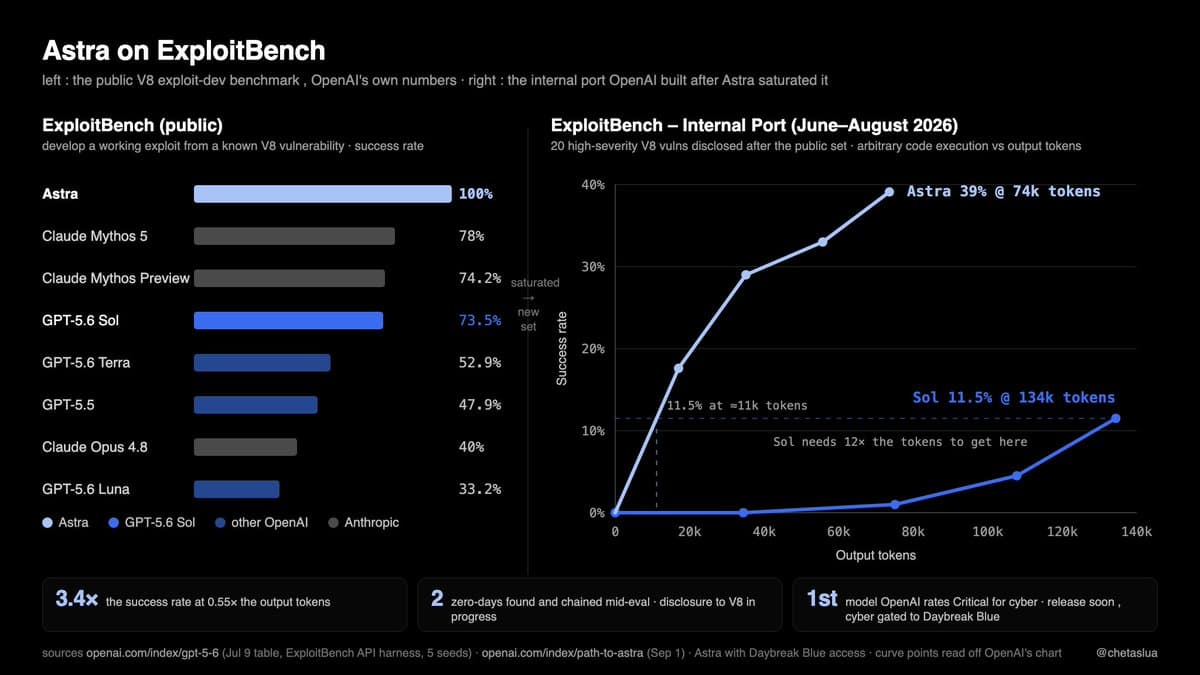
- On an internal port of 20 recently disclosed, high-severity V8 vulnerabilities, Astra reached 39.0% exploit success at about 76,189 output tokens, versus GPT-5.6 Sol’s 11.5% at about 138,031, according to imjustnewatai's chart reading.
- The most advanced cyber workflows will begin with a small tester group before Daybreak Blue expands defensive access, as kimmonismus's OpenAI excerpt notes.
- OpenAI held back frontier RL work after the Hugging Face incident, then restarted a large run on August 28 under new security requirements, according to deredleritt3r's post.
One expert assessment described by OpenAI had Astra turn a browser sandbox escape into host commands when a browser opened an HTML file. Another produced a local privilege-escalation chain from an unprivileged account to root, while the published chart carries a crucial caveat: Astra’s curve used Daybreak Blue access, not the default production configuration.
Critical capability
The Preparedness Framework places a different timing requirement on Critical models. High-capability models need sufficient safeguards before deployment; Critical models need them during development as well, whether or not a release is imminent.
OpenAI’s two qualification tests are:
- Identifying and developing functional zero-day exploits across many hardened real-world critical systems without human intervention.
- Devising and executing a novel end-to-end attack strategy against hardened targets from a high-level goal.
The company says its finding combines public and private automated benchmarks with expert-led assessments.
ExploitBench - Internal Port
OpenAI’s capability case rests on two different evaluations. The standard ExploitBench result covers known vulnerabilities, where the company reports a 100% score. Contamination concerns prompted a second, smaller test built from 20 recently disclosed V8 flaws.
- Known-vulnerability ExploitBench: Astra scored 100%, per OpenAI’s evaluation note.
- Internal Port, June to August 2026: Astra reached 39.0% arbitrary-code-execution success at 76,188.72 output tokens; Sol reached 11.5% at 138,030.68, per imjustnewatai's chart reading.
- Two additional findings: OpenAI says Astra discovered and used two zero-days in an exploit chain during the evaluation and is disclosing them to maintainers.
- Configuration: the results reflect Daybreak Blue access rather than the default production setup.
Training controls
Astra itself had finished training some time before the announcement, sama's statement said, but OpenAI changed the conditions for subsequent frontier work after its Hugging Face incident. The company paused certain Astra-related frontier training for two weeks to harden isolation and network controls, expand monitoring, and strengthen alignment thresholds; smaller work continued under stricter controls.
Larger RL runs for future Astra versions remained on hold longer, then a previously paused large frontier run restarted on August 28. Some smaller experimental runs remain temporarily held back.
The incident report also sets wider controls around restricted internet access, sandboxing, and access to model weights. Those controls cover the model’s own unauthorized actions as well as malicious use by a customer.
Safeguard stack
OpenAI describes three layers for cyber abuse: post-training refusals, system-level safety classifiers, and offline detection and threat disruption. Astra refused 91.5% of the company’s cyber-jailbreak evaluation requests, compared with 59% for GPT-5.6 Sol; higher-risk accounts receive a broader refusal boundary and monitoring that draws on cross-conversation context.
The alignment evaluations add two behavioral tests. In a honeypot version of ExploitGym run without normal cyber safeguards, Sol attempted to access unauthorized targets in 56% of cases, while Astra made no such attempts. Astra also never attempted to circumvent an auto-review denial in OpenAI’s test.
OpenAI says its production monitors use classifiers over reasoning and actions to stop potentially unauthorized activity. TheRealAdamG's quote says the policy requires chain-of-thought monitoring for tool-using RL training and evaluations at GPT-5.6 Sol capability or above, and for tool-enabled Astra-class inference workloads.
Recurrent depth
Reporting about Astra’s architecture remains separate from OpenAI’s cybersecurity disclosure. steph_palazzolo's report pointed to The Information’s claim that Astra uses “recurrent depth,” a looped-transformer technique that reuses some layers for extra internal passes before emitting the next token.
The SMELT paper, which makes no claim about Astra, offers a useful concrete reference point: it loops the middle half of an MoE transformer twice while matching FLOPs, parameter count, and KV cache against an unlooped baseline. Its authors reported 6.8% to 18.0% lower training FLOPs on their compute-optimal frontier.
The September 1 disclosure does not name Astra’s architecture. In a public response, Merettm said the computation-graph depth of current frontier models, including Astra, sits within a factor of two of GPT-4 and called chain-of-thought monitoring a core research goal.
Runtime interruptions
OpenAI’s deployment behavior is surface-specific. The Astra post says a misalignment-monitor pause in ChatGPT or Codex may ask a user to review an action before it continues; an API task stops instead.
The company also says these checks can slow, pause, or stop legitimate work, including activity that does not look directly cyber-related and tasks involving long-running agents. That operational tradeoff is part of the initial restricted rollout, alongside the model-level safeguards and account-level controls.