
Epoch estimates OpenAI researchers’ coding-agent use doubled every 34 days
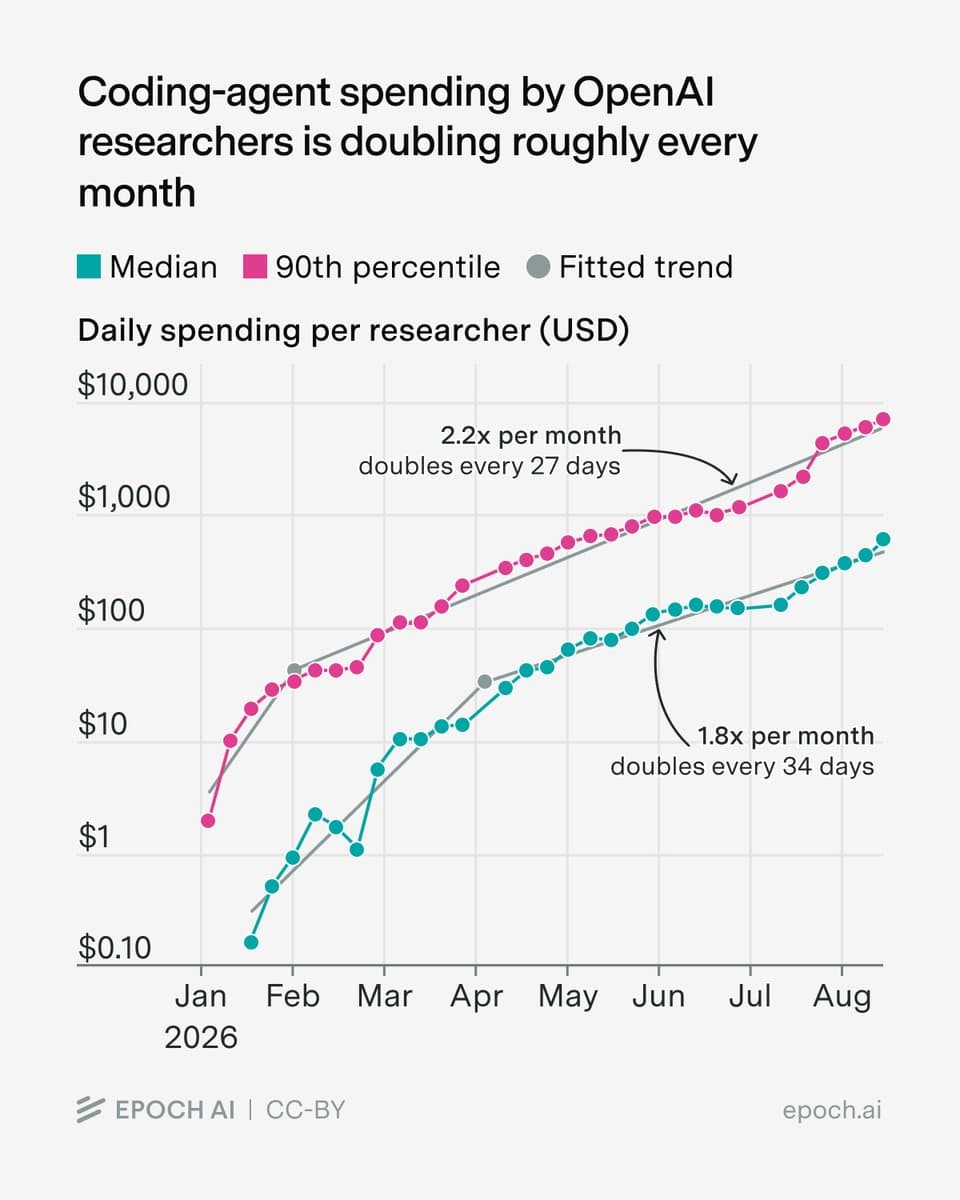
Epoch estimates coding-agent usage doubled every 34 days at the median and every 27 days at the 90th percentile from January through August. The figures use API prices rather than OpenAI’s actual costs.
TL;DR
- Median daily coding-agent usage rose from under $1 in January to $601 by mid-August, while the 90th percentile passed $7,000, with both figures valued at API list prices in the Epoch AI report.
- The recent trend implies a doubling every 34 days at the median and every 27 days at the 90th percentile, based on Epoch AI's fit.
- These figures measure retail-price equivalents rather than OpenAI's actual costs, and exclude programmatic Codex exec usage, according to Epoch AI's caveat.
- OpenAI's research organization reached 3.1 agent-workdays for every human workday by mid-August, a separate usage measure repeated in the 3.1-workday summary.
- The roughly $2 million annualized figure belongs to the 90th-percentile researcher, not the median, as the correction clarifies.
OpenAI's original post pairs the spending chart with a broader claim about concurrent agents reshaping research work. Epoch AI's reconstruction fits the weekly data with a breakpoint, while Simon Willison's read flags a sharp late-July acceleration that the one-line doubling headline smooths out.
Price series
The underlying weekly series runs from a median of $0 per day and a 90th-percentile value of $1.95 on January 4 to $601.25 and $7,047.13 on the week ending August 15, according to Epoch AI's table.
- January 4: median, $0 per day; 90th percentile, $1.95 per day.
- August 15: median, $601.25 per day; 90th percentile, $7,047.13 per day.
The two curves describe different usage levels inside the same research organization. The 90th percentile was already above $1,000 per day in June, while the median crossed $100 per day at the end of May, based on the weekly values in the published series.
The fitted growth
Epoch did not calculate the headline by dividing the two endpoints. It fit the logarithm of each weekly series with both a simple trend and a continuous piecewise-linear trend containing one fitted breakpoint, then selected the lower-BIC model. The fitted result shows the breakpoint model winning for both groups.
- Median: 1.8x monthly growth, equivalent to a 34-day doubling time, with a 90% interval of 1.6x to 2.1x monthly growth.
- 90th percentile: 2.2x monthly growth, equivalent to a 27-day doubling time, with a 90% interval of 2.0x to 2.3x monthly growth.
The fitted model uses weekly means of daily percentile values, includes the final partial week, and omits the first two zero-valued median observations. Changing the minimum segment size from five observations to four or six leaves the median's recent rate at 1.8x per month and moves the 90th-percentile rate only between 2.1x and 2.2x, according to Epoch's methodology.
Retail prices and annualized math
OpenAI valued usage at retail API prices from September 3, mapping internal or pre-deployment models to the nearest production counterpart. The calculation does not reveal hardware costs, utilization, discounts, or marginal inference costs, as OpenAI's methods and Epoch's analysis make clear.
The usage scope is also narrower than all coding-agent activity. OpenAI includes interactive surfaces, but excludes programmatic automations such as Codex exec; its definition of “researcher” covers the wider research organization, including infrastructure builders and project managers.
Using 260 working days, $601.25 per day annualizes to about $156,000, which Epoch rounds to $160,000. The $7,047.13 figure annualizes to about $1.83 million, which Epoch rounds to roughly $2 million.
The $601/day figure appears in the roundup and the linked report. One annualized summary paired it with roughly $2 million per year, but the correction assigns that figure to the 90th percentile. These are activity estimates priced in dollars, not OpenAI invoices.
Adoption versus intensity
The percentile series is cross-sectional, not a fixed panel of the same researchers. Each day's median and 90th percentile can represent different people as the research organization changes, according to Epoch's limitations.
That makes the early median especially sensitive to adoption. Researchers with zero eligible usage remain in the calculation, so the rise from January combines new researchers starting to use agents with existing users increasing their intensity, a distinction highlighted in Epoch AI's explanation.
The 90th-percentile breakpoint is less stable than its recent slope. Epoch's fit places that breakpoint between January 25 and February 8 under reasonable changes to the fitting rule, while the later 2.1x to 2.2x monthly growth estimate barely moves.
Agent-workdays
OpenAI reports a separate runtime measure: before June, total agent runtime across research was below total human labor; by mid-August, the organization was using 3.1 agent-workdays for every eight-hour human workday. The usage summary repeats that ratio.
The count includes daily peaks from agents started directly by researchers and downstream subagents. OpenAI also reports that the number of researchers running four or more agents simultaneously increased over the period, putting the $600-per-day median alongside a shift toward concurrent workflows.
This runtime metric and the API-price series answer different questions. One counts modeled labor time; the other prices eligible inference at a public rate.
Task mix and intervention
OpenAI classified agent output against a six-part taxonomy for AI research:
- Decide: what to work on and where to allocate effort.
- Design: research ideas and engineering specifications.
- Build: code and datasets.
- Run: training, evaluations, hardware, and serving.
- Analyze: experiments, models, deployment, and external work.
- Communicate: findings, feedback, status, and decisions.
Research and infrastructure code dominated the January mix. By August, technical help and monitoring runs had increased, while high-level planning remained a minimal share of agent output tokens, according to OpenAI's task-mix analysis.
OpenAI says success rates generally rose from January through July across several difficulty buckets, but agents still needed substantial steering on harder work. More than half of successful tasks estimated at four to eight hours of human effort involved at least one human intervention.