
OpenAI launches Daybreak with GPT-5.5-Cyber, Codex workflows, and repo scanning
OpenAI launched Daybreak, combining GPT-5.5, Codex workflows, repo scanning, threat modeling, and patch generation for cyber-defense teams. It packages frontier models into a continuous secure-software workflow, so teams can test whether it fits their response pipeline.
TL;DR
- OpenAI says OpenAI's launch post Daybreak bundles its frontier models, Codex, and security partners into a cyber defense product aimed at finding and fixing vulnerabilities earlier in the software lifecycle.
- According to thsottiaux's overview, Daybreak combines cyber models, Trusted Access tiers, Codex security workflows, large-scale repo scanning, and patch generation, which makes it look more like a secure software pipeline than a single model release.
- btibor91's roundup adds the most concrete model detail: GPT-5.5-Cyber is in limited preview for defenders of critical infrastructure, while Trusted Access for Cyber gives vetted users fewer classifier refusals on workflows like malware analysis and reverse engineering.
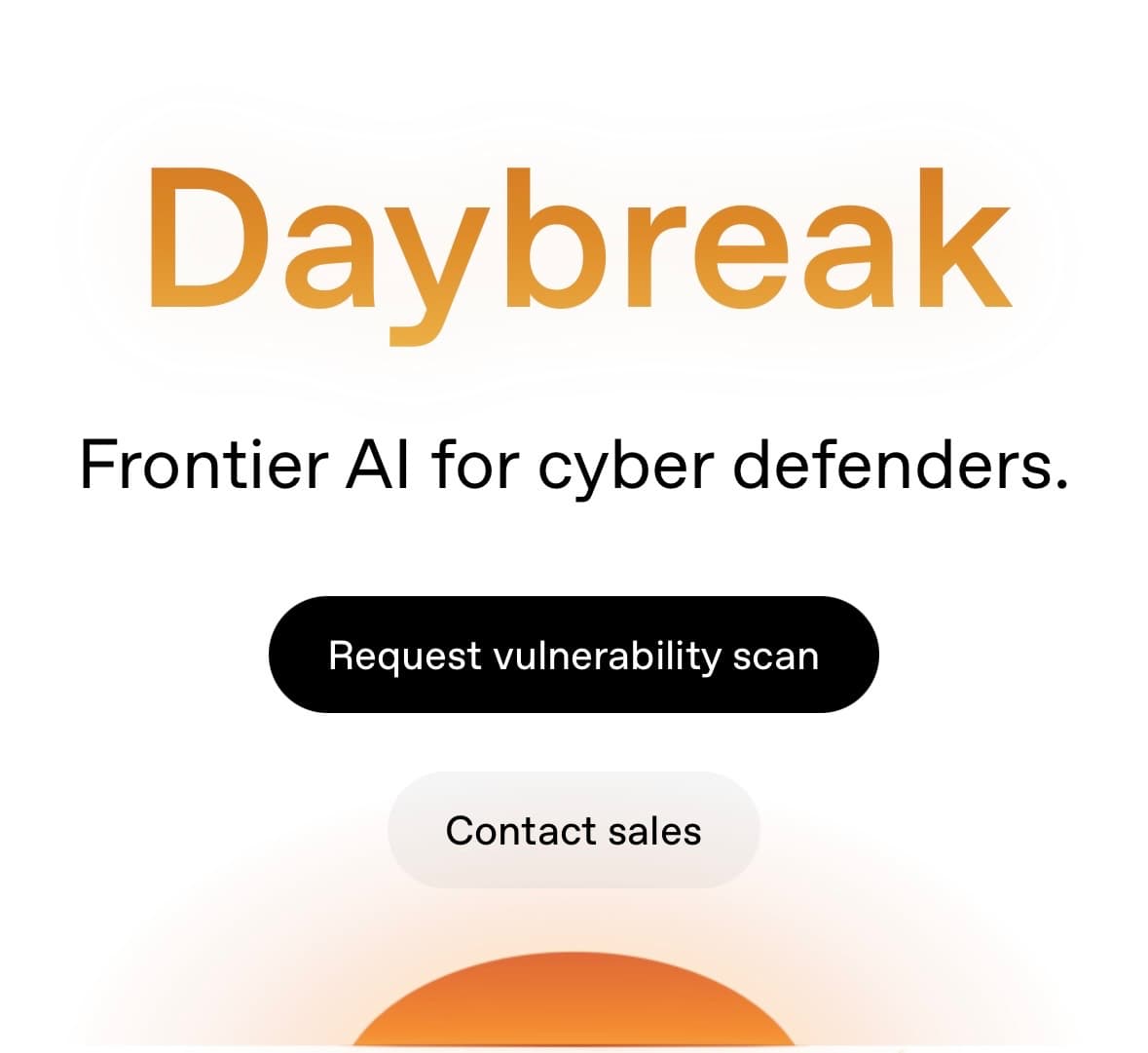
- In Adam G's post, OpenAI framed Daybreak as an iterative deployment effort with industry and government partners, not a broad self-serve launch, and thsottiaux's screenshot points users to a request-a-scan flow and sales contact rather than an open product signup.
You can go straight to OpenAI's Daybreak page, see the request vulnerability scan surface from thsottiaux's screenshot, and btibor91's earlier roundup quietly fills in the model policy details that the launch posts left vague, including limited preview scope, fewer refusals, and an upcoming Advanced Account Security requirement.
Daybreak packages OpenAI models, Codex, and repo-scale analysis
The official framing from OpenAI's launch post is broad: Daybreak brings together OpenAI models, Codex, and security partners to accelerate cyber defense and continuously secure software. Adam G's post is more specific about the job list, naming secure code review, threat modeling, patch validation, dependency risk analysis, detection, and remediation guidance.
That package matters because the launch evidence points to a workflow product, not a standalone cyber model. thsottiaux's overview explicitly lists advanced Codex workflows, repo scanning at scale, patch generation, and Trusted Access tiers, while OpenAI's Daybreak page is the canonical landing page attached across the launch thread.
Security workflows break into three concrete jobs
Across OpenAI's automation post and Wes Roth's summary, the launch breaks into three concrete workflow buckets:
- Find and fix vulnerabilities earlier in development.
- Cut through security backlogs by validating which issues are real.
- Automate detection, validation, and response across a codebase.
TheRundownAI's summary adds one more specific mechanic: Daybreak builds a threat model from the repository and prioritizes realistic attack paths. That is the closest any launch-adjacent source gets to describing how the system chooses what to analyze first.
Trusted Access for Cyber is the policy layer
The most useful distinction in the evidence is between Daybreak the umbrella effort and Trusted Access for Cyber, or TAC, the access policy around it. Sam Altman's post pitches the program as OpenAI working with companies now because cyber-capable AI is already useful and getting better fast, while btibor91's roundup says TAC gives vetted defenders fewer classifier refusals on defensive workflows.
The workflows named in btibor91's roundup are unusually concrete for an OpenAI safety-tier description:
- vulnerability triage
- malware analysis
- binary reverse engineering
- detection engineering
- patch validation
That makes TAC look less like a marketing tier and more like the permission system that determines which security tasks OpenAI will actually let these models perform.
Eight security firms are in the first wave
The partner list in TheRundownAI's summary names eight firms at launch:
- Cloudflare
- Cisco
- CrowdStrike
- Palo Alto Networks
- Oracle
- Zscaler
- Akamai
- Fortinet
gdb's post calls Daybreak an umbrella effort for defensive acceleration, which fits the partner-heavy rollout. OpenAI's own copy in Adam G's post also says the company is working with industry and government partners over the coming weeks as it prepares to deploy increasingly cyber-capable models.
GPT-5.5-Cyber is a separate limited preview
The launch thread markets Daybreak as the product layer, but btibor91's roundup is where GPT-5.5-Cyber itself gets defined. According to that post, GPT-5.5-Cyber is in limited preview for defenders of critical infrastructure, sits alongside GPT-5.5 with TAC, and is tuned mainly to be more permissive rather than to beat base GPT-5.5 on every cyber benchmark.
That same post adds two concrete constraints absent from the main announcement:
- individual TAC members will need Advanced Account Security starting June 1, 2026
- OpenAI does not expect GPT-5.5-Cyber to outperform GPT-5.5 on every cyber eval
btibor91's weekly recap shows GPT-5.5-Cyber arrived in the same burst of OpenAI product updates as new realtime voice models, Trusted Contact, and a Codex Chrome extension, which helps explain why some of the model-specific details surfaced outside the main Daybreak marketing thread.