
OpenAI releases healthcare computer-use agents through its API
OpenAI's healthcare computer-use agents are available through its API. The update also adds clinical search improvements and more than 20 plugins to ChatGPT for Healthcare.
TL;DR
- Healthcare computer-use agents are available through the OpenAI API, ChatGPT for Healthcare and ChatGPT for Clinicians, according to the availability announcement.
- GPT-6 Luna scored 2.5 percentage points below Astra on HealthAdminBench while costing 98% less in OpenAI's reported evaluation.
- Clinical search improvements arrive alongside more than 20 new healthcare plugins in the plugin update.
Assort's Athena workflow is the sharpest engineering detail: its API attaches a referral, then a computer-use agent marks it “visit scheduled” in the EHR. CVS Health also reports an agent handling system steps for tens of thousands of consults daily, with screenshots and action records used to verify application state.
API access
The November 16 release exposes computer use through the API; inside ChatGPT products, it runs through ChatGPT Work and Codex. OpenAI's availability notes distinguish two workspace paths:
- Healthcare organizations: Computer use and clinical search are subject to workspace settings. Administrators enable new healthcare plugins.
- Individual clinicians: ChatGPT for Clinicians is free for eligible, verified U.S. clinicians, with computer use, improved clinical search and selected plugins.
For API integrations, OpenAI's integration guide describes an application-managed runtime:
- A browser or desktop executes requested actions and captures screenshots.
- The same session stays alive throughout the task.
- Permission checks, cancellation, step limits and time limits belong in the application; the sample loop illustrates the exchange.
EHR drafts
GPT-6 Astra uses synthetic patient records in the EHR demonstration. OpenAI's workflow walkthrough follows a lower-back-pain message through three stages:
- Review visit notes, physical therapy records and prior imaging in the EHR.
- Draft an MRI order, an encounter note and a patient reply for clinician review.
- Reuse the records to prepare a prior-authorization request in the insurer's portal for an authorization specialist to review.
HealthAdminBench and physician review
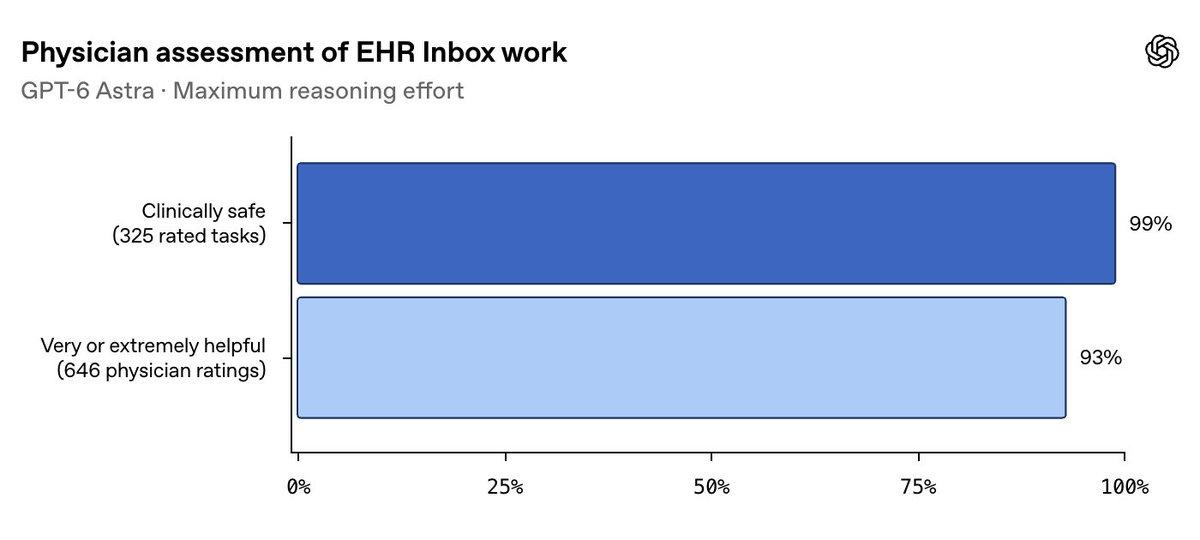
OpenAI's evaluation report separates administrative performance from physician assessment of clinical inbox work.
Administrative workflows
- Benchmark: Stanford's HealthAdminBench contains 135 tasks across four GUI environments.
- Performance: GPT-6 Astra earned 94.3% of available rubric points; GPT-6 Luna earned 91.8%. Both ran at maximum reasoning effort.
- Cost: Luna cost 8.5 cents per task, 98% less than Astra in this evaluation.
Clinical inbox work
- Safety: Physicians rated 99% of 325 reviewed Astra tasks safe. They assessed whether inaccuracies, omissions or actions could plausibly cause patient harm.
- Helpfulness: In 93% of 646 assessments, physicians selected “very helpful” or “extremely helpful” on a five-point scale.
CVS and Cigna deployments
OpenAI's customer report describes different deployment stages:
- CVS Health: A production agent cleared a months-long document-sending backlog over one weekend, according to the deployment update. CVS is also open sourcing an Agent Kit built with OpenAI's Agents SDK.
- Cigna Healthcare: Agents gather context previously spread across more than 10 clinical and administrative systems, bringing information together in seconds. Cigna says it moved from concept to deployment in under eight weeks.
- Abridge: Its planned inpatient workflow would coordinate medication access and home-health services concurrently, involving clinicians in decisions requiring clinical judgment.
Clinical search and plugins
Improved clinical search changes how ChatGPT finds, evaluates and cites medical evidence. In a blind evaluation involving more than 1,300 physician reviews, the updated experience scored higher across all eight evaluated dimensions, according to OpenAI's release notes.
The same announcement gives five cross-plugin workflow examples:
- Luma Health + TriZetto: Find appointments awaiting confirmation and check insurance eligibility.
- Metriport + UpToDate: Retrieve an external discharge summary, identify medication changes and find monitoring guidance.
- Aiva + Amion: Retrieve hospital policy and identify the covering specialist.
- IMO Health + Stedi + Turquoise Health: Match a procedure code, check benefits and compare negotiated rates.
- Assort Health + Ferry Health: Combine referral trends with outstanding scheduling work.
The new plugins are also available through ChartGPT, which brings ChatGPT into EHR workflows.
Approval gates and patient data
Ambience's agent stops when chart evidence is ambiguous and waits for clinician approval before submitting a prior authorization, according to OpenAI's deployment report. Health systems define allowable actions, can pause the agent and receive a step-by-step audit log.
OpenAI's data-handling requirements specify additional deployment conditions:
- Protected-health-information workflows require eligible services covered by the organization's Business Associate Agreement with OpenAI, required security and retention settings, and protections extended to connected systems.
- ChatGPT for Healthcare provides role-based access controls and audit logs; organizations can restrict agent access to the records and actions needed for a task.
- Organization data is not used to train OpenAI foundation models.