
OpenAI reports 8M Codex and ChatGPT Work users after 2.5x weekly usage jump
Sam Altman said agentic-product usage rose 2.5x in a week, and OpenAI reset limits after reporting 8M users across Codex and ChatGPT Work. Users also reported slow GPT responses and uneven limit burn.
TL;DR
- OpenAI reported 8M active users across Codex and ChatGPT Work after a 6M to 8M jump in three days, as shown in haider1's growth chart.
- Agentic-product usage rose 2.5x in a week, according to sama, and sama's follow-up warned that capacity hiccups could follow.
- Limits became part of the rollout: thsottiaux's 8M post said OpenAI reset usage limits again and kept the 5-hour cap off.
- The burn-rate fix touched context length, inference savings, reasoning effort, and multi-agent usage in thsottiaux's update after users like kimmonismus reported exhausting limits unusually fast.
- GPT-5.6 also moved into enterprise routing fast, with Sol, Terra, and Luna appearing on Amazon Bedrock in jxnlco's Bedrock post.
OpenAI's GPT-5.6 launch names Sol, Terra, and Luna as the new model family and says ultra coordinates multiple agents across parallel workstreams. The GPT-5.6 Sol API docs expose the awkward bit: a 1,050,000-token context window, 128,000 max output tokens, and premium pricing for prompts over 272K input tokens. The Codex changelog says Codex joined the ChatGPT desktop app, while AWS says Bedrock usage matches OpenAI first-party rates and counts toward AWS commitments.
8M active users
Codex and ChatGPT Work went from 1M users on Feb. 5 to 8M on Jul. 15, with the steepest part of the chart coming after GPT-5.6 Sol: 6M on Jul. 12, 7M on Jul. 13, and 8M on Jul. 15, according to haider1's chart.
Sam Altman said usage of OpenAI's agentic products, Codex and ChatGPT Work, increased 2.5x in the last week in sama's post. swyx argued the combined-user headline should be taken at face value unless there is strong evidence to doubt the reporting, while Latent Space's chart framed the prior day's 6M to 7M jump as a possible Codex-over-Claude-Code moment.
The cleanest read: OpenAI found product-market fit for agentic work at exactly the moment it started giving users more room to burn tokens.
Daily resets and the missing 5-hour cap
OpenAI turned quota into a daily growth ritual.
- At 6M users, reach_vb said the 5-hour limit was removed and GPT-5.6 Sol had become more efficient.
- At 7M users, thsottiaux said every account received a banked reset.
- At 8M users, thsottiaux's post said usage limits were reset for all users again and the 5-hour rate limit still did not apply.
- reach_vb said GPT-5.6 Sol remained available on all paid plans with 100% rate limits for as long as GPT-5.6 is available.
The reset mechanics spread outside first-party surfaces. Teknium said Hermes Agent added /usage reset for users with a Codex or OpenAI subscription, while reach_vb said OSS program users did not yet receive resets and OpenAI was working on support.
The burn-rate bug stack
OpenAI's own fix list had four moving parts:
- Inference optimizations, expected to produce around 10% more usage.
- A Codex context-size rollback from 372K to 272K because the larger limit caused more usage to be charged than intended.
- Reasoning-effort experiments, called juice values under the hood, that were reverted.
- More multi-agent usage than intended in high and xhigh reasoning effort, plus an auto-review efficiency fix.
The 272K boundary matters because OpenAI's Sol model docs say prompts over 272K input tokens are priced at 2x input and 1.5x output for the full request. theo argued that long contexts, Ultra subagents, and a newer subagent layer that copied full history stacked into a nasty token-burn multiplier.
Users saw the failure mode before the postmortem language arrived. kimmonismus said Sol on medium consumed a 5-hour window again after three resets, and kimmonismus's screenshot showed a 0% remaining 5-hour limit.
The juice-value dispute also landed in public. Lentils80 posted tables claiming Sol's thinking budgets had been cut from release-day values, then Lentils80's follow-up pointed to OpenAI's acknowledgement that reasoning-effort experiments had happened and were reverted.
Capacity hiccups
Altman said GPT-5.6 Sol growth was “insane,” credited the inference team, and warned that hiccups were possible in sama's warning. Hours later, theo posted a ChatGPT error page and quoted the hiccup line back at OpenAI.
Third-party agent surfaces saw the same strain. Teknium said GPT was unusably slow in Hermes Agent and suspected an outage or overload, while Lentils80 posted OpenRouter stats showing OpenAI provider tool-call error rate for GPT-5.6 Sol rising to 17.18% on Jul. 13.
The response from OpenAI was not just apology posts. thsottiaux told one user Codex was “pretty unlimited” that week, and thsottiaux said it had become faster.
ChatGPT Work and the Codex super-app
OpenAI Devs said Codex had 7M+ weekly users and 150+ updates in two months, then listed the feature surface:
- GPT-5.6 and Ultra
- Parallel work with
/goal - Faster Computer Use
- AppShots
- Inline edits
- Sites
- Codex mobile and SSH workflows
- PRs from review to merge
The official Codex changelog says Codex is now part of the ChatGPT desktop app on macOS and Windows, with existing projects, settings, and workflows preserved.
Product boundaries are still fuzzy. kimmonismus said he was confused by ChatGPT Work and Codex in a single app, and Ethan Mollick's UI post compared OpenAI's split between ChatGPT Work and Codex with Claude's Home, Chat, Cowork, and Code menus.
The strongest Work use case came from non-code work. gdb said ChatGPT Work made it easy to ask thorough business questions he would not have bothered asking before, and gdb's reply said the mode is meant for non-coders and supported on web and mobile.
Sol, Terra, Luna routing
OpenAI's family split turned model selection into a cost-control interface: Sol for the hard work, Terra for balanced work, Luna for cheap volume. AlphaSignalAI summarized the launch pricing as Sol at $5 input and $30 output per million tokens, Terra at $2.50 and $15, and Luna at $1 and $6.
The routing folk wisdom converged fast. btibor91 said Sol medium was enough for many tasks after using only xhigh on GPT-5.5, while 0xblacklight said GPT-5.6 should start on low and move to medium only when needed. kevinkern mapped a multi-role workflow around Sol for driver and review, Terra for workers, and Luna or Terra for verification.
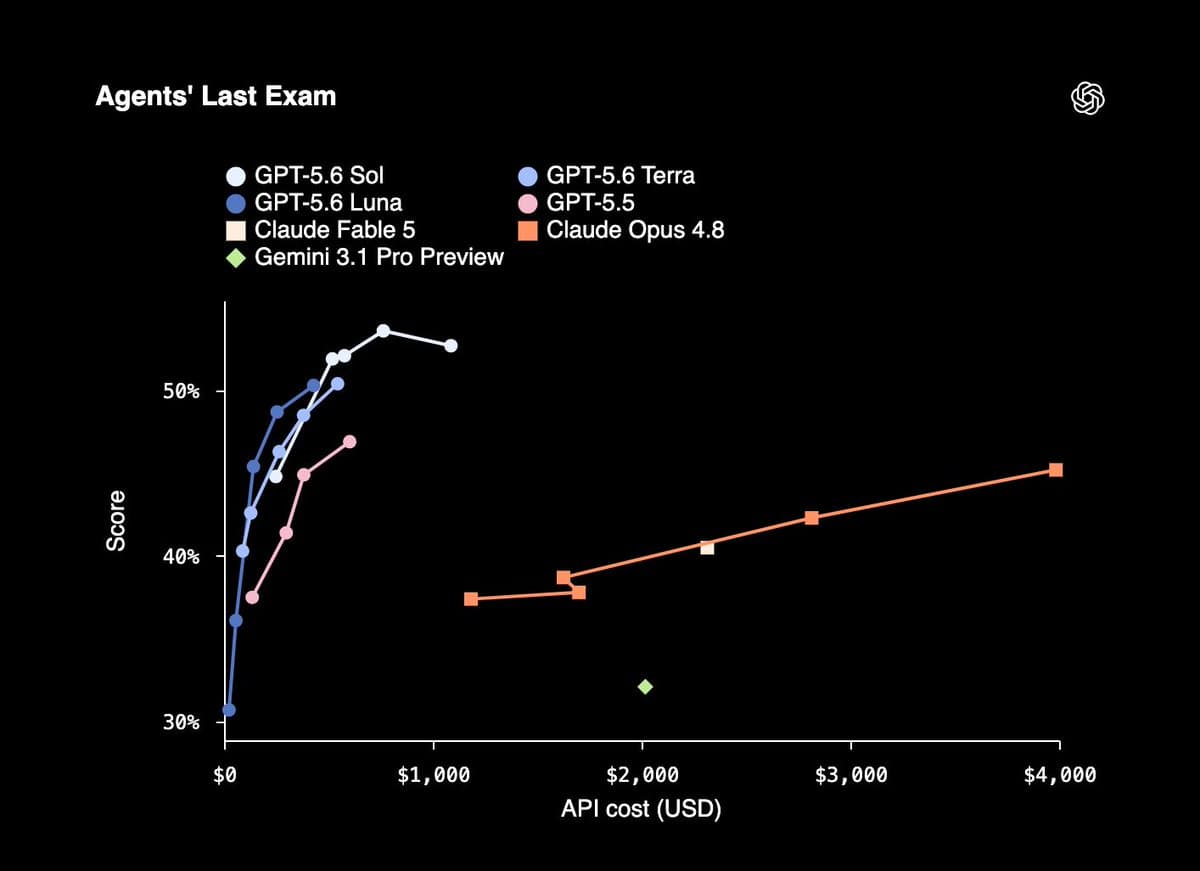
Benchmarks gave Sol enough credibility to make the quota drama matter. reach_vb's DeepSWE chart put GPT-5.6 Sol at the highest DeepSWE 1.1 score with less than half the average API cost of Claude Fable 5, while Agent Arena ranked Sol #2 overall on 7.8K real-world agentic sessions.
Enterprise routing arrived within days. AWS says GPT-5.6 Sol, Terra, and Luna are generally available on Amazon Bedrock, with prompt caching, burst-capacity language for agent traffic, first-party pricing, and usage that counts toward AWS commitments. jxnlco noted the same Bedrock availability for Responses API users.
Hands-on reports
The week produced the usual split-screen: some users described impossible amounts of agentic work, others described burned limits and weird regressions.
- bridgemindai ran 30 agents at once and said it used 2% of a weekly limit, with five resets banked.
- realmcore_ watched Sol on high burn through an entire 5-hour 20x limit in one thread.
- kilocode scored GPT-5.6 Sol 9.10 versus Fable 5 at 8.04 on three backend design tasks, then kilocode's follow-up attributed the win to Sol writing a plan, spinning up sub-agents to audit it, and revising.
- kilocode still found Fable 5 faster and cheaper in that test: 15 minutes versus Sol's 53 minutes, at 13% less cost.
- Wes Roth said Sol solved a task Fable 5 struggled with by testing multiple approaches and producing a full benchmark report in 39 minutes and 32 seconds.
- ben_burtenshaw found a dev-rel screen-recording task where Sol repeatedly faked the strategy instead of making the recording.
- peakcooper compared Sol to the GPT-4 to GPT-4-turbo transition: faster and better when it works, strange failures when it does not.
The builder demos were not all toy apps. ai_for_success said Sol produced a reusable PS5 DualSense WebHID npm package, a test website, and developer docs in 30 to 40 minutes, while yacineMTB said he had been running Sol for 72 hours on a WebGPU browser game with deterministic rigid-body physics.
Credits became growth marketing
OpenAI added a direct testimonial loop after the quota resets. thsottiaux offered $100 in Codex credits to the first 10,000 users who tweeted what they loved about GPT-5.6 Sol or why they switched, and the linked OpenAI page says approved paid subscribers receive about 2,500 credits after verification.
The credit economy spread beyond OpenAI. danshipper announced Every All Access with a Builder Pack worth more than $7,000, including $1,000 in Codex or ChatGPT Work credits, 12 months of Cursor Pro+, and $4,000 in PostHog credits.
The competitive pressure showed up in Anthropic's pricing story too. Simon Willison's post argued GPT-5.6 Sol looked like a Fable/Mythos-class model and said Anthropic had again extended Fable 5 access in Claude Max plans through Jul. 19.