
Goodfire opens Silico private beta for automated interpretability and RL experiments
Goodfire opened a private beta for Silico, which it says can run automated interpretability and RL experiments. Reported examples include a GLM-5.2 J-space replication and a Qwen3-8B RLFR run that reduced hallucinations by 37%.
TL;DR
- Silico is now in private beta, and GoodfireAI's launch thread positions it as an AI research team for J-space replication, reward-model training, RL, and cancer-prediction interpretability.
- The fastest replication claim is J-space: GoodfireAI's J-space example says Silico reproduced the result on GLM-5.2 overnight, then pushed the experiment to roughly 256k tokens for multi-hop QA.
- The strongest training claim is RLFR: GoodfireAI's RLFR example says Silico reproduced Goodfire's feature-reward RL method in 2 days and reduced Qwen3-8B hallucinations by 37% without capability loss.
- The cross-domain pitch shows up in the launch examples, with GoodfireAI's protein example using BSFs on protein language models and GoodfireAI's pathology example replicating PICASSO on Midnight-12k.
- The main open implementation question is harnessing, since nrehiew_ called the system process-changing but asked how much comes from scaffolding versus a Goodfire-specific training stack.
The Silico page frames the product as three things: frontier interpretability methods, a "model neuroscientist" agent, and a shared model-design environment. The examples jump across Anthropic's J-space, Goodfire's RLFR, Block-Sparse Featurizers, and PICASSO for pathology models. The gated contact page says early access is aimed at Fortune 500 enterprises, major healthcare institutions, and AI research labs.
What Silico is
Goodfire opened private beta for Silico with a simple pitch: prompts like "replicate J-space on GLM 5.2," "train a reward model and run RL to reduce hallucinations," and "show me how this model makes cancer predictions" become runnable research workflows.
The official Silico page defines the platform as three pieces:
- Frontier interpretability techniques, Goodfire's methods for interpreting and improving models.
- The model neuroscientist, an agent that plans and runs experiments, returns results, and learns over time.
- A model design environment, a team workspace for training and debugging models on Goodfire's infrastructure.
The page lists five job families for the platform: prediction inspection, health checks, failure debugging, behavior shaping, and generalization from less data.
J-space on GLM-5.2
Goodfire says Silico replicated J-space on GLM-5.2 overnight, then extended the context to roughly 256k tokens while reproducing key multi-hop QA results.
Anthropic's global workspace write-up defines J-space as a set of internal activation patterns found with the Jacobian lens. In Anthropic's framing, those patterns let a model hold verbalizable concepts silently in activations, without writing a scratchpad token.
Z.ai's GLM-5.2 documentation describes the model as a long-horizon system with usable 1M-token context. Goodfire's claim is narrower: Silico reproduced the J-space result on GLM-5.2 and extended that experiment to a 256k-token setting.
The immediate technical debate was about whether the channel can be blocked. In willdepue's thread, blocking attention gradients into past tokens was floated as a way to prevent J-space from forming, with a follow-up saying it appeared to work but destroyed performance. LiorOnAI expected the optimization pressure to reappear through residual streams or other circuits, while torchcompiled called the proposed variant "the transformer with no transformer."
The open ablations are concrete: attention-gradient blocking, residual-stream rerouting, and the performance cost of removing the workspace.
RLFR on Qwen3-8B
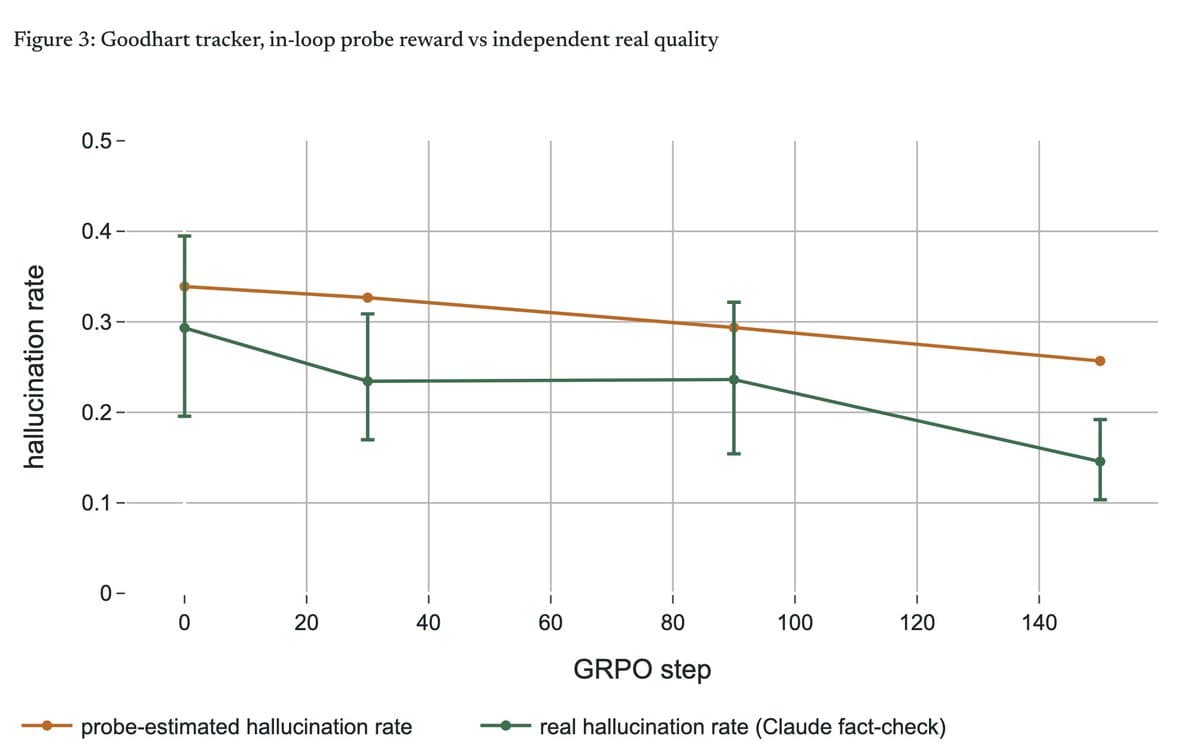
Goodfire says its team spent months developing RLFR, then Silico reproduced it in 2 days on Qwen3-8B, reducing hallucinations by 37% without capability loss.
Goodfire's RLFR research post defines the method as Reinforcement Learning from Feature Rewards: lightweight probes read a model's internal representations and provide reward signals for RL.
The original RLFR setup had four probe stages:
- Localize candidate entity spans in long-form output.
- Classify whether each span is hallucinated.
- Generate inline corrections or retractions when a hallucination is flagged.
- Grade those interventions with reward probes.
Goodfire reported a 58% hallucination reduction on Gemma-3-12B-IT with its probing harness, roughly 90x lower cost per rewarded intervention than an LLM-as-judge alternative, and no degradation on standard benchmarks. The Silico launch example is a portability claim: the same method moved to Qwen3-8B in 2 days and still produced a 37% reduction.
Protein and pathology models
Goodfire also used Silico outside text-only LLM work.
- Protein language models: GoodfireAI's protein example says Silico used BSFs to find unsupervised subspaces whose activations correlate with known protein structures. Goodfire's BSF paper post defines Block-Sparse Featurizers as methods that decompose activations into multidimensional subspaces rather than single directions.
- Digital pathology: GoodfireAI's pathology example says Silico replicated PICASSO on Midnight-12k in one shot. The PICASSO preprint describes a pathology framework that decomposes model embeddings into interpretable histomorphological concepts and allows those concepts to be manipulated.
Goodfire's life-sciences page pitches this as tracing predictive signal through interpretable features to separate real biological structure from dataset artifacts.
The model neuroscientist
The model-neuroscientist part is the product hook for coding-agent nerds: an experiment-running agent, but pointed at model internals instead of a repo.
A community screenshot showed the agent queueing three experiments:
- Representation geometry before vs after RLFR.
- Identifying goblins lurking in latents.
- Catching reward hacking in a coding agent.
Goodfire's public Silico pages describe the agent and workspace, but not the amount of scaffolding behind these runs or whether the training stack is Goodfire-specific. That matches nrehiew_'s question about how much harnessing is needed versus how much the models can already do.
The most excited reaction came from the training loop side: oneill_c said useful interpretability being tightly coupled with training research matched a backlog of questions they had not had time to tool up.
Access and surfaces
Goodfire's access post points users to the private-beta request flow. The contact page says the platform is used by Fortune 500 enterprises, major healthcare institutions, and AI research labs.
The public product pages split Silico into three surfaces:
- Language models: Goodfire's LLM page emphasizes predicting failures before deployment, correcting failure modes, and shaping datasets, features, and rewards.
- Life sciences: Goodfire's life-sciences page emphasizes biological structure, biomarkers, and feature-level model correction.
- Robotics and vision: Goodfire's robotics and vision page emphasizes latent-space checks for physical generalization, checkpoint failure tracing, and steering physical behavior without retraining.