
OpenAI and Work Louder release $230 Codex Micro control deck
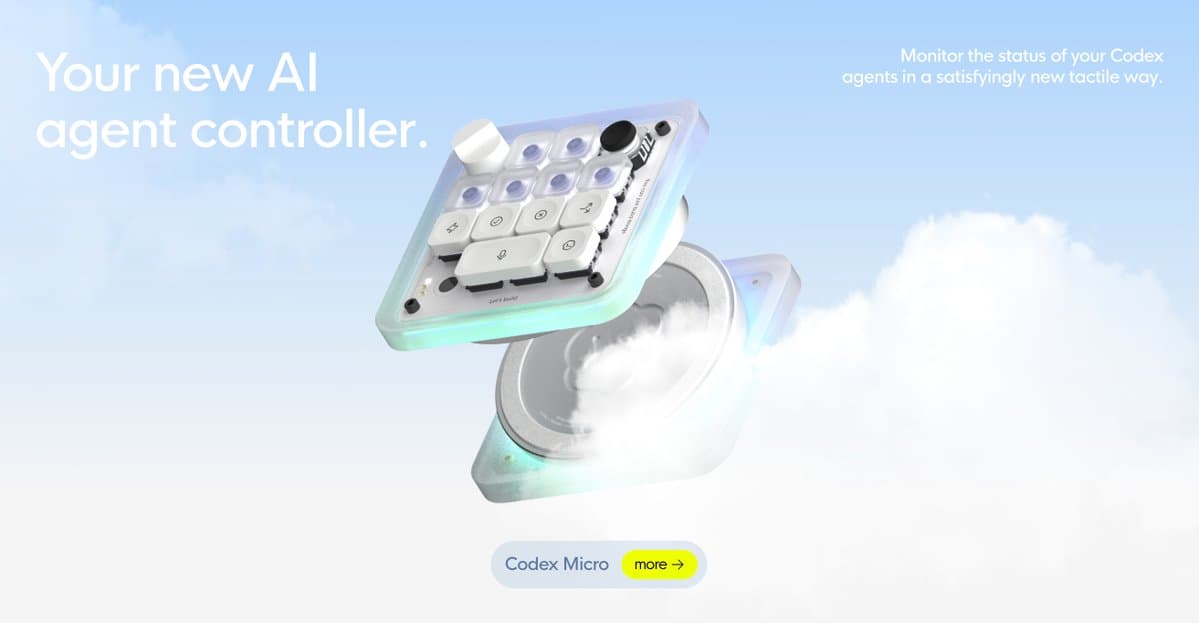
OpenAI and Work Louder released kbd-1.0-codex-micro, a compact hardware controller for Codex workflows with mappable buttons, a joystick, status keys, and RGB feedback. Posts from Work Louder and early users describe Codex-focused mappings for multi-agent status, accept/reject actions, six layers, and app auto-switching.
TL;DR
- OpenAI and Work Louder shipped a $230 limited-run Codex Micro with Clicky and Silent options, after OpenAIDevs introduced
kbd-1.0-codex-microand testingcatalog spotted the Supply listing. - The launch is about physical orchestration for parallel Codex work, since btibor91's feature inventory says six RGB Agent Keys track Codex thread state and can focus or foreground a task.
- The Codex-specific controls go past a branded macropad: TheRundownAI's control list names accept, reject, push-to-talk, new chat, joystick-launched workflows, and a reasoning dial.
- Platform scope is ChatGPT desktop first: the Codex Micro docs say setup starts in the ChatGPT desktop app, while TheZachMueller bought one while noting there is no Linux Codex app yet.
- Community reaction split fast between instant buy and generic-keypad skepticism, with NickADobos ordering immediately and jasonzhou1993 posting a $20 keypad comparison.
The Codex Micro docs include exact UI timings: a 350 ms double-tap window for Agent Keys, a 500 ms dial hold to reopen settings, and one Codex layer plus five more Work Louder Input layers. The Work Louder product page calls it the only AI controller directly integrated into Codex, while btibor91's video scrape found the device foreshadowed inside OpenAI videos as “Document the Codex Micro keyboard” and a hidden “tibo” sequence on the Codex pricing page. OpenAI's Supply page listed it out of stock during research.
Codex Micro
OpenAI's Supply Co. x Work Louder page names the product Codex Micro, prices it at $230, and describes kbd-1.0-codex-micro as a way to keep active chats close, see live RGB agent feedback, and map Codex actions to tactile controls.
The official listing included the Codex Icon Keyset with 32 extra keycaps, warranty and support, and two switch options: Clicky and Silent. sama turned the Silent option into the launch's smallest culture war by saying he was amazed some people wanted it.
The hardware spec from Work Louder lists 13 mechanical switches, one touch sensor, one rotary encoder, one planar joystick, Bluetooth and USB-C, RGB lighting, Mac and Windows support, a sandblasted anodized bottom, PBT and PC keycaps, and a USB-C to USB-C cable.
Agent Keys
Six frosted Agent Keys are the real Codex integration. The official docs say each key can follow a task, show live status, switch to that task on one press, and bring ChatGPT forward on a double press within 350 ms.
The status map is fixed:
- White: idle.
- Blue: thinking.
- Green: complete with an unread update.
- Amber: requires input.
- Red: error.
- Off: no assigned task.
Out of the box, the keys follow the six most recently updated tasks. Settings can change that source to pinned tasks, priority tasks, or custom assignments, but the docs say Agent Keys cannot be turned into extra Command Keys.
Command keys, joystick, and dial
OpenAI's docs list six default Command Key actions:
- Toggle Fast mode.
- Approve the current request.
- Decline the current request.
- Continue the current task in a new task.
- Start push-to-talk.
- Send the message in the composer.
The analog controls get their own defaults:
- Joystick up: toggle Plan mode.
- Joystick right: go forward in app history.
- Joystick down: show or hide the sidebar.
- Joystick left: go back in app history.
- Dial: move through composer controls, with Reasoning selected by default.
The docs also say Command Keys can be remapped to open the browser or terminal, review changes, commit with Git, create a pull request, attach files or photos, manage scheduled tasks, change reasoning effort, or open Skills. The Mic key uses the computer's microphone rather than one built into Codex Micro, a detail dkundel also confirmed in a reply.
ChatGPT desktop setup
Setup starts inside the ChatGPT desktop app. The Codex Micro docs say to connect over USB-C or Bluetooth, wait for ChatGPT to detect the device, grant Input Monitoring on macOS, then configure it from Settings > Codex Micro.
The settings page covers Agent Key sources, Command Key actions, analog directions, and lighting. Pressing and holding the dial for 500 ms opens those settings again.
Mac and Windows are the named platforms on both the official and Work Louder pages. Linux was the immediate gap in TheZachMueller's order post, which noted the device was already ordered despite the lack of a Linux Codex app.
AppSense layers
Codex uses layer 1. The docs say Work Louder Input can configure up to five more layers for shortcuts and actions in other apps.
btibor91's feature inventory says Input can map shortcuts to any key, dial, or joystick across six layers, with a bottom-left touch sensor, three layer LEDs, and AppSense auto-switching after the active app stays focused for five seconds.
That layer split is the part that makes the device more than a Codex-only novelty: Codex gets the live agent state, while Work Louder Input gets the general-purpose shortcut surface.
Checkout totals
The list price was $230, but early checkout screenshots put the paid total higher. RayFernando1337's order screenshot showed $251.96 after $21.96 shipping, while haydenbleasel's receipt showed $262.35 after $12.51 shipping and $19.84 taxes.
International fees were the recurring complaint. dkundel's fee reply said the list price excludes customs and taxes, and another dkundel reply said most of the scary shipping line was taxes and customs rather than freight.
Generic keypads
The software workaround arrived the same day. emollick said GPT-5.6 Pro wrote a project plan for using a Stream Deck to control Codex, Codex implemented it, installed it by taking over the computer, and the project was then open sourced.
The clone argument was blunt. jasonzhou1993 asked how Codex Micro differs from a $20 keypad, teortaxesTex predicted a wave of AliExpress knockoffs and “device APIs” for every AI service, and dingyi argued the form factor looked like a 2023 product with an OpenAI skin.