
OpenClaw users report Hermes Agent migrations with clearer approvals, cron jobs, and Telegram UX
Practitioners said skills and workflows were porting from OpenClaw to Hermes Agent with fewer surprises around approvals, job control, and mobile use. That matters because teams choosing a self-hosted agent stack are now comparing operational clarity and migration friction, not just model support.
TL;DR
- niallohiggins' migration report said existing OpenClaw workflows, including coffee ordering, Amazon subscription management, financial skills, agent mail, Stripe Link CLI, and Bitwarden secrets, ported to Hermes with less work than expected.
- In niallohiggins' follow-up, the main difference was operational clarity: Hermes felt more explicit about approvals, cron and job management, workflow triggers, and what the agent was doing.
- Mobile surfaced as part of the migration story, because niallohiggins' Telegram note called Hermes' slash-command workflow good enough for parallel queries from a phone, while niallohiggins' Replit iOS note pointed to parallel agents as a second front in on-the-go use.
- The comparison is happening against a moving target: openclaw's 2026.5.12 release thread shipped Codex-first login, fallback recovery, sturdier Telegram polling, leaner installs, and openclaw's security-pass update tightened sandbox binds and credential handling.
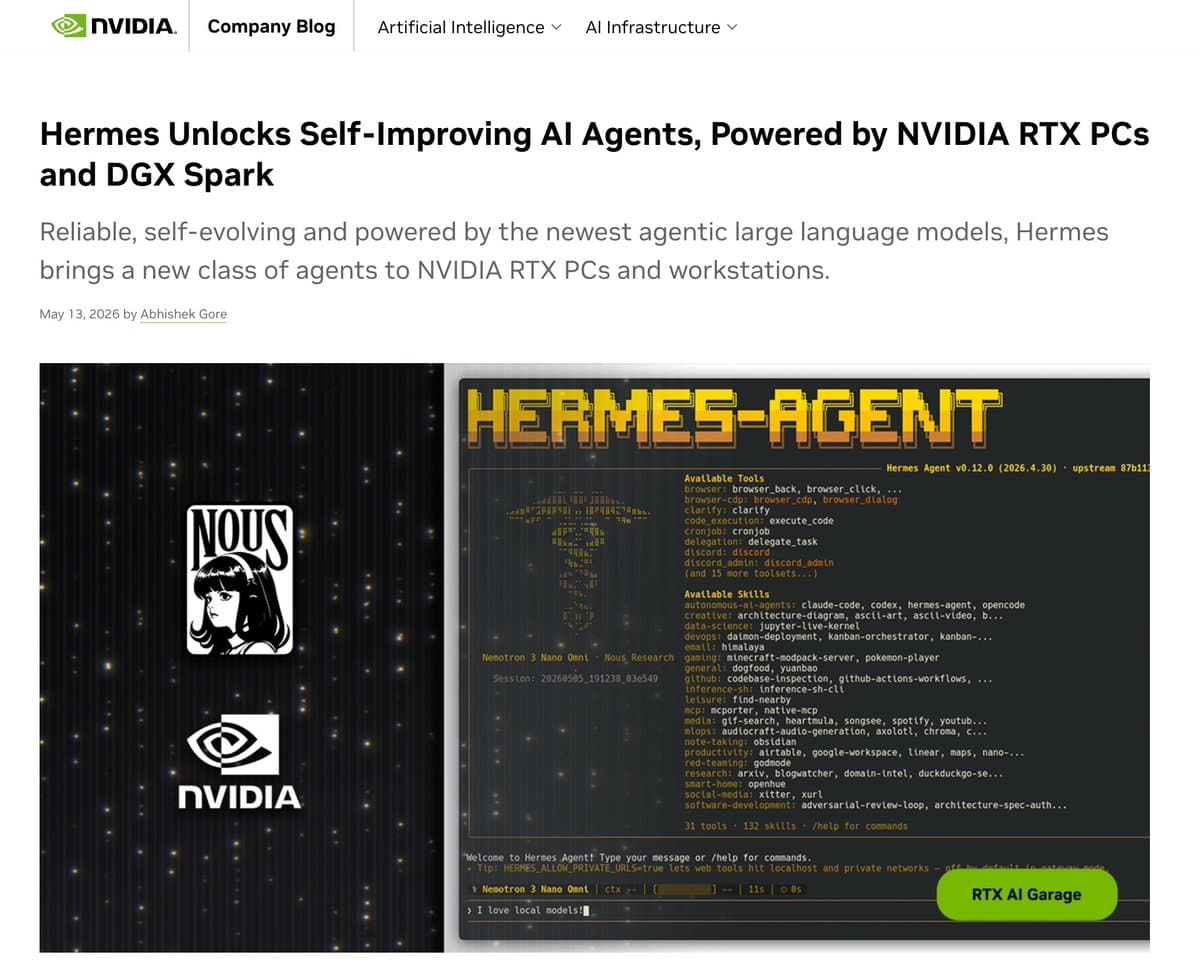
- Hermes momentum is no longer just anecdotal, because Teknium's usage screenshot claimed Hermes was already approaching 2x OpenClaw's token volume, while NousResearch's NVIDIA post added native RTX PC and DGX Spark support.
You can open the Codex app-server runtime docs, skim the OpenClaw 2026.5.12 release notes, and even read NVIDIA's DGX Spark write-up. The oddest reveal in the evidence is that migration stories are mixing very practical ops details, approvals and spool durability, with mobile-agent weirdness like niallohiggins' Replit iOS post and steipete's Uber-by-agent demo.
Migration friction
The strongest primary evidence here is boring in a good way. According to niallohiggins' migration report, a grab bag of existing OpenClaw automations moved over without a rewrite, and most of the work was delegated to an agent.
That lines up with a broader complaint from builders who tried to sit on top of OpenClaw as a product surface. In danshipper's platform note, OpenClaw was described as powerful but difficult to build a stable service around because of fast changes and regressions.
Those two points together explain why this story turned into a migration story instead of a feature-comparison thread. The question practitioners are answering in public is how much glue survives the move.
Approvals and job control
The most specific Hermes praise in the evidence is not about models. In niallohiggins' approvals post, the gains were:
- clearer approvals
- clearer cron and job management
- clearer workflow triggers
- better visibility into what the agent is doing
That maps onto kilocode's architecture diagram, which argued that Hermes is optimized agent-first while OpenClaw is optimized gateway-first. The diagram is marketing, but it gives a concrete lens for why two stacks with similar checklists can feel different in day-to-day operations.
Telegram and mobile control
Hermes' Telegram surface showed up as a practical reason to switch, not a novelty channel. In niallohiggins' Telegram UX post, slash commands were the detail that mattered, because they made parallel queries and workflows manageable from mobile.
That same mobile and low-setup angle appears elsewhere in the evidence:
- testingcatalog's head-to-head test said Hermes and OpenClaw were both available with one-click install on Atomic Bot.
- niallohiggins' Replit iOS note called out parallel agents from the updated Replit iOS app.
- steipete's Uber-by-agent demo showed how far chat-native control had already drifted into real-world actions.
Hermes looks stronger in this slice of evidence when the job is steering agents from chat and phone surfaces, not just from a terminal.
Codex runtime
Hermes added a sharp interoperability hook in NousResearch's Codex runtime announcement: OpenAI turns can be handed to Codex's app-server runtime, while Hermes stays in charge of the sessions database, slash commands, gateway, memory, and skill review. The official runtime doc describes it as opt-in.
OpenClaw moved in a related direction on the same week. In openclaw's 2026.5.12 release thread, OpenAI setup started defaulting to ChatGPT and Codex login, and openclaw's OpenAI setup note added OAuth and profile reuse for Codex runs.
The result is a comparison that is less about raw model access than about where Codex sits in the stack. Hermes can wrap it as a runtime. OpenClaw can center it more directly in setup and provider flow.
OpenClaw's recovery pass
The anti-Hermes story is that OpenClaw is not standing still. The 2026.5.12 release bundled a cleanup pass across the exact pain points migration threads usually exploit.
The notable fixes were:
- fallback runtimes before output, plus stalled-stream and silent-failure recovery, per openclaw's fallback-recovery note
- Telegram polling in an isolated worker with a durable local spool, per openclaw's Telegram note
- lighter plugin installs and startup paths, per openclaw's plugin-install note
- stricter sandbox binds, SecretRefs for provider credentials, and more consistent redaction, per openclaw's security-pass update
- explicit delta and replace frames in gateway v4 chat streams, per openclaw's gateway protocol note
For readers who only saw the exodus posts, the release notes matter because they show OpenClaw responding with operational fixes instead of new abstractions.
Momentum and deployment surfaces
The migration chatter quickly turned into distribution chatter. In thursdai_pod's roundup, the hosts framed the week as an OpenClaw exodus, and thursdai_pod's clip post quoted Ryan Carson saying he was done with the constant breaking.
Hermes also picked up new deployment surfaces that OpenClaw users could point to immediately:
- Teknium's usage screenshot claimed Hermes had nearly doubled OpenClaw's token volume days after passing it
- NousResearch's NVIDIA post said Hermes now runs natively on NVIDIA RTX PCs and DGX Spark, with an official NVIDIA blog post
- Teknium's VPS setup repost highlighted a one-folder VPS setup that could be managed from laptop or phone
That last point is the clearest new fact at the end of this story: Hermes is not only winning migration anecdotes, it is accumulating hardware and remote-management surfaces that make those migrations easier to operationalize.