
OpenRouter launches Image API with typed capabilities and exact USD cost
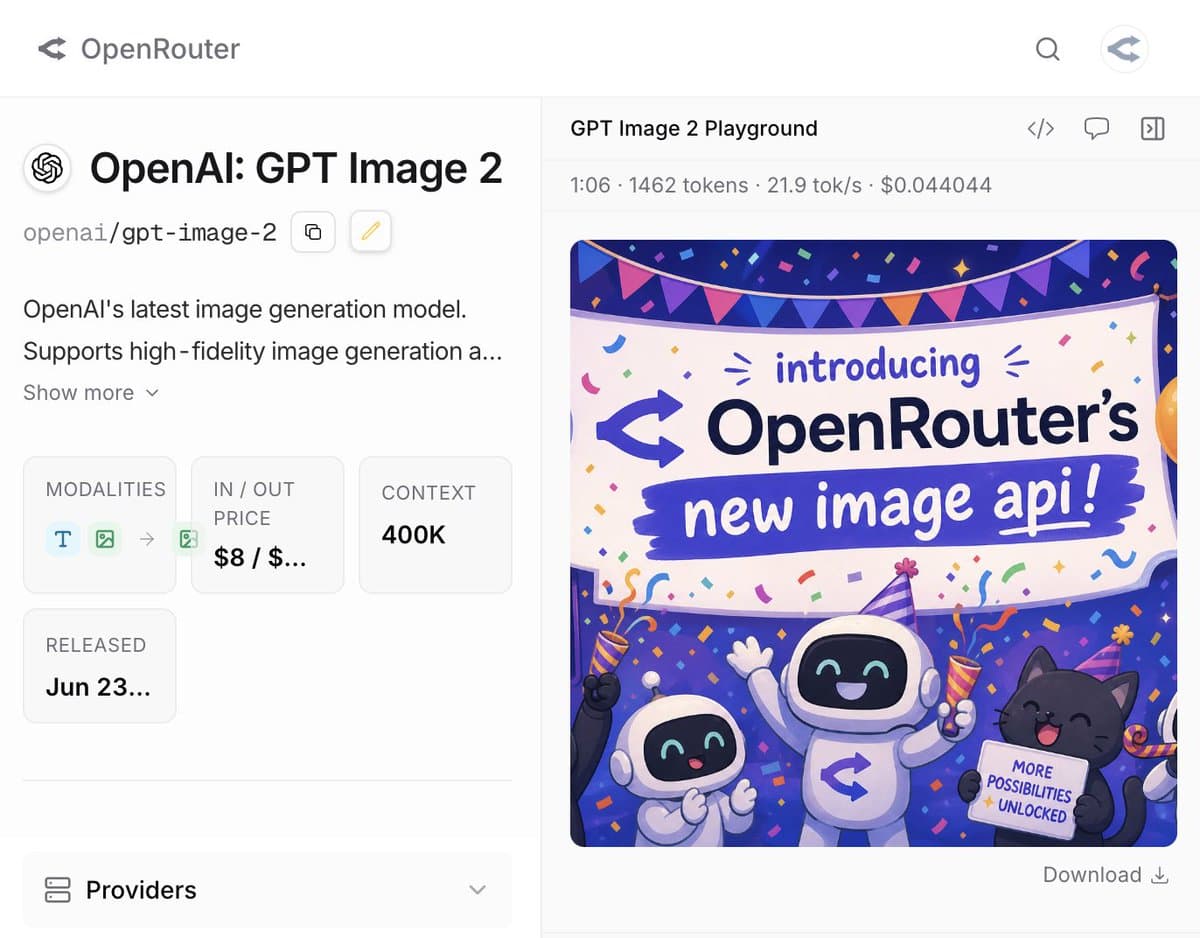
OpenRouter released a dedicated Image API that normalizes request shapes across 30-plus models from eight providers. Agents can inspect limits, passthrough options, streaming, and exact per-call cost without hardcoding vendor quirks.
TL;DR
- OpenRouter shipped a dedicated Image API that fronts more than 30 image models from eight providers, according to OpenRouter's launch post.
- The main pitch is typed capability discovery: OpenRouter's models-endpoint post says
/api/v1/images/modelsreturns per-model descriptors so clients can validate inputs instead of hardcoding vendor quirks. - OpenRouter also normalized one request shape across providers, and OpenRouter's request-shape post lists resolution, aspect ratio, quality, output format, transparency, input references, and streaming among the unified fields.
- Pricing metadata is part of the response path: OpenRouter's pricing post says the usage object includes exact USD cost even when underlying vendors bill per image, megapixel, or token.
You can jump straight to the full announcement, browse the image model catalog, and inspect the docs. One of the more useful implementation details is that OpenRouter's passthrough post exposes an allowed_passthrough_parameters list for vendor-specific knobs, while OpenRouter's streaming post adds native SSE previews for OpenAI image models.
Dedicated Image API
OpenRouter is splitting image generation out as its own surface instead of treating it like a sidecar on the text API. The launch post frames it as unified access to 30-plus models from Google, OpenAI, Black Forest Labs, Recraft, ByteDance, Sourceful, Microsoft, and xAI.
The concrete problem is vendor mismatch. OpenRouter's heterogeneity post points to aspect-ratio limits, per-call image caps, and reference-image limits that vary model by model.
Typed capabilities
The interesting piece is the models endpoint. According to OpenRouter's models-endpoint post, each model advertises typed capability descriptors, so a client can check supported fields before making a request.
That lets the API surface structure instead of forcing trial-and-error:
- aspect ratio support, which OpenRouter's heterogeneity post says ranges at least from 14 options on Gemini 3.1 Flash Image to 18 on Seedream 4.5
- output count limits, where the same post says some models generate up to 10 images per call and others cap at 1
- input reference limits, where OpenRouter's example says some models accept 16 references and others 4
OpenRouter explicitly pitches that shape to agent builders. In OpenRouter's agent-use post, the company says an agent can use the models response to pick a model, validate inputs, and generate images without repeated 400s.
Normalized requests and passthrough knobs
OpenRouter says one request schema now spans every provider. Its normalization post names seven fields that travel across the abstraction layer:
- resolution
- aspect ratio
- quality
- output format
- transparency
- input references
- streaming
The escape hatch is provider.options. OpenRouter's passthrough post says provider-specific settings, including Black Forest Labs' steps or guidance parameters, can still be passed through, and each endpoint advertises which passthrough keys are allowed.
Cost accounting and streaming
The pricing layer is more opinionated than the launch headline suggests. OpenRouter's pricing post contrasts three billing styles inside one API: Seedream 4.5 at $0.04 per image, FLUX.2 Pro at $0.03 per megapixel, and GPT-5.4 Image 2 plus Gemini 3.1 Flash Image billed per token.
Instead of leaving developers to reverse-engineer that mix, the same post says every response includes exact USD cost in the usage object.
There is also partial streaming support already. OpenRouter's streaming post says OpenAI GPT Image models can send native SSE previews with "stream": true, and OpenRouter's docs post links both the docs and the model browser from the launch thread.