
Periodic Labs releases open Neon model for X-ray diffraction analysis
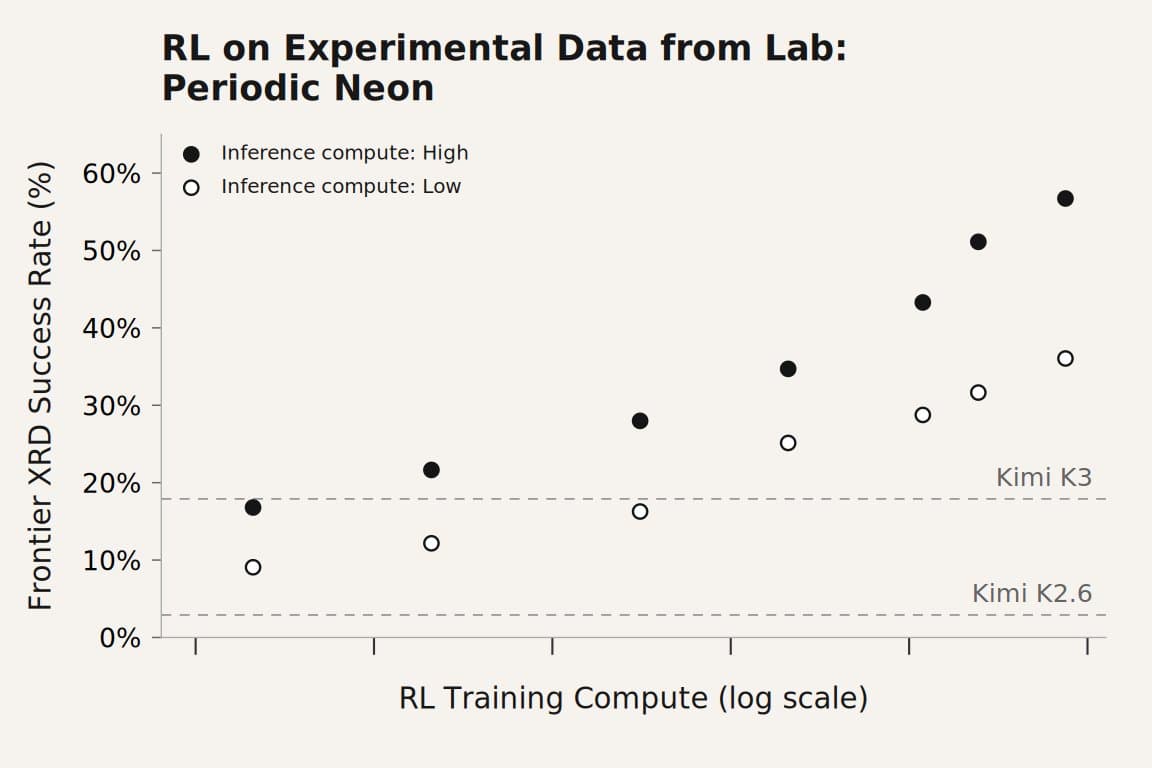
Periodic Labs released its open Neon model for X-ray diffraction analysis. The company says mid-training and RL on lab data raised accuracy from 2.7% to 55.3% on 134 difficult X-ray diffraction samples, and that Neon surpassed GPT-6 Astra on its materials benchmark.
TL;DR
- Neon starts from the 1T Kimi K2.6 base that Liam Fedus identified in a reply, then adds midtraining and RL on Periodic's experimental data.
- XRD-analysis success rose from 2.7% to 55.3%, +52.6 points, across 134 difficult internal samples in Liam Fedus's benchmark result.
- Periodic's tool context moves the same Opus 5 setup from 8.33% to 31.53%, +23.2 points, in the harness comparison.
- The training stack reports 4.1x Megatron-baseline throughput, 2.5x faster decoding, and 95%+ cluster utilization, according to Liam Fedus's infrastructure figures.
- Neon's public availability remains unclear: Liam Fedus's announcement calls out an open-source starting model, while Periodic's launch announcement describes Neon as deployed in its own labs.
Periodic says its proprietary midtraining corpus is doubling every month, although only a small fraction concerns XRD. Its infrastructure report describes XRD reasoning traces lasting more than an hour and checkpoint conversion compressed from 30 minutes to one.
What shipped
- Neon is a 1T-parameter model post-trained for experimental-result analysis, which DBahdanau's launch post describes as an XRD expert trained on lab data.
- The starting point was open-weight Kimi K2.6, followed by scientific midtraining and RL on experimental data, per Periodic's research report.
- Periodic's loop combines labs, research, and infrastructure, as Liam Fedus's overview puts it: experiments produce data, models learn from it, and then help choose the next experiment.
- Neon is deployed in Menlo Park's high-throughput labs for materials work, including superconductors, magnets, and semiconductor materials, according to Liam Fedus's launch announcement.
Benchmarks that moved
First-party
- Kimi K2.6 baseline to Neon: 2.7% → 55.3% FrontierXRD success, +52.6 points, on 134 hard internal samples, per Liam Fedus's result.
- Claude Opus 5 with Claude Code plus open-source XRD tools to Opus 5 with Periodic's harness: 8.33% → 31.53%, +23.2 points, while cost per attempt rose from $4.56 to $5.41, in the harness chart.
Where it regressed
Neon's 55.3% FrontierXRD result leaves 44.7% of the difficult internal set unsolved, based on the score reported by Liam Fedus's benchmark result.
- All model-comparison points use Periodic's internal Scientific Harness. Its research report says that harness includes lab context, proprietary structure and simulation databases, and XRD software.
- External-model cost estimates assume perfect caching across agent turns, while Neon is priced from internal throughput at $2.50 per H200-hour. A question from eliebakouch's cost comment specifically asked for a comparison with public API pricing.
- The 198-measurement generalization set holds out chemical systems from both midtraining and RL, but Periodic says it is easier than FrontierXRD; smaller subsystems can still occur in training.
- Human experts agreed with each other 77.2% of the time, versus 74.6% for Periodic's LLM-judge ensemble against experts, a -2.6-point gap documented in the judge chart.
- When asked for a full harness Pareto curve, Fedus said in a reply from Liam Fedus that the research post provides a comparison against existing harnesses instead.
Under the hood
Neon uses two post-training stages:
- Scientific midtraining: a multimodal mix of academic literature, code, and experimental data. Periodic says early ablations produced higher subsequent RL reward and FrontierXRD success even though XRD is a small share of that corpus.
- Long-context multimodal RL: agentic XRD traces combine synthesis conditions, thermodynamic reasoning, databases, and tool calls. The model is rewarded against scientific assessments rather than simple pattern-fitting.
Each XRD pattern received labels from three materials PhDs. Periodic then used an ensemble of two agentic LLM judges, Opus 5 and GPT-5.6-Sol, as the reward and evaluation signal, according to its research report.
Fedus credited Sekou Markaba with key reward-function insights in Liam Fedus's note on Neon, while the public write-up specifies the judge's calibration and agreement but not the reward-function design.
Pbox
Periodic built the surrounding RL system on Megatron, SGLang, Miles, and Ray, then modified it for rollouts that can spend hours reasoning and executing scientific tools. The company reports the following changes in its infrastructure report:
- Inference: 10 → 25 tokens per second per request for the 1T model at the same batch size, +150%, using prefill-decode disaggregation and delta router replay.
- Checkpoint conversion: 30 minutes → 1 minute, -96.7%, by distributing Megatron-to-Hugging Face conversion across Ray workers.
- Sandboxed file round trips: 726.8 ms with the hosted provider → 162.2 ms with pbox, -77.7%, with 3.3x aggregate data throughput.
Pbox runs gVisor sandboxes on CPUs reserved from the same Slurm-allocated GPU nodes as the RL job. It was built after model-written code requested 80 GB of RAM and brought down an early combined training, inference, and code-execution job.
The Ray-based resharding work is part of the production stack, and DBahdanau's Ray note credits the framework's architecture for scaling well.
Availability
Periodic's three September 15 posts name no downloadable Neon checkpoint, hosted API, source repository, or license. Their language is specific: Neon was trained from open weights, while the system itself is deployed in Periodic's labs.
The underlying base is Kimi K2.6, which Liam Fedus's reply identifies directly. The material released so far is the research, infrastructure description, and benchmark evidence, rather than public access terms for a Neon model package.