
Perplexity adds hybrid local-cloud routing to its Mac app
Perplexity's Mac app can route sensitive agent steps to local models while using cloud models for other work. The company also open-sourced the PII classifier used to decide where work runs.
TL;DR
- Perplexity Computer now divides one agent task between cloud models for research, planning, and reasoning, and a local Mac model for private files and on-device actions, as AravSrinivas's launch post describes.
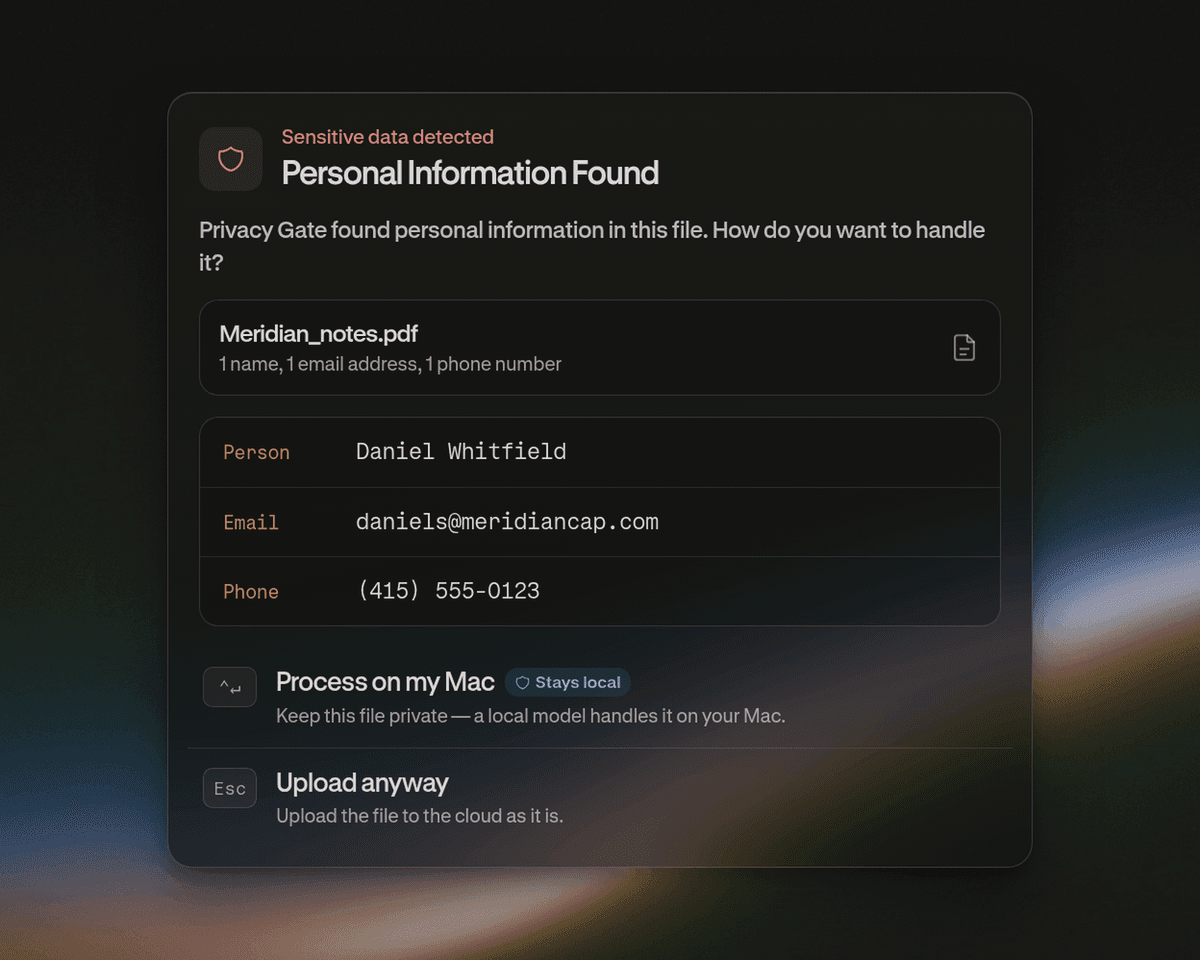
- A local Privacy Gate screens files before cloud egress. The Privacy Gate announcement says users can process a flagged file on the Mac, upload it anyway, or skip that step.
- Perplexity open-sourced the routing classifier, announced by AravSrinivas, as a roughly 600M-parameter PII masking model with token-level detection and a conversation-level sensitivity score.
- Hybrid runs on Apple silicon Macs with macOS 15 or later and at least 24GB of unified memory, according to Perplexity's launch thread; AravSrinivas's cost explanation says locally consumed tokens carry no token charge.
PII-TRACE defines success more harshly than ordinary PII detection: every occurrence of a recurring identifier must be found. A day before launch, WesRoth's pre-launch report had already surfaced the core design, cloud orchestration with Mac-local subtasks. Perplexity's launch post also says a task can start from an iPhone while the Mac accesses files and runs sensitive steps.
Cloud-local handoff
Perplexity assigns cloud models to web search, planning, and frontier reasoning, while the Mac model handles confidential files, sensitive information, and local actions, its launch documentation says. Computer coordinates those branches into one output, rather than making the user move context between separate tools.
Privacy Gate
Privacy Gate runs before content from a protected file can leave the Mac. The policy can mask sensitive details, keep work local, reject an action, or ask for consent, according to Perplexity's technical launch post.
The Privacy Gate announcement shows the immediate file-level choices:
- Process on the Mac.
- Upload the file to the cloud.
- Skip the step.
Credentials, payment-card numbers, and government IDs receive the strictest handling in Perplexity's policy. The underlying PII-TRACE research identifies the boundary's hard problem: a single missed repeat of an identifier in a long conversation can still expose it to the cloud.
PII-Tracer
The published pplx-pii-masking model card describes a bidirectional Qwen3-derived encoder with about 600M parameters and a 4,096-token context limit. It emits 37 BIOES token labels, four span positions for each of nine categories plus the outside label, then uses constrained Viterbi decoding to produce valid spans.
The nine categories are private_person, account_number, private_url, private_date, private_address, private_email, private_phone, other_pii, and secret. A second head mean-pools the conversation into a scalar sensitivity prediction, so routing can use both precise spans and a document-level signal.
Perplexity trained and evaluated PII-Tracer against its PII-TRACE dataset of 13,148 synthetic conversations across 13 languages and 10 writing systems. In the company's first-party results, PII-Tracer posted the highest character F1 among 12 tested detectors at 0.629, while GPT-5.6-sol scored higher on the two span-level F1 measures.
Availability and controls
Perplexity lists three downloadable local models at launch: Gemma 4 E4B, Qwen3.6 35B-A3B, and an unnamed Perplexity model. The setup flow is one-click model download followed by choosing Hybrid and selecting local and cloud models.
AravSrinivas wrote that Hybrid Compute is for all users of the Mac app, while Perplexity's availability details specify Pro, Max, and Enterprise subscribers. For Enterprise accounts, Perplexity says administrators can set organization-wide local, masking, and approval rules, then audit when information leaves a device.