
Qwen releases Qwen-Image-2.1 with open weights
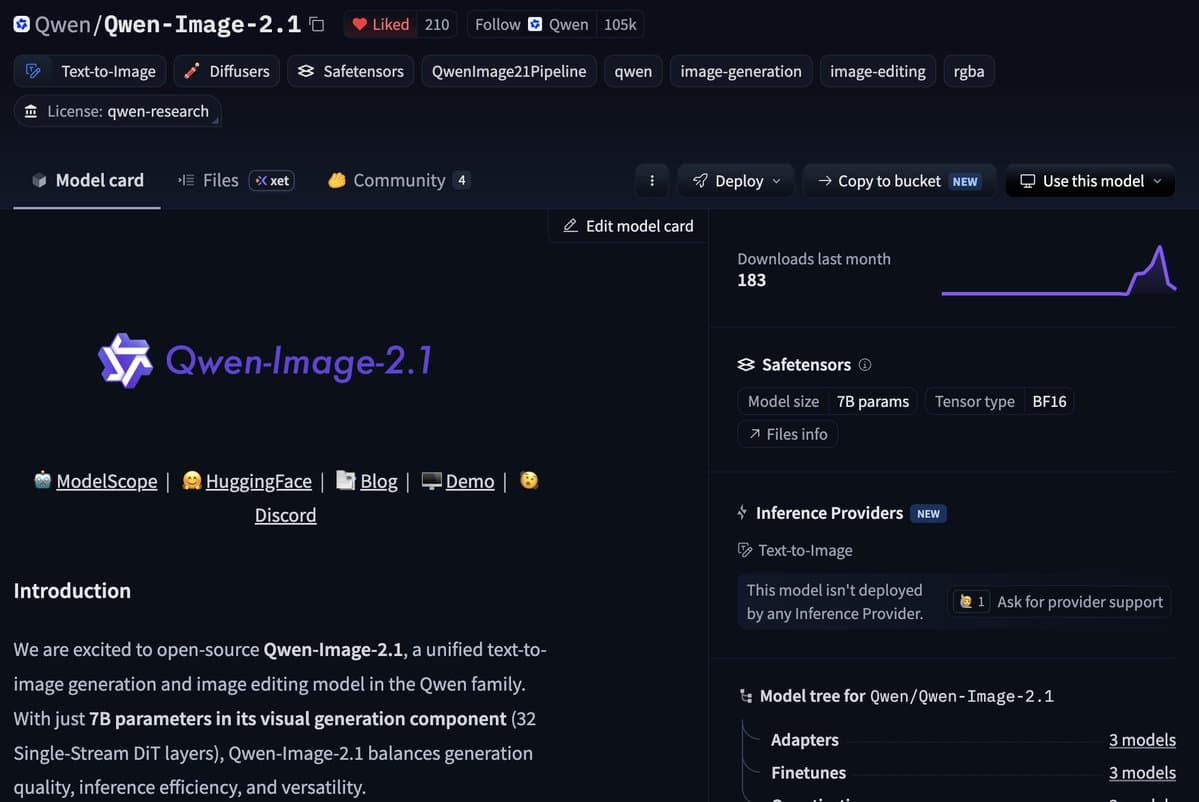
Qwen-Image-2.1 is a 7B model that combines image generation and editing, including native RGBA output and support for up to 10 reference images. It has day-one support in ComfyUI, Diffusers, vLLM-Omni, and Ostris, but its license is non-com
TL;DR
- Qwen-Image-2.1 ships downloadable weights for a single generation-and-editing model, with a 7B visual generator and up to ten reference images, according to the official launch post.
- Native RGBA is a first-class output path, not an after-the-fact background-removal step: multimodalart's post highlighted transparent PNG generation, while Qwen documents editing on transparent layers.
- The rollout reached ComfyUI, Diffusers, vLLM-Omni, SGLang-Diffusion, and Ostris on day one, starting with ComfyUI's announcement of native 2K generation, ten-image edits, and alpha output.
- Qwen's published comparison graphic puts its 60.28 overall score 0.46 points above Nano Banana 2.0's 59.82, as kimmonismus's chart repost shows, but it supplies no public evaluation protocol.
- The weights use a research-only license. ostrisai's license post flagged the strict non-commercial terms, which require a separate agreement for commercial use.
The model card uses the same QwenImage21Pipeline for a 2,048 by 2,048 text-to-image call and an image-edit call, both at 40 steps. Its transparency example begins by explicitly telling the model that the image has an alpha channel, while ComfyUI's package ships separate text-to-image and editing workflows plus quantized model variants.
What shipped
- Open weights for Qwen-Image-2.1 under the Qwen Research License Agreement, announced in the official launch post and reiterated by Alibaba_Qwen's day-one reply.
- A unified checkpoint for text-to-image generation, image-conditioned editing, transparent-image editing, and subject extraction, per the official model card.
- A 7B, 32-layer single-stream DiT visual generator with a Qwen3-VL-8B text encoder in the vLLM-Omni serving description, according to vLLM's launch details.
- Native 2K generation, 40-step reference examples, and supported aspect ratios from 1:1 at 2048 by 2048 through 16:9 at 2752 by 1536 in the reference pipeline.
- A browser demo through Hugging Face Spaces, which Alibaba_Qwen's demo post described as requiring no setup.
Benchmarks that moved
First-party
- Overall Score: Qwen Image 2512, 52.06 → Qwen-Image-2.1, 60.28, +8.22 points, in kimmonismus's repost of Qwen's scorecard.
- Overall Score: Nano Banana 2.0, 59.82 → Qwen-Image-2.1, 60.28, +0.46 points, in kimmonismus's repost of Qwen's scorecard.
- Overall Score: GPT Image 1, 54.07 → Qwen-Image-2.1, 60.28, +6.21 points, in kimmonismus's repost of Qwen's scorecard.
Third-party evaluators
Customer-reported
The chart labels its value only as “Overall Score.” The official model card describes capabilities and code paths, but does not define the score's task mix, rater protocol, prompt set, or variance.
Where it regressed
No published before-and-after test identifies a regression. The available scorecard is a cross-model ranking, rather than an editing, text-rendering, alpha, or multi-reference ablation.
The deployment footprint also needs a qualifier. Qwen's 7B figure covers the visual-generation component, while the vLLM serving configuration pairs a 7.1B DiT with a Qwen3-VL-8B encoder and a 16x RGBA autoencoder in vLLM's model description.
The repository documents CPU offload but no hardware or VRAM floor. An early reply from ai_for_success said “64 should be fine” and “128 should be enough,” without naming units, precision, resolution, or batch size.
Under the hood
Qwen calls the visual core a 32-layer single-stream DiT. The model card attributes its multi-image efficiency to mixed-granularity attention and prefix-KV-cache reuse.
vLLM-Omni describes the serving-side mechanics more concretely:
- Cross-step prefix-KV reuse, so text and reference-image prefixes are not recomputed at each denoising step.
- Dedicated CUDA graphs for fixed-shape decoding.
- Request-level and step-level continuous batching with phase-aware prefill/decode scheduling.
- Tensor parallelism and Ulysses sequence parallelism.
- Distributed VAE decode with adaptive out-of-memory recovery.
- FP8 weights, FP8 prefix-KV storage, and CPU offload across memory budgets.
Diffusers support arrived with what RisingSayak's post called a “disentangled prefill + decode” design. RisingSayak also clarified in an earlier reply that the model is “not an omni model” RisingSayak's reply, despite vLLM-Omni being one of its serving surfaces.
Native alpha and edit controls
The model card lists three local-control inputs: circles, painted annotations, and separate masks. Its release examples use a circle-marked image to request multiple simultaneous edits, and Alibaba_Qwen's text-rendering thread carries the related generation and editing examples.
The documented control set is:
- Up to ten reference images in one request.
- Identity preservation for people and products.
- Native RGBA generation and transparent-layer editing.
- Subject extraction from photographs.
- Multi-region edits in a single instruction.
For RGBA generation, Qwen's own code example prompts for “an RGBA image with transparency” and “alpha channel,” rather than exposing a separate transparent-output switch. Ostris later reported training with alpha support on a small T-shirt-design set for 750 steps ostrisai's training update.
Where it shows up
The integrations were unusually broad for day one:
- ComfyUI added native 2K generation, ten-reference editing, and alpha output in ComfyUI's announcement.
- Diffusers added a
QwenImage21Pipelinepath on day one in RisingSayak's post. - vLLM-Omni supports generation, editing, and transparent images in Alibaba_Qwen's vLLM post.
- SGLang-Diffusion added text-to-image, multi-image editing, and RGBA serving in Alibaba_Qwen's SGLang post.
- Ostris AI Toolkit added model support, then alpha-aware training in ostrisai's announcement.
The license
The downloadable materials are governed by the Qwen Research License Agreement, which defines non-commercial use as research or evaluation only. Commercial use of the materials requires a separate license request.
Qwen drew a separate line around outputs: Alibaba_Qwen's clarification says generated images and other content are not licensed materials, and that users retain rights to them.
Redistribution remains conditional on passing along the agreement, marking modified files, and retaining the prescribed attribution notice. The license also requires an AI model made available after being created, trained, fine-tuned, or improved with Qwen materials to display “Built with Qwen” or “Improved using Qwen,” and bars “Qwen” from serving as the primary name of a derivative product.