
Users report Qwen 3.8 27B agents vary sharply by harness
Local users report that Qwen 3.8 27B agent behavior changes substantially with the harness, quantization, context settings, and hardware. One 3-bit MacBook Air run at 57K context took 63 hours.
TL;DR
- Qwen 3.8 27B's agent behavior is varying with the wrapper around it: an RTX 3090 comparison by Healthy-Nebula-3603 put PI Agent's context compaction at 90K tokens and OpenCode's at 67K under the same 100K-server setup.
- One OpenCode deployment stopped after reasoning with no response, action, or GPU activity, according to Novel_Friendship913's bug report, even though Qwen 3.6-35B-A3B worked on the same machine and client.
- Memory-constrained local setups are trading features for fit: mt5o's 16 GB configuration disables MTP and moves the vision projector to CPU/RAM while keeping roughly 100K tokens of context.
- A 3-bit Qwen run on a 24 GB M2 MacBook Air did eventually produce a flyable HTML simulator, but HyperFoci's test took 63 hours across an initial generation and a repair pass.
The official Qwen model card describes a native vision-language model with flexible thinking control for multi-step work. The Unsloth distribution separately lists developer-role support and improved nested-object parsing for tool calls. Those ingredients still leave the chat template, agent loop, context policy, quant, and hardware to the local stack.
PI Agent and OpenCode
Healthy-Nebula-3603 compared PI Agent and OpenCode against the same RTX 3090 llama-server deployment, using Qwen3.8-27B Q4_K_M, a 100,000-token context setting, flash attention, and the vision projector held in system memory.
Qwen 3.8 27b - PI AGENT vs OPENCODE - another smaple
0 comments
The post reported these harness-level differences:
- PI Agent began compaction around 90K tokens; OpenCode began at 67K with a 100K context and 32K output cap.
- PI Agent accepted 64K or larger output settings in the author's setup.
- The author reported fewer freezes and faster runs in PI Agent.
This is one installation rather than a harness benchmark, but it puts the operational divergence in configuration that otherwise held the local server constant.
A 16 GB configuration
mt5o's Windows command line illustrates how a 27B agent gets compressed into a 16 GB VRAM budget. The custom IQ4_XS GGUF used in the post is itself labeled for 16 GB VRAM.
16 GB VRAM purgatory discussion thread
0 comments
The configuration:
- Uses Q4_0 K and V caches, full GPU layer offload, and a 100,100-token context target.
- Disables MTP, then forces the MTP header to CPU/RAM.
- Loads the BF16 multimodal projector but prevents its GPU offload, which the author estimated saves roughly 800 to 900 MB of VRAM.
- Enables reasoning and flash attention, with a 1,024-token minimum for images.
- Sets
--no-context-shift; the author associated that with a DeltaNet context-shifting stall.
A stalled OpenCode run
Novel_Friendship913 reported a more severe failure: Qwen3.8-27B GGUF would think for a while, then stop without returning text or issuing an action. GPU activity fell to zero.
OpenCode + llama.cpp + unsloth/Qwen3.8-27B-GGUF:Q6_K_XL = only failure so far
0 comments
The setup was a 128 GB AMD Strix Halo Windows machine running llama.cpp behind an HTTP API, with OpenCode on a separate Linux host. It enabled reasoning and tool calls, configured 131,072 tokens of context, and used draft-mtp,ngram-mod speculation. The author said Qwen3.6-35B-A3B-MTP-GGUF at Q8_K_XL worked with that same OpenCode installation.
The report identifies the symptom and the complete runtime surface, but no root cause.
3-bit on a MacBook Air
HyperFoci ran Qwen3.8-27B Q3_K_S through LM Studio Bionic on a 24 GB M2 MacBook Air with 57K context. The first flight-simulator prompt ran for 47.8 hours and produced a title screen whose keypress did not work; a repair prompt ran another 15 hours.
I tried to do agenic coding with Qwen 3.8 27B 3bit quant on a macbook air m2 24gb. It took 63 hours, but amazingly, the flight simulator worked.
0 comments
The completed page was flyable, albeit buggy and without a plane model. For the identical initial prompt, the author recorded a 20-minute Google AI Studio run that one-shotted selectable plane models and a smooth voxel landscape, and a two-hour Qwen Studio run with a rougher, shimmering landscape.
DGX Spark as an implementer
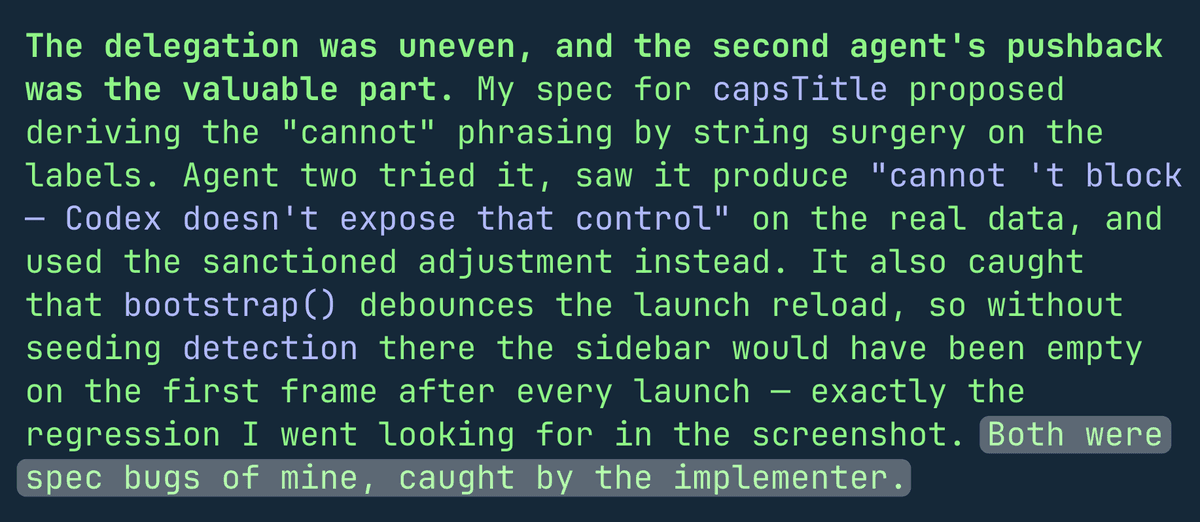
Daniel_mac8 put Qwen3.8-27B on a DGX Spark in a role-split coding setup: Claude Code's Opus 5 was the orchestrator and the local Qwen model the implementer. The author said the local agent catches bugs created by the orchestrator and described its marginal inference cost as zero.
That deployment assigns the small local model a bounded engineering role rather than asking it to carry an entire agentic run on laptop-class hardware.