
Alibaba releases Qwen4-Max with a 1M-token context window
Qwen4-Max accepts text, images and video through QwenCloud and is available from inference providers. Artificial Analysis reports 39% fewer output tokens than its predecessor.
TL;DR
- Qwen4-Max accepts text, images and video with a 1M-token context window, with QwenCloud access covered in WesRoth's launch report.
- Output-token use fell 39% versus Qwen3.8-Max in the independent testing summarized by WesRoth, while average task cost fell from $10.02 to $3.27.
- Coding and finance improved, as Alibaba highlighted, but ValsAI found regressions in tax and legal research.
- Max ships without downloadable weights, as MatthewBerman noted; Alibaba's announcement promises open weights for smaller Qwen4 models.
Only 71 billion of the model's 2.4 trillion parameters activate per token. QwenCloud's documented output budget is smaller than Vercel's launch advertisement, while Artificial Analysis's breakdown puts 85–90% of its evaluation bill on input rather than generated answers.
QwenCloud API and output limits
Alibaba released Qwen4-Max on November 16. Its architecture description says the new sparse MoE activates 25% fewer parameters per token than Qwen3.8-Max at the same total parameter count.
QwenCloud documents these limits and defaults in its model specification:
- Model ID:
qwen4-max. - Input and output: text, images and video in; text out.
- Context: 1,000,000 tokens, with maximum input lengths of 991,808 tokens without thinking and 983,616 with thinking.
- Completion budget: 131,072 tokens without thinking; 262,144 tokens shared between thinking and the final answer with thinking enabled.
- Reasoning: enabled by default at
high, with a 131,072-token thinking budget. Supported effort levels arelow,highandxhigh. - Interfaces: OpenAI Chat Completions, Responses, Anthropic Messages and DashScope. Tool calling, parallel tool calls and structured outputs are supported.
- Unavailable: batch inference, fine-tuning and model deployment.
Vercel advertised up to 384K output tokens in its launch post. Alibaba's separate Model Studio specification agrees with QwenCloud's smaller completion limits.
Token use and cache pricing
Singapore list prices fell from $2 to $1.50 per million input tokens and from $6 to $4.50 per million output tokens, a 25% reduction. Cache hits fell from $0.25 to $0.075 per million tokens, a 70% reduction, according to Artificial Analysis's launch results.
Independent measurements on the Artificial Analysis model page put average Intelligence Index task cost at $3.27. Its launch comparison provides the underlying changes:
- Task cost: $10.02 → $3.27, approximately 67% lower.
- Output tokens per task: approximately 171,000 → 105,000, 39% fewer, with both models evaluated at
xhigh. - Total input tokens across the index: 14.5 billion → 9.9 billion, 32% fewer.
Input accounts for roughly 85–90% of the evaluation cost because agentic tests resend context on successive turns. The cache discount is doing substantial work alongside shorter generations.
Explicit caching also appears in the QwenCloud documentation:
- Manual or automatically placed cache breakpoints support reusable input prefixes.
- Expiry options are five minutes and one hour, with five minutes the default.
- Chat Completions, Responses and Anthropic Messages support the new explicit cache; DashScope does not.
- Implicit caching does not guarantee a hit.
Coding, finance and workplace scores
Qwen4-Max moved from 34 to 43 on the Artificial Analysis Intelligence Index, +9 points, a gain Alibaba highlighted. The launch chart places it below Kimi K3.1 Pro at 46 and Opus 5.5 at 59.
Alibaba's evaluations
- Work360: 47.74 → 52.69, +4.95 points, across a taxonomy covering 721 specialized fields, according to Alibaba's launch thread.
- Work360 task cost: $4.43 → $1.67, approximately 62% lower, in the same internal evaluation.
Independent evaluators
Qwen4-Max improved on coding and finance in ValsAI's testing against Qwen3.8-Max 0902:
- Vals Index: 59.0% → 63.2%, +4.2 points, ranking 11th overall.
- Terminal-Bench 4.0: 38.9% → 48.5%, +9.6 points, with the largest gains in machine-learning and operations tasks; hardware tasks mostly failed.
- Vibe Code Bench: 16 of 50 apps → 21 of 50 apps passed every test, five additional fully passing apps.
- Finance Agent: 58.8% → 66.7%, +7.9 points, moving from 31st to eighth. The model averaged about 51 tool calls per question against a typical 39.
Other evaluators reported gains on different workloads:
- Agent Arena: 39th → 14th overall, with +7.5% net improvement across 14,700 sessions, as Alibaba reported.
- Image-to-WebDev Arena: 1,639 → 1,674, +35 points, reaching sixth place in Alibaba's announcement. Arena describes these as preliminary AutoEval results in its accompanying thread.
- Extended NYT Connections: 88.3 → 90.8, +2.5 points, with estimated response cost down 86%, according to LechMazur's results.
Tax and legal regressions
Shorter runs coincided with lower task-level success in parts of ValsAI's evaluation:
- Tax Agent: 49.7% → 40.4%, −9.3 points. Answers were about 40% shorter, with approximately 30% fewer tool calls.
- Legal Research: 46.2% → 41.3%, −4.9 points. Average citations fell from 19 to 11, and answers were less than half as long.
- EMB: 72.0% → 70.8%, −1.2 points.
Legal Research's checklist accuracy nevertheless rose from 80.7% to 84.7%. The benchmark requires every checklist item to be correct for a task to pass, so improved average coverage can coexist with fewer fully successful tasks.
HLAB, another legal benchmark, was the exception to token savings: output grew from approximately 124,000 to 447,000 tokens per task, about 3.6 times as much. Qwen4-Max answered 95.7% of checklist items correctly but fully passed only 21.3% of tasks.
Object detection and OCR
Vision improved over Qwen3.8-Max, but evaluator skalskip92 described Qwen4-Max as still behind Google, OpenAI and Anthropic on his benchmarks.
His comparisons separate tasks and reasoning effort:
- Object detection: 57.6 → 62.0 at low effort, +4.4 points; 54.8 → 62.6 at maximum effort, +7.8 points, in the detection results.
- Single-value extraction: 63.9 → 70.9 at low effort, +7.0 points; 61.7 → 66.5 at high effort, +4.8 points, in the extraction results.
- Structured extraction: 85.4 → 88.0 at low effort, +2.6 points; 81.6 → 89.2 at high effort, +7.6 points, in the JSON extraction results.
- Text localization and recognition: 59.0 → 72.5 at low effort, +13.5 points; 59.6 → 71.3 at high effort, +11.7 points, in the text-recognition results.
Higher effort reduced Qwen4-Max's single-value and text-localization scores, while improving structured extraction. The linked Roboflow OCR benchmark uses deterministic scoring and labels its results preliminary, with a single run per configuration.
High-effort processing time fell from 78.4 to 17.4 seconds per image in the timing comparison. Cost fell from $0.0280 to $0.0088 per image, approximately 68%, although low-effort cost rose from $0.0077 to $0.0083 in the cost comparison.
Scientific workflows
Alibaba's professional-work and science showcase reports three tool-driven workflows:
- Coolant discovery: a continuous 48-hour agent run completed four iterations combining molecular design, synthesis, testing and active learning. Alibaba says the resulting molecule was experimentally validated.
- Alzheimer's research: 454 tool calls and 3,239 metric evaluations produced 24 optimized candidate molecules for further laboratory validation.
- Machining: simulation feedback caught overcuts and insufficient material removal, reducing workpiece programming time from roughly 475 minutes to 24 minutes in the demonstration.
Inference providers and open weights
QwenCloud access extends to Qwen Studio, QwenWork and Qoder through Alibaba's launch offering. Third-party availability includes:
- Vercel AI Gateway: available with Alibaba's launch-day endorsement; Vercel's model slug is
alibaba/qwen4-max. - OpenRouter: live according to its launch announcement, with provider routing on the model page.
- OpenCode Go: available in the coding tool's announcement.
- Novita: supported from day one, according to Alibaba's availability post.
- You.com: live according to Alibaba's announcement.
- Venice: available anonymously. In its own 3D-scene test, the provider reported less than half Qwen3.8-Max's time and cost in its launch demonstration.
Alibaba also invited developers to try Qwen4-Max in a reply to AI/ML API.
Smaller open-weight models remain forthcoming. Unsloth says Qwen4-27B will fit 16GB RAM setups in its announcement, and its planned GGUF releases will use Unsloth Dynamic 3.1.
FrontierMemory and task-agent choice
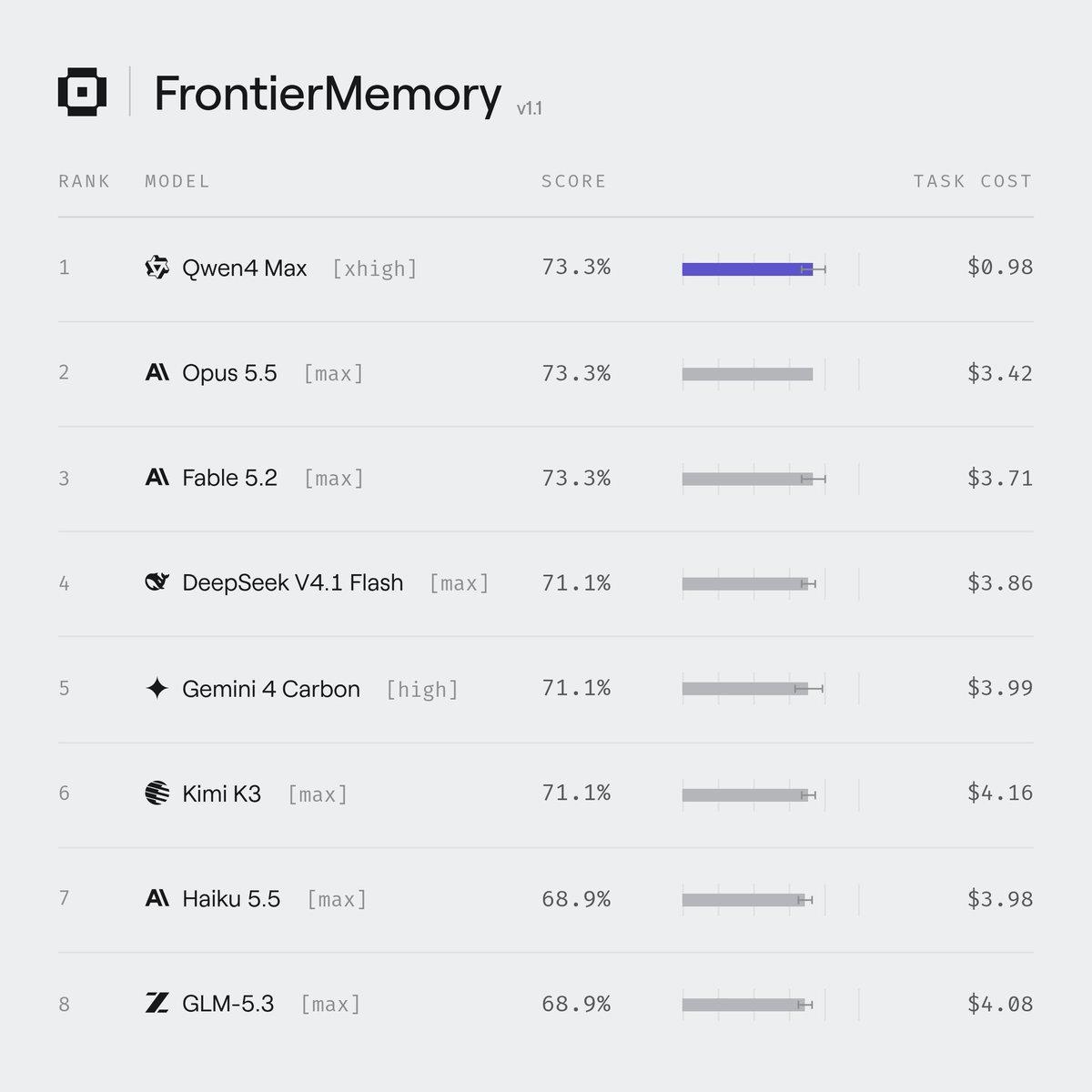
Qwen4-Max tied Opus 5.5 and Fable 5.2 at 73.3% in Letta_AI's FrontierMemory results. Memory-generation runs cost about $54 per dream, under one-fifth of Opus 5.5's reported cost.
FrontierMemory's methodology evaluates memories learned from past agent trajectories by plugging them into a separate task-solving agent. The comparison reverses with that executor, as Letta_AI explained:
- GPT-6 Sol as task agent: Qwen-generated memories scored 73.3%, versus 64.4% for Opus-generated memories, +8.9 points.
- Opus 5.5 as task agent: Qwen-generated memories scored 68.9%, versus 73.3% for Opus's own memories, −4.4 points.