
Zero launches systems language for agents after 3,000 agent tasks
Triangle Company introduced Zero as a systems language aimed at agent-friendly tooling and said the compiler mostly self-hosts after about 3,000 agent tasks in three days. Early inspection praised the tiny C compiler but found broken Mach-O lowering and no fuzz tests, so the release looks experimental rather than production-ready.
TL;DR
- ctatedev's launch post introduced Zero as "the programming language for agents," with explicit capabilities, JSON diagnostics, and typed safe fixes as the core pitch.
- In ctatedev's longer thread, the creator said Zero reached a mostly self-hosting state after more than 3,000 agent tasks across three days.
- cramforce claimed a Bun rewrite in Zero hit a 98.7 percent test pass rate with compilation time down 96.2 percent, and ctatedev's reply confirmed that same number.
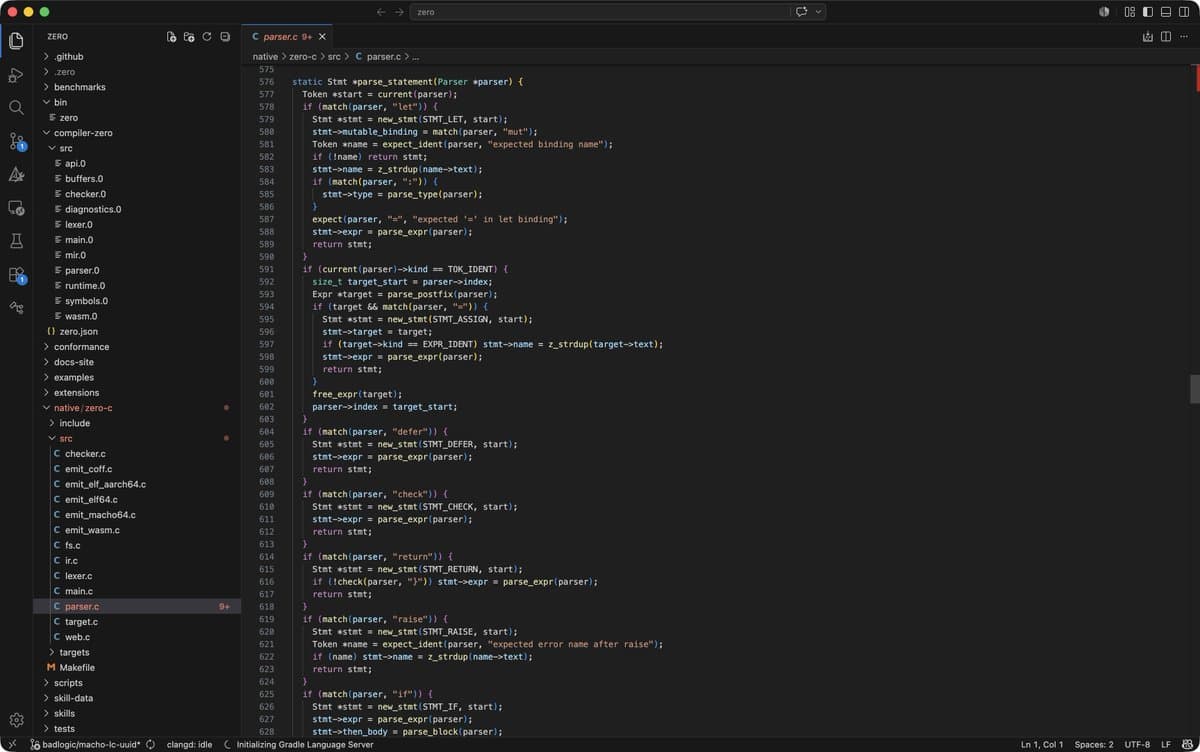
- Early code reading from badlogicgames' compiler walkthrough described a tiny plain-C compiler with a recursive descent parser and direct machine-code emission, while a follow-up bug report said the Mach-O emitter could not lower f64.
- badlogicgames' fuzzing note and a later thread update both framed the release as promising but very early, citing zero fuzz tests, toy platform support, and active bug filing.
You can jump from badlogicgames' first post to the official Zero site, then over to a fuzzing PR and an issue report that landed almost immediately. The weird part is how much of the story is already about agent process rather than language design: ctatedev made the 3,000-task build log part of the launch, while badlogicgames focused on how hackable the compiler looks under the hood.
Zero
Zero's public pitch is short and unusually specific. According to ctatedev's launch post, the language is meant to be faster, smaller, and easier for agents to use and repair.
In ctatedev's longer thread, that expands into three design goals:
- Make new languages and version changes easier for agents to learn and patch, even when they are not in training data.
- Ship a broad enough standard library that most projects do not need external dependencies.
- Keep the development loop tight enough that even small models can work reliably.
The launch image in
shows the aesthetic clearly: a tiny syntax surface and a zero build hello.0 flow that produces a 16.2 KiB binary in 1 ms. The official landing page linked from badlogicgames' first post is zerolang.ai.
Agent-built compiler
The most interesting fact in the launch is not a feature, it is the process. In ctatedev's build log, ctatedev said the language reached its current state in three days and took more than 3,000 agent tasks to get there.
That same post says the compiler now mostly self-hosts, while stressing that the project is "nowhere near ready" for serious comparisons, benchmarks, or evals. cramforce's benchmark claim added one eye-popping datapoint, a Bun rewrite at 98.7 percent test pass rate and 96.2 percent faster compilation, and ctatedev's reply answered "98.7% there" when asked about the result.
That makes Zero feel like Christmas come early for coding-agent nerds: half language launch, half public experiment in whether agent-driven iteration can brute-force a usable systems toolchain this quickly.
Plain C toolchain
The fastest external read came from badlogicgames' compiler walkthrough, which described the compiler as plain C, using a recursive descent parser and a simple IR that directly emits machine code for each platform.
That architecture matters because it explains both the praise and the fragility in the reactions. badlogicgames called it "super cute" and fun to hack on, while a later fuzzing post said the small toolchain, small binary, and small type system were the appealing part of the experiment.
The thread also suggests Zero is aiming for explicit machine-level ambition, not just a WASM toy. In badlogicgames' longer thread, the author argued that a minimal system language eventually runs into real-world complexity, and that a WASM-only target would be easier but would change the claim.
Breakpoints
The sharpest caveats showed up within minutes of the launch. badlogicgames' Mach-O bug report said the Mach-O emitter was a "complete toy" that could not lower f64, after the first inspection post had already flagged it as broken from source.
The security and robustness story looks just as early. badlogicgames' compiler walkthrough said the project had zero fuzz tests, and the fuzzing follow-up described using Clanker to fuzz the type checker.
That turned into immediate repo activity. badlogicgames' PR post linked a GitHub pull request for fuzzing-related changes, and the issue-thread update linked a GitHub issue while arguing that the minimal-toolchain idea gets harder once real platform constraints show up.