
AI in Design 2026 reports 91% weekly AI use and 50% shipping AI-generated code
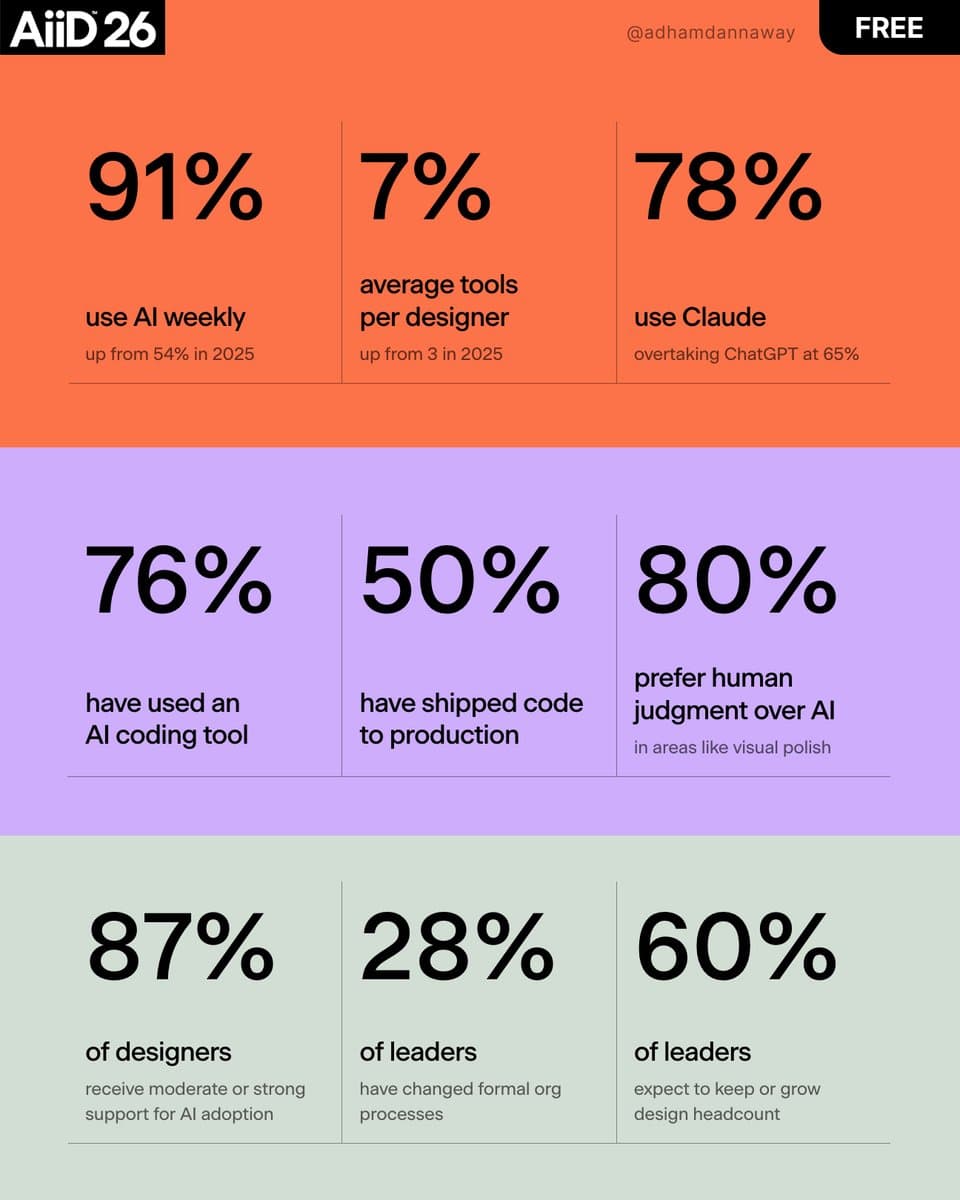
The AI in Design 2026 report says weekly AI use among designers reached 91%, Claude passed ChatGPT in the stack, and half of respondents have shipped AI-generated code to production. That matters because related evidence points to design work moving from static mockups toward code-backed workflows and custom internal tools, with output reliability still the main blocker.
TL;DR
- AdhamDannaway's report thread says weekly AI use among designers jumped to 91%, up from 54% last year, while the average designer now uses seven AI tools.
- The same report thread says Claude passed ChatGPT in designers' stacks, 78% to 65%, and that 50% of designers have already shipped AI-generated code to production.
- According to the main HN thread on Claude Design, creatives are already using conversational UI generation as a front end to code workflows, then exporting the design system into Claude Code for implementation.
- LukeW's post and AmirMushich's Claude Design workflow point in the same direction: design deliverables are drifting from static files toward brand-aware internal tools that generate assets on demand.
- Reliability is still the sticking point. While the AI in Design thread says 62% of designers name inconsistency as the biggest barrier, ClaudeDevs' product update says Anthropic spent the week making Claude Code more responsive and easier to debug.
You can read Anthropic's Claude Design announcement, skim the main HN thread, and jump from Luke Wroblewski's brand-encoded asset tools post to a live creator example where a prompt turns ChatGPT Image output into a React Native build. The weirdly consistent throughline is that more of design work now ends in runnable code, HTML, or an internal tool, not a handoff deck.
AI in Design 2026
The report's useful numbers are brutally concrete:
- 91% of designers use AI weekly, up from 54% last year, per AdhamDannaway's summary
- Designers now use an average of seven AI tools, also from the same thread
- Claude leads ChatGPT among designers, 78% to 65%, according to the report thread
- 50% have shipped AI-generated code to production, again via AdhamDannaway
- 80% say reliable output is what makes a tool stick, while 62% say inconsistency is the biggest barrier, per the same source
The other sharp finding in that thread is role drift. Figma shows up less as the center of gravity and more as a finishing step, while designers increasingly get judged on the workflow tools they build around the work.
Claude Design handoff
Claude Design
1.2k upvotes · 762 comments
Discussion around Claude Design
1.2k upvotes · 762 comments
The Hacker News discussion around Anthropic's Claude Design post reads like a field report from teams already treating design as a code-adjacent workflow.
Three recurring patterns show up in the discussion highlights:
- A PM describes ideas in natural language, explores interface options conversationally, tweaks details with comments, then exports the design system into Claude Code, according to florakel on design-to-code handoff.
- One commenter describes a domain expert building a CRUD app in Claude Design, then handing it to Claude Code for the existing stack, via DecoPerson on AI UI prototyping.
- Another says they are already pasting Google Stitch output into Claude Design because the first design pass is strong enough to keep moving, per qingcharles on comparison with Figma/Lovable/Stitch.
That lines up with the report's bigger shift: the mockup is becoming an intermediate artifact, not the final deliverable.
Code-backed mockups
Aakash Gupta's thread about OpenAI's internal app workflow describes designers shipping full UI with instrumented noop backends, what the team calls the painted door pattern. Users can click through a realistic product before APIs exist, and the interaction data decides what gets built next.
The same thread says engineers increasingly contribute constraints and tests instead of first-draft implementation, while PMs write markdown PRDs that compile into pull requests through Codex, per Gupta's summary. That is Christmas come early for design systems people.
On the creator side, viktoroddy's post compresses the stack into one line: ChatGPT Image generated the design, then Claude Opus 4.6 turned it into a working React Native site. It is a small demo, but it makes the new default obvious. Visual generation and code generation are no longer separate lanes.
Bespoke brand tools
Luke Wroblewski wrote that the future design deliverable is a custom tool that creates assets on demand with brand guidelines encoded into the system, in his linked blog post. His tweet is short, but the claim matches what the report says about designers becoming toolmakers.
Amir Mushich's Claude Design workflow is the concrete version: he built a Claude Project that generates comprehensive HTML and PDF brand guidelines so Claude Design has a structured brand source to work from. That is a very different artifact from a static style guide.
There is a similar pattern in Peter Yang's /slides skill demo, where HTML becomes the output format for animated presentations rather than a one-off deck. Once the deliverable is code, not pixels, the same asset can be regenerated, versioned, and remixed by the tool that made it.
Reliability
The report says inconsistency is the biggest blocker, and the platform chatter around Claude Code lands in exactly that gap.
[Src:6|ClaudeDevs' update] says Anthropic focused on responsiveness and reliability, while another post in the same thread says /feedback can now bundle the last day or week of sessions instead of forcing users to find a single broken run. That is a small product change with a clear subtext: the failures are intermittent enough that Anthropic now wants the surrounding session history, not one bad trace.
The same week, ClaudeDevs shipped a security-guidance plugin through the /plugins marketplace, and the follow-up doc link says teams can enforce org-specific rules through a claude-security-guidance.md file. Meanwhile, bentossell's complaint is the blunt user version of the report's 62% barrier number: "every time i try cc it just misses." The tools are getting deeper into the workflow at exactly the moment their consistency is under the brightest light.