
Claude Opus 4.8 adds mid-conversation system messages with prompt caching
Anthropic documented mid-conversation system messages and automatic cache preservation in Opus 4.8, while Claude Code and Cowork gained /effort controls. Try the new workflow controls if you rely on long sessions, since they may matter more operationally than the raw model bump.
TL;DR
- Anthropic documented a small but very practical API change: with Opus 4.8, a system-role message can be inserted after a user turn, and ClaudeDevs' announcement says the update can preserve prompt-cache hits when paired with the automatic caching docs.
- The companion docs spell out the behavior more clearly than the launch hype: ClaudeDevs' follow-up says the new system message becomes authoritative from that point onward, while the mid-conversation system messages page shows how to update instructions without replaying a whole long session.
- Claude Code and Cowork also got direct effort controls, with Boris Cherny's repost pointing to a new
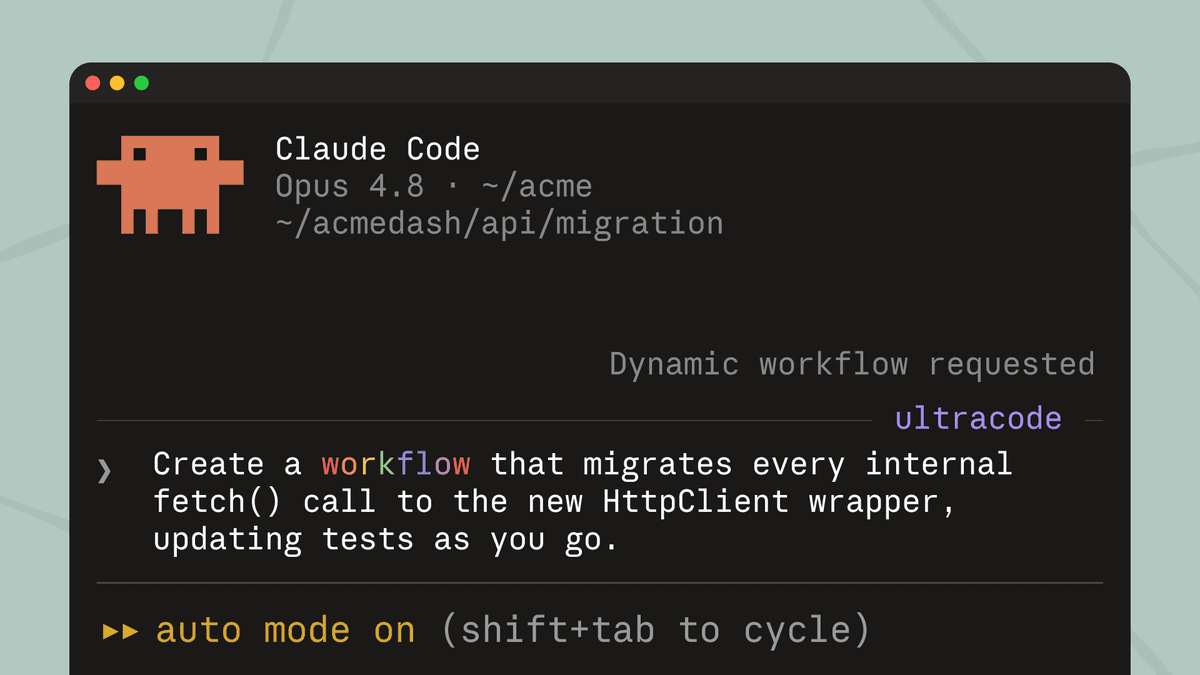
/effortsurface that lets users pick reasoning level and adaptive thinking instead of burying that choice inside prompts. - The bigger workflow shift landed in the same drop: ClaudeDevs' dynamic workflows post and Cat Wu's walkthrough describe Claude writing an orchestration script, fanning work across parallel subagents, and checking results before returning them.
- Early reaction split fast. Dan Shipper's hands-on report called Opus 4.8 a major writing and coding bump, while Greg Isenberg's take argued the real story was the tooling around the model, not the model bump itself.
Anthropic's own docs are where the useful details live. You can read the mid-conversation system messages guide, the automatic caching docs, and the dynamic workflows launch post. The weirdly important bit is that a prompt edit mid-run now has a first-class API shape, right as Claude Code is adding /effort, workflow orchestration, and a research-preview mode that can spin up hundreds of agents in parallel.
Mid-conversation system messages
This is the feature buried inside the Opus 4.8 release that will matter most to anyone running long sessions. Instead of restating the entire system prompt, you can append a new system-role message after a user turn, and from that point onward Claude treats it as the active authority, according to ClaudeDevs' API explanation.
The operational payoff is cache stability. As ClaudeDevs' launch note and the main HN thread both point out, the old pattern often forced developers to resend large prompt prefixes, while the new one lets them update instructions without invalidating earlier cached context.
That changes a few common agent patterns:
- long-running creative or coding sessions can tighten instructions midstream
- tool-using loops can inject a fresh rule after a failed attempt
- cached prefixes stay reusable, which lowers latency and input cost in repeated runs
The official documentation matters here more than the marketing copy. The mid-conversation system messages page defines the message shape, and the automatic caching docs explain how Anthropic wants those updates paired with cache preservation.
Effort controls
Anthropic shipped a second control surface at the same time: direct effort tuning in Claude Code and Cowork. Boris Cherny's repost says users can now configure effort level and adaptive thinking through /effort, while ClaudeDevs' migration note says Claude Code's built-in claude-api skill can update model strings and suggest prompt changes tuned for Opus 4.8.
That is a workflow change, not just a settings tweak. Reasoning depth is becoming an explicit part of the interface, with model choice, effort level, and cache strategy all exposed as knobs instead of prompt folklore.
The early hands-on reports also suggest effort level changes output quality enough to be noticeable. In Dan Shipper's week of testing, Opus 4.8's coding and writing results varied by reasoning level, with his team favoring xhigh for coding and high for writing.
Dynamic workflows
The same release also pushed Claude Code toward much larger jobs. According to ClaudeDevs' research preview announcement, saying "workflow" in a prompt can trigger Claude to write an orchestration script on the fly, then launch a fleet of coordinated subagents in parallel.
The mechanics are unusually concrete across Anthropic's posts and user reactions:
- Claude generates an orchestration plan first, per Cat Wu's description
- work fans out across parallel subagents, per ClaudeDevs' launch thread
- results are checked before they come back, per Cat Wu's follow-up
- the feature is meant for oversized jobs such as migrations, refactors, performance work, and batch bug fixes, per Boris Cherny's note
- Anthropic is already framing it as token-intensive, per that same note and the official workflows docs
The blog examples are even more aggressive. Cat Wu's Bun port example says Jarred Sumner used dynamic workflows on a roughly 750,000-line Zig-to-Rust port, with 99.8 percent of the test suite passing after 11 days from first commit to merge.
Creative and product reactions
The reactions split along a line creative users will recognize immediately: model quality versus harness quality. Dan Shipper's hands-on report said Opus 4.8 scored well for writing, report creation, and deck generation, and described it as producing fewer obvious "AI-isms" than GPT-5.5 in his team's tests.
Other creators were less convinced by the base model jump. Meng To's landing-page test said Opus 4.8 could design beautiful landing pages but still trailed GPT-5.5, while Greg Isenberg's reaction argued model releases are starting to feel interchangeable and that dynamic workflows was the release that actually moved the needle.
That split is probably the cleanest summary of this launch. Anthropic shipped a model update, but a lot of the day-one conversation moved immediately to interface controls, orchestration, and the harness around the model.
Pricing and recency
Anthropic kept Opus 4.8 at the same price as 4.7, according to Boris Cherny's launch post, and that detail showed up quickly in the HN discussion because it landed alongside a new system-message capability rather than a headline pricing change.
One more small but concrete delta surfaced outside the official copy. stevibe's modelclock test put Opus 4.8's knowledge cutoff around 2025-10-10 to 2025-10-14, versus 2025-07-25 for Opus 4.7. That is not the splashiest part of the release, but it is new information for anyone comparing output freshness across the two versions.