
Anthropic makes Claude Opus 5.5 the default across Claude Code, Claude, and Cowork for paid plans
Anthropic says Claude Opus 5.5 is now the default across Claude Code, Claude, and Cowork for paid plans. The company says it is faster and cheaper than Opus 5, with rate limits extending 25% further.
TL;DR
- Claude Opus 5.5 is now the default in Claude Code, Claude, and Cowork for paid plans, a rollout _catwu's announcement says sets
mediumeffort by default. - API list prices fell from $5/$25 to $4/$20 per million input/output tokens, while ClaudeDevs' pricing update also puts cache reads at $0.20 per million, down from $0.50.
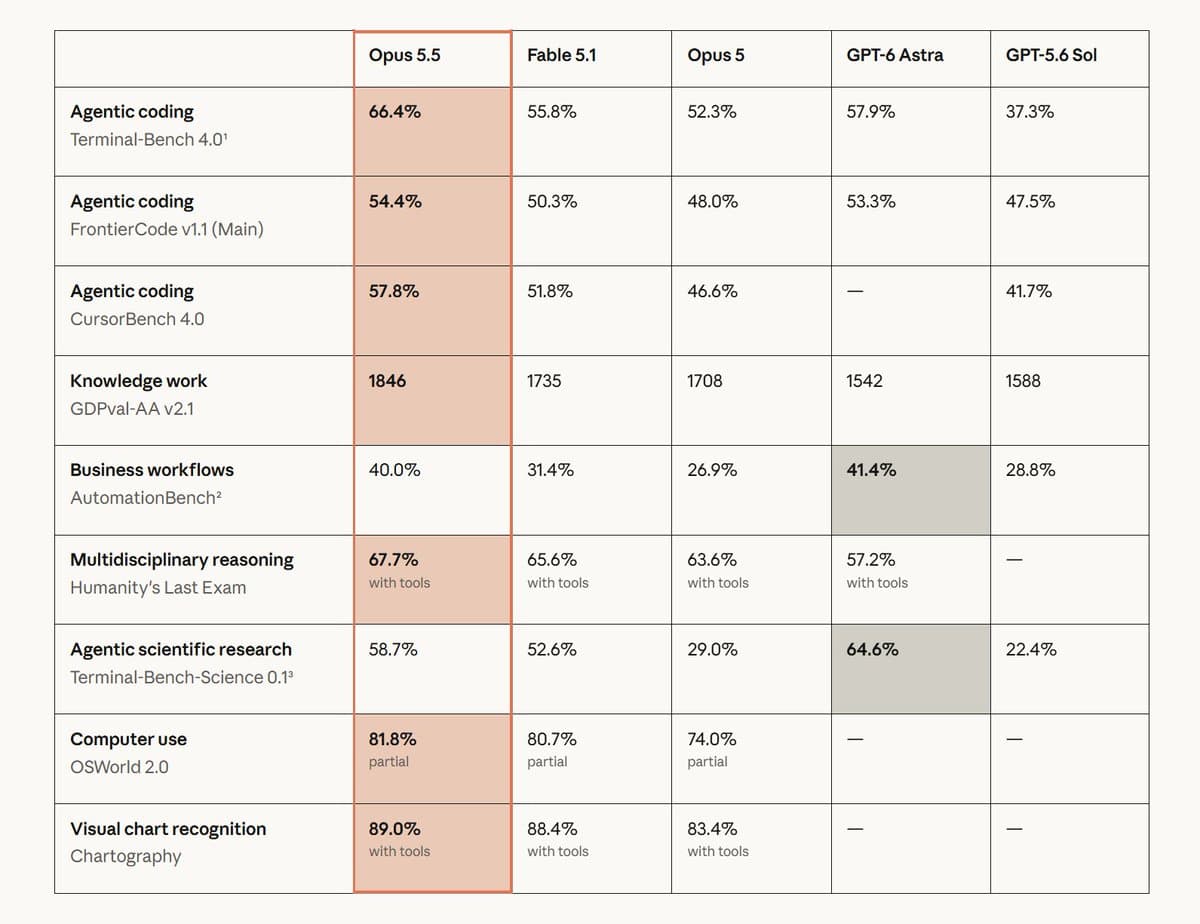
- Agentic terminal coding rose from 52.3% on Opus 5 to 66.4% on Opus 5.5, a +14.1-point claim in minchoi's benchmark post.
- Creative demos are already unusually broad: higgsfield_ai's Blender demo says the model built, rigged, textured, and animated a windmill in 15 minutes.
- Adaptive thinking is now always on, so ClaudeDevs' first-session tips explicitly tell users to drop “think carefully” from prompts.
The migration documentation lists four breaking API changes, including a retired computer-use tool. A Higgsfield build turned a house photo and floor plans into a Blender model with an X-ray browser viewer.
What shipped
- Pro, Max, and Team users get Opus 5.5 as the default in Claude Code, Claude, and Cowork, per _catwu's announcement.
- Claude Code's five-hour and weekly allowances both stretch 25% further, as _catwu's reply clarifies.
- The company added a banked reset that users can apply from Settings → Usage through October 22, according to LLMJunky's post.
- Some accounts still see Chat and Cowork as separate experiences because the merge remains in rollout, _catwu's rollout update says.
Benchmarks that moved
First-party
- Terminal-Bench 4.0: 52.3% → 66.4%, +14.1 points, in the benchmark table screenshot.
- FrontierCode v1.1 Main: 48.0% → 54.4%, +6.4 points, in the benchmark table screenshot.
- CursorBench 4.0: 46.6% → 57.8%, +11.2 points, in the benchmark table screenshot.
- GDPval-AA v2.1: 1,708 → 1,846, +138 Elo, in the benchmark table screenshot.
Third-party evaluators
- Pre-release evaluation: no public old-to-new score → no published delta, n/a, although Anthropic’s launch announcement names METR and Frontier Design as pre-release evaluators.
- Terminal-Bench’s public board: 58.2% Astra maximum → no Opus 5.5 row, not a comparable delta, according to an independent leaderboard check.
Customer-reported
- HAProxy C-to-Rust port: Fable 5.1 took 12 hours → Opus 5.5 took 9.5 hours, -2.5 hours, while both passed nearly all tests in bcherny's porting test.
- A 200,000-line audit-and-fix run: Opus 5 took 20+ hours → Opus 5.5 took under three, at least -17 hours, and used 2.5× fewer tokens in minchoi's quoted tester case.
Where it regressed
The migration has hard compatibility breaks. The platform documentation says callers can no longer disable thinking, forced tool choice now errors, thinking blocks cannot move between models or conversations, and computer_20251124 is rejected on the Anthropic API and Google Cloud.
The same document flags a quieter UI failure: at the default display setting, text between tool calls arrives in empty thinking blocks, so apps that streamed it as progress can appear silent.
In danshipper's testing, a knowledge-work run exceeded a 10-minute limit without a score. The same assessment found more legible prose than earlier Opus, but said its drafts still buried the main point and trailed Astra on writing tasks.
Anthropic’s 66.4% Terminal-Bench result also came from its own xhigh-effort setup; the public board had not posted an Opus 5.5 run when it was checked, as the independent analysis notes.
Under the hood
Opus 5.5 has a 1M-token context window, a 128K-token maximum output, and the claude-opus-5-5 model ID, according to the model overview.
Adaptive thinking is mandatory. effort now controls depth across low, medium, high, xhigh, and a session-only max setting, while trq212 describes the model as usable across every effort level.
For long agent runs, ClaudeDevs' launch thread says compaction summarizes older turns while retaining recent context. Fast mode reaches up to 2.5× speed at $8/$40 per million input/output tokens.
The claimed 40% task-cost reduction is broader than the 20% input/output list-price cut: the cost explainer prices cache reads at $0.20 per million and notes that thinking is billed as output. The model also routes flagged cyber, bio, and frontier-LLM-development requests to another model, ClaudeDevs' safeguards note says.
Vibe Check
- A personal-site experiment used Claude workflows to make successive redesigns, critique them, and cut the iterations into a trailer, as trq212 described.
- A formal-verification run produced 16 pull requests for bugs and race conditions in the Claude Agent SDK after a few short prompts, using Lean and, in some cases, TLA+, according to bcherny's verification report.
- A code-generated Golden Gate Bridge flyover led petergyang's 3D test to put Opus roughly level with Astra for building 3D scenes.
Where it shows up
- The GitHub Copilot changelog says Opus 5.5 is available for agentic coding, long-running tasks, and knowledge work. GitHub also says its text outputs are watermarked without token or price impact.
- minchoi's availability list names the API, AWS, Google Cloud, and Microsoft Azure as launch-day surfaces.
- Linear added Opus 5.5 alongside GPT-6 Sol and Luna to its coding sessions, linear's post says.
- Claude’s Slack entry point is part of the rollout material too: _catwu's Slack note links to ways to try Opus 5.5 with Claude Tag.
Higgsfield builds
Most creative evidence came from Higgsfield’s own launch-day demos, spanning asset generation, technical art, finishing, and sound.
- An exoskeleton redesign used 5.5 million tokens in a 39-minute one-shot run to analyze weak points and make a joint-level 3D Blender model, higgsfield_ai's exoskeleton demo says.
- A continuous JavaScript animation zoomed from a freckle to galaxies and back, with the visuals and transitions editable in code, in higgsfield_ai's zoom animation.
- A post-production demo used Photoshop and DaVinci Resolve Fusion to find and repair rendering errors in an AI-generated video, a process higgsfield_ai's cleanup demo says took minutes rather than hours of manual work.
- Another build created a browser-based interior design app that turns furniture photos into 3D objects, then renders views photorealistically with Seedream 5.0, according to higgsfield_ai's furniture-app demo.