
Claude Opus 5.5: creators build coded motion graphics
Creators are sharing coded animations, explainers, and music videos made with Claude Opus 5.5. Reports suggest the workflow works best with detailed prompts, reusable templates and assets, plus substantial steering and iteration.
TL;DR
- Code-first motion has become viable for compact, polished pieces: techhalla's 20-second brief specifies a loopable 60fps bumper down to its spring math, beat grid, type system, and render pre-pass.
- The reported one-shot output still rests on art direction and reference assets: MengTo's motion-design post says the work required steering, code references, and a library of 3D devices, effects, and templates.
- The workflow now reaches editable compositing: Higgsfield's motion-design announcement says its MCP can generate assets, animate a composition, render it, and return an After Effects project.
- Hybrid production remains visible in the strongest examples: Higgsfield's short-film notes used Blender previs for a difficult stunt, then image references for the final look.
Anthropic's Opus 5.5 launch note says context per request has grown 2.6x as developers connect more tools and skills. Higgsfield's production bundle lists 11 workflows across 3D, VFX, editing, and design, with scenes, layers, paths, timelines, and grades kept editable where possible.
A prompt as a production brief
techhalla's 20-second identity bumper reads like a miniature animation spec rather than a loose style request.
The brief locks down:
- Delivery: a 20-second, 1080-by-1080, 60fps HTML piece whose first and last frames match.
- Visual system: black, magenta, acid green, and white; three named type roles; no gradients, glassmorphism, or generic AI imagery.
- Narrative: six exact copy beats, from “STOP SCROLLING” to the final handle lockup.
- Motion mechanics: a pure
seek(t)function, closed-form springs, per-glyph stagger at 120 BPM, mask reveals, one orthographic camera, and four subframes of blended motion blur. - Quality control: eight stills exported before the full render to catch cramped type, orphan words, and contrast problems.
The reported run spent eight minutes planning, two installing dependencies and building HTML, then four autofixing and rendering.
Reference libraries and scoring loops
MengTo described a more directed route to the glossy 3D look: substantial steering and code references, plus an open-source library of device models, buttons, effects, and motion templates. The post says a URL or local project can supply the content to adapt, while an empty asset library tends toward generic output.
The same creator used a component-level quality loop on a coded river voyage. Opus scored the ship, water, landscapes, buildings, and their smaller parts, then kept improving them toward an 8-out-of-10 threshold within a time and token budget.
Two edit paths: After Effects and Remotion
Higgsfield's MCP presents a tool-connected route: generate images, logos, and graphics, build and animate a composition, render the video, then continue in an editable After Effects project.
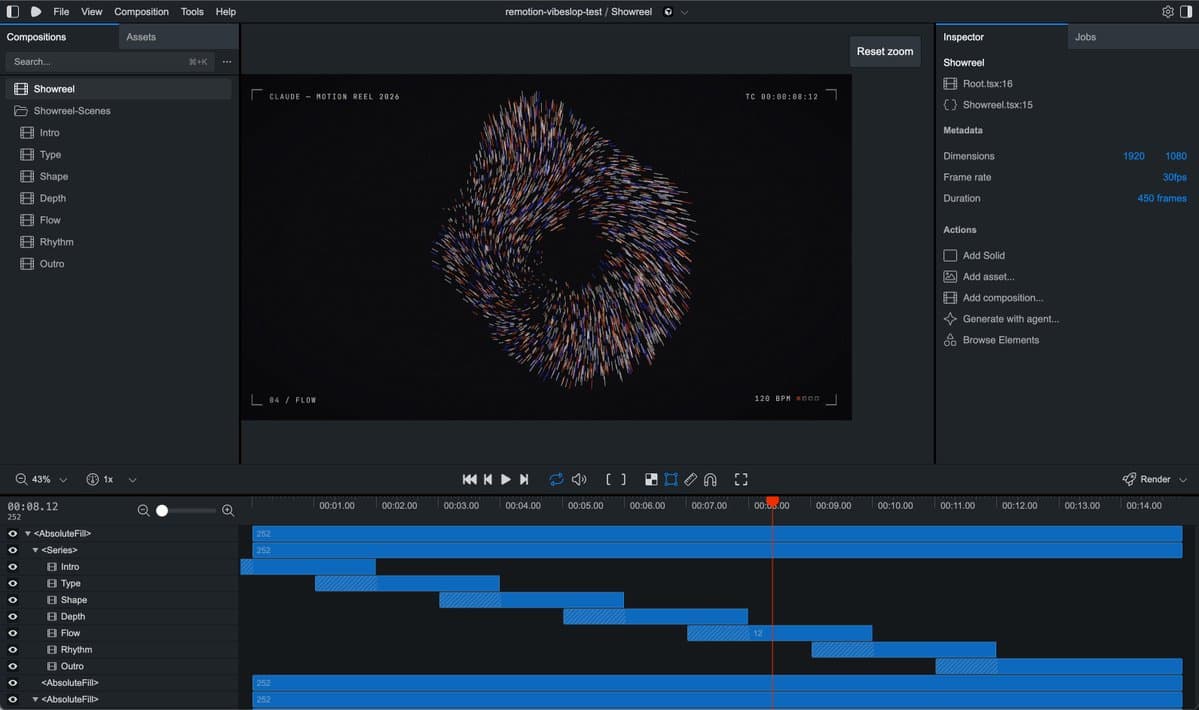
tequilafunks used a code-native alternative with Remotion. The model split a 15-second showreel into chapters and layered compositions; tequilafunks said the demo was mostly custom math, with Remotion supplying time, sequencing, interpolation, and easier later iteration.
The craft shows up in preproduction
In Higgsfield's Passport Rush breakdown, the team said its car chase ran to 18 scenes in three days. Its postmortem records four production choices:
- Storyboards came first, followed by character, prop, and location reference sheets for anything that needed to match between shots.
- A watercolor taxi stretched like a PNG once animated, so the team switched to a cleaner 3D car and kept the watercolor treatment in the backgrounds.
- The taxi's two-wheel squeeze between trucks was animated in Blender, where a gray preview established movement and camera before image references supplied the final look.
- The shared Claude prompt structure was: scene and style, what each reference is for, timed action, then constraints.
Code-generated sound and explainers
The motion work also extends into long explainers and fully synthesized scores. goodside said in a five-minute UMAP explainer that Claude supplied the visual concepts and narration after being prompted from Claude Code on a phone.
koldo2k's clock loop gives the corresponding sound brief: a 15-second square animation with a stick figure fighting the red second hand, plus code-synthesized ticks, impacts, a metallic clank, alarm bells, and a rewind. koldo2k's post reports the Opus 5.5 Extra run took 42 minutes.
The loop's prompt fixes the score at 96 BPM and exactly eight bars, matching 20 seconds of animation.