
Cody’s agent workflow reportedly makes UGC ads for about $5
Holmberg detailed Cody’s ad pipeline, from brand research to generation and review. The setup uses a shared data warehouse, constrained ad APIs and a vision-model check before ads go live.
TL;DR
- An AI-avatar test ad reportedly cost $4.75, compared with $300 to $500 for a UGC creator and motion designer, as detailed in the production walkthrough.
- One brand URL becomes five ad concepts and uploaded creatives in the static-ad workflow.
- The surrounding system separates production from oversight: agents query a shared data warehouse, while a vision-model review loop checks creative before it goes live.
Marketer Cody Schneider’s demo on The Startup Ideas Podcast offers the workflows as reusable skill files for Claude Code and other agent harnesses. Its finishing tool, Tesseract by Mirage, produces editable motion graphics and is free to use, with agent costs separate.
UGC ads for about $5
In shannholmberg’s account of the demonstration, Schneider’s test ad cost $4.75. The comparison was $300 to $500 for a UGC creator and a motion designer.
The production sequence has five stages:
- Script and voice: A script is written, then turned into a voice-cloned reading.
- Video generation: Seedance receives the audio, exact script and a reference image together to constrain the dialogue and appearance.
- Low-resolution rendering: Video is generated at 480p, then upscaled with FFmpeg. Schneider put the 1080p route at about $14 per video in his setup.
- Dialogue repair: Word-by-word transcription is compared with the script, and mispronounced words are replaced at their timestamps.
- Finishing: Tesseract adds captions and motion graphics.
The word-level repair pass is the standout detail.
Five static ads from one URL
The static-ad skill uses a brand’s website as its starting point:
- Brand extraction: Fonts and colors come from the website.
- Ad research: Existing brand ads come from the Meta Ad Library.
- Audience research: Reddit and social posts supply pain points and desired outcomes.
- Concepting: The agent proposes five concepts with headlines.
- Publishing: Generated creatives are uploaded to a new ad set.
More precise brand rules can come from a Markdown guidelines file, according to the static-ad walkthrough.
Four building blocks
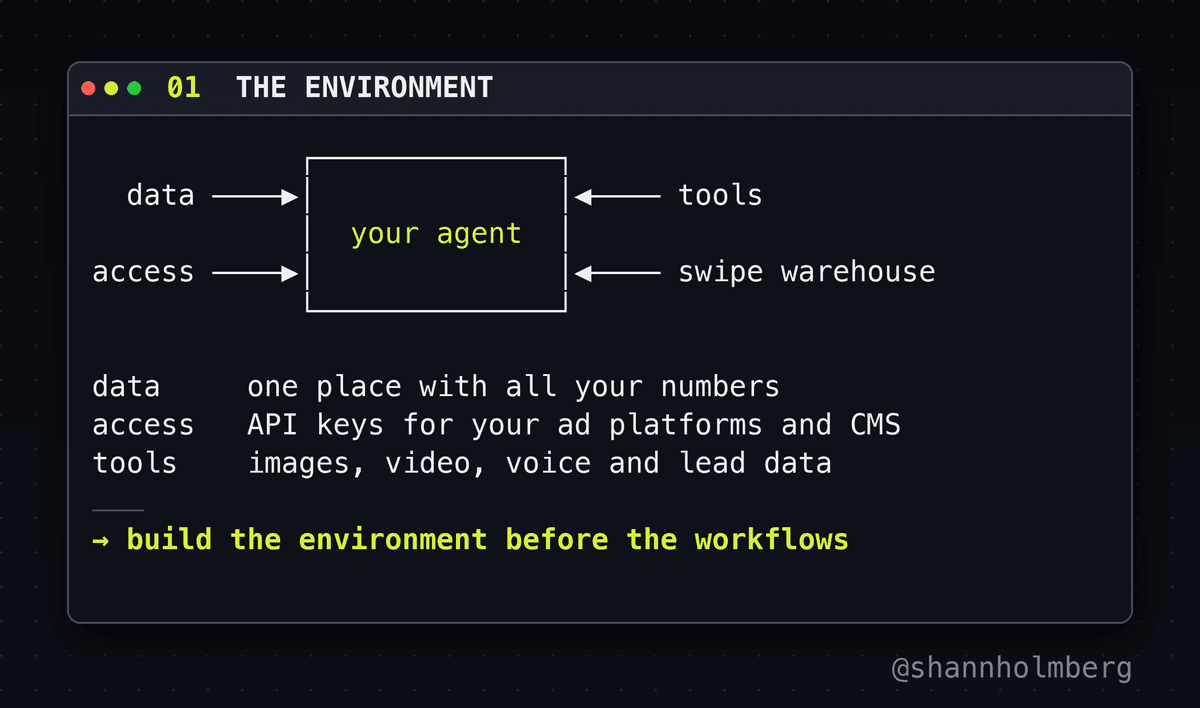
The setup begins with four prerequisites:
- Data: One place containing the business’s data.
- Access: Credentials for ad platforms and the CMS.
- Tools: APIs for generation, transcription and lead data.
- References: A growing swipe library of ads and other creative.
Schneider’s tool layer spans four services or categories:
- Kie AI: Image and video models behind one API.
- fal: Voice cloning and transcription.
- OpenRouter: Language models.
- A lead-data provider: Contact information.
Warehouse reads, platform writes
Airbyte handles ingestion into ClickHouse, the shared warehouse. Connecting the business’s data there lets the agent trace advertising through to revenue and customer lifetime value, according to the warehouse explanation.
Meta and Google Ads APIs handle changes such as uploading creative, turning ads off and moving them around. Performance reads come from the warehouse instead.
Schneider links account bans to agents flooding platform APIs with requests in the explanation of API access.
Vision-model review
Before an ad goes live, a vision model checks it against supplied rules, including prohibited claims in regulated markets. Failed ads return for changes; Schneider’s team reportedly usually needs two or three rounds.
An optional “creative director” agent can also score videos and show only those reaching 8/10.
Specialist ad agents
An early attempt to let one all-purpose agent run Facebook ads across several companies went badly, according to shannholmberg’s account. Schneider instead describes encoding a media buyer’s individual jobs in software, with a reasoning loop over current data.
His Google Ads example reportedly checks 5,000 search terms against a landing page in 20 seconds, evaluating whether the search intent fits before money is spent.
JSON prompts beside ad results
Schneider’s clients reportedly moved from 10 ads a month to 300, released in cohorts of 30.
Each generation prompt is saved as JSON alongside the ad’s results. That preserves the connection between performance and the script, avatar and hook used to make the creative.
Shared references and cloud hosting
Schneider names Sublime and Cosmos as places to collect creative references, giving agents and teammates a shared library of examples.
The deployment step moves the setup to the cloud so production can continue when the operator’s laptop is closed.