
Fable 5 creators ship app workflows with Benji v3 and GPT 5.5 subagents
Fable 5 appeared in creator workflows for scrollable story templates and Benji v3’s TanStack Router/Convex rewrite with GPT 5.5 subagents. A hidden-object build showed 100 mapped puzzles moving toward a playable site.
TL;DR
- MengTo's workflow post described a Fable 5 chain that starts with screen recording, turns it into a prompt, adds video generation, then specifies every scroll interaction, library choice, and storytelling beat.
- thekitze's Benji v3 post said the rewrite is using TanStack Router, Convex, and GPT 5.5 subagents, with every action now instant and synced across devices.
- GlennHasABeard's 100-puzzle update showed 100 hidden-object puzzles mapped, while his playable-site post showed the answer-zone tooling moving the puzzles toward a web game.
- LLMJunky's StarSwap run used Fable as planner and reviewer around GPT 5.5 High worktrees, reporting 40,000 lines of code in 96% of one 5-hour session.
- trq212's availability post said Fable comes off subscriptions after July 7, and shannholmberg's habits post framed it as a specialist model for the hardest slice of work.
Fable is showing up less like a chat box and more like a temporary creative operating system. The Fable prompt library packages overnight delegation and verification prompts, Higgsfield Explainer turns topics into faceless videos through Supercomputer, MCP, and CLI surfaces, and MotionSites is selling scroll-video hero prompts built around React, Tailwind, GSAP, and HLS.js. The strangest artifacts were personal: om_patel5's gear shifter post showed a physical shifter for Claude models, AIandDesign's SNES port reply said Fable nearly ported Rotatron to real SNES hardware, and thekitze's tooling audit screenshot found that most assistant time had gone into building tools that build tools.
Screen recording to prompt
MengTo described a production loop with three pieces:
- Screen recording to prompt.
- Video generation.
- A detailed Fable 5 prompt covering scroll interactions, libraries, and story flow section by section.
His punchline was not the output alone. He said the team's templates improved because Fable could handle ideas that would normally take days, which is the cleanest creator-read on the current Fable wave: the model is being judged by how much project shape it can hold at once.
Benji v3 rewrite
thekitze said the new Benji v3 rewrite is almost done with Fable 5 plus GPT 5.5 subagents, then posted the actual migration stack:
- Convex DB and auth.
- Better Auth.
- TanStack Start.
- shadcn with Base UI.
The four named problem areas were concrete:
- Date and timezone issues.
- Instant sync between devices.
- Optimistic UI.
- iOS and Android mobile app work.
That is Christmas come early for coding-agent nerds: less one-shot toy app, more multi-agent rewrite of a real personal operating system.
Hidden-object puzzles
GlennHasABeard mapped 100 puzzles, then showed the toolchain for turning static hidden-object illustrations into playable web assets. The screenshot includes selectable answer slots, a finger-friendly radius slider, clean JPEG export, marked-reference export, and an answer-key generator.
The workflow is small but sharp: make the puzzle art, mark answer zones, export web images, ship the interaction layer. That is the kind of creator pipeline Fable is making visible, not just the final demo.
Fable as brain, GPT 5.5 as hands
LLMJunky's StarSwap run is the clearest orchestration pattern in the evidence pool:
- Ask Fable for the 10 highest-impact product improvements.
- Pick 7 of them.
- Have Fable write independent plans into the repo.
- Delegate each plan to GPT 5.5 High through Codex Exec in separate worktrees.
- Bring Fable back to review, validate, and fix each result.
- Parallelize tasks that do not depend on ordering.
- Merge the worktrees into main and resolve conflicts.
The run reported 40,000 lines of code and 96% of a single 5-hour Claude Pro session. LLMJunky's follow-up called the plans entry-level once scoped, which is exactly why the pattern spread: the hard part was decomposition, not hero coding.
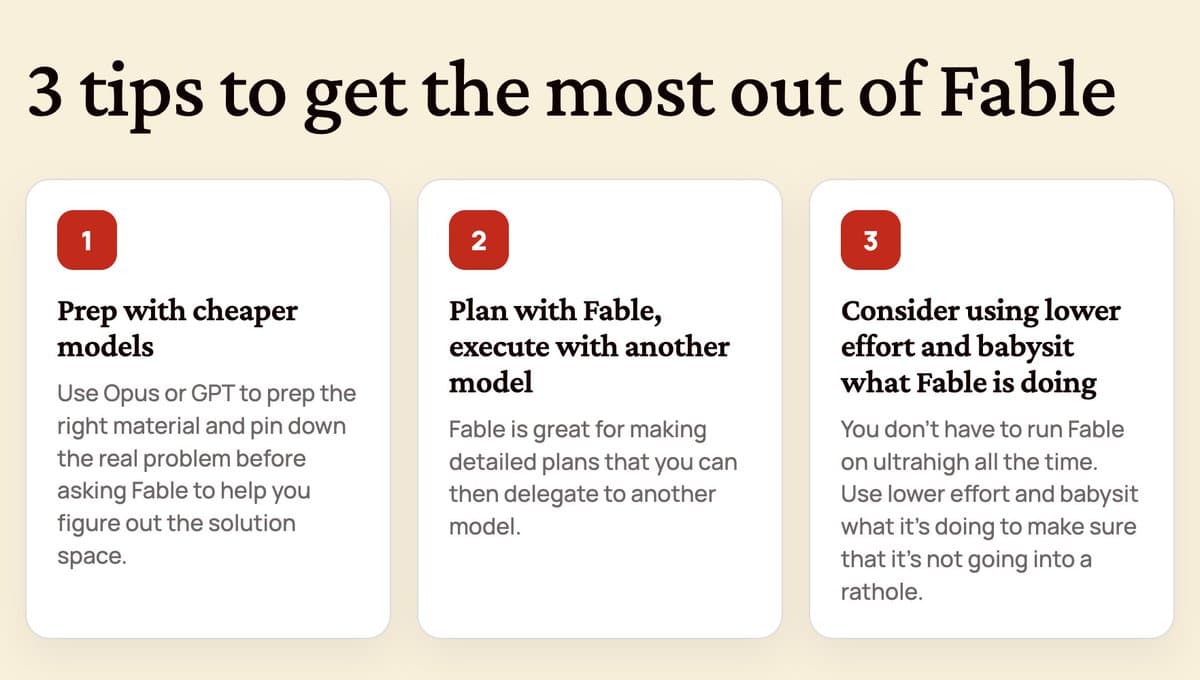
AIandDesign's architect-coder workflow described a similar split: Fable as architect, Opus or GPT-5.5 as coders, Fable as reviewer, then cheaper models as fixers. AIandDesign's follow-up called that a way to get Fable-quality output while spending less on build execution.
Cinematic website prompts
viktoroddy posted a full prompt for a scroll-driven hero page, and it reads more like a production spec than a vibe prompt.
The core blocks:
- Scroll-scrubbed background video.
- Floating text that animates out on scroll.
- Pill navigation with hover motion and mobile hamburger fallback.
- A glass panel sliding up from below.
- Bottom marquee with repeated brand names.
The implementation stack:
- React 19, TypeScript, Vite.
- Tailwind CSS v4.
- GSAP with ScrollTrigger and ScrollToPlugin.
- HLS.js for streamed video.
- lucide-react, motion, and react-router-dom.
MengTo's separate landing-page post said Fable understood WebGL, scroll behaviors, and text animations with simple prompts, while MengTo's prompt-detail reply said the best prompts were short enough that the model could infer the animation system without being overdescribed.
Camera paths and 4D reconstruction
Bilawal Sidhu's IronSight fused footage from two pairs of Meta Ray-Bans into a 4D reconstruction. Sidhu's glasses reply said the footage was all from the Meta glasses, and his primitives reply said he queued experiments overnight, selected primitives, then spent a few hours building.
The adjacent Higgsfield example used Fable 5 inside Supercomputer for a creator app that blocks 3D scenes, records a real cinema camera move, and renders the result through Seedance 2.0. The useful detail is the clay pass: a 15-second rough scene carries camera trajectory, timing, and framing that a text prompt keeps losing.
Higgsfield's Explainer launch pushed the same pattern into faceless documentaries: auto-research the topic, narrate in any language, and render up to 10 minutes in one run.
Dyslexia tutors and screenplay evals
AIandDesign showed a pre-alpha dyslexia tutor for children, with drag-and-drop letter exercises and phonics matching. AIandDesign's curriculum reply said a professional dyslexia specialist checks the curriculum files, and AIandDesign's Cursor-credit reply said the app was being built in Cursor with Fable and other models.
rainisto used Fable on BeatBandit, a screenplay tool, through an MCP workflow. The system generated a screenplay from a premise, ran separate reviewer agents to score the work, inspected how story beats became scene lists, treatments, and scripts, then found bugs, prompt changes, missing story elements, and values to tune.
The follow-up screenshot reported a measured improvement: non-repetition moved from 5.05 to 6.75, structural variety from 5.2 to 6.7, macro AI feel from 4.9 to 6.6, escalation from 6.85 to 7.55, and watchability from 6.8 to 7.65.
Subscription window and token burn
The economics kept interrupting the demos. gregisenberg said Fable 5 was included only through July 7, then moved to pay-per-use credits at $10 per million input tokens and $50 per million output tokens, with usage drawing down roughly twice as fast as Opus and only up to 50% of the weekly limit.
trq212 said Anthropic aims to restore Fable as a standard part of subscriptions once capacity allows, and the Anthropic Fable post described the rollout as staged because demand was hard to predict.
The usage hacks became their own genre. shannholmberg's six habits were: give the why, say what not to do, let it act instead of over-planning, force verification, say less, and avoid asking it to reveal reasoning because that can trigger a reroute. danshipper's benchmark reply added that Fable can fall back to Opus 4.8, so some benchmark results measure a mix of Fable and Opus.
The rough edges were visible too. thekitze's token-burn post said Fable was eating tokens even with subagents, AIandDesign's bad-night post called one session disappointing, and LLMJunky's ugly-website post showed a first try he later compared unfavorably with GPT 5.5 High.