
InVideo Agent One claims 20-minute ad builds from one product image
Creators showed Agent One generating a 30-second commercial from one instruction and one product image, while another thread used it to build a film bible, storyboards, assets, and animation setup. The posts describe automation across voice, music, scenes, and edits, with final assembly still cleaned up in Premiere.
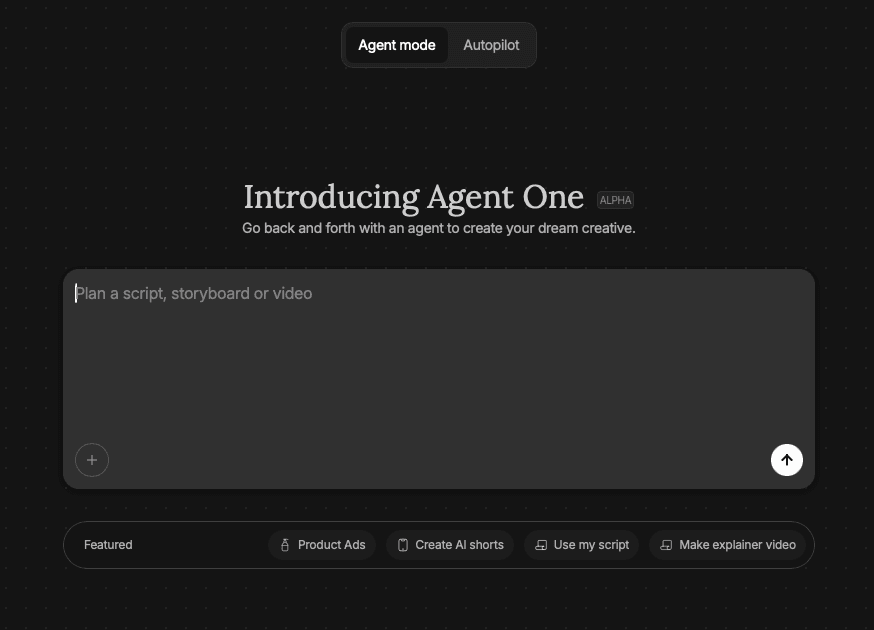
TL;DR
- CharaspowerAI's demo thread claims InVideo's Agent One produced a 30-second commercial in under 20 minutes from one instruction and one product image.
- In CharaspowerAI's workflow breakdown, the creator says the agent handled shots, visuals, voice-over, audio, and editing autonomously.
- Uncanny_Harry's production thread describes a different flow: Agent One read a script, asked questions, identified characters and props, and assembled a film bible before moving into storyboards and assets.
- According to Uncanny_Harry's animation post, the system can either pick models itself or let the creator choose them, and it leaves room for manual shot control.
- Uncanny_Harry's Premiere handoff and AIandDesign's early access note suggest the product is showing up in creator workflows before full public saturation, with one paid residency example in carolletta's post.
You can see the finished 30-second ad in CharaspowerAI's demo, a longer AI short called "Clickbait" in Uncanny_Harry's thread, and a separate branded film in carolletta's final video. InVideo's public site already places InVideo in the browser-first video creation market, but these threads are more interesting for the workflow details: a script-reading pre-production agent in Uncanny_Harry's post, automatic model switching when moderation blocks an image in the storyboard post, and a manual breakout path for precise shot control in the animation post.
20-minute commercial
The sharpest claim in the evidence pool is simple: one creator says Agent One turned a single product image plus one instruction into a 30-second commercial in under 20 minutes, then generated the video, voice-over, music, sound design, and edit without a custom workflow setup.
CharaspowerAI's thread breaks the handoff into five autonomous outputs:
- Shots
- Visuals
- Voice-over
- Audio
- Editing
That is Christmas-come-early framing for solo ad makers, because the compression is not just image-to-video. It is brief-to-finished-spot, at least in the example CharaspowerAI posted.
Film bible
A second thread fills in what the black box is doing before image generation. Uncanny_Harry says the first agent they used was a pre-production agent that read an existing script, asked follow-up questions about style and look, identified characters, locations, and props, then assembled a visual bible for the film.
The interesting part is the memory behavior. In Uncanny_Harry's post, the creator says the agent caught mismatches between requested character details and generated images, then reinforced its own prompt and tried again.
Storyboards and model switching
Once the bible existed, Uncanny_Harry says Agent One used it to generate final assets and storyboard images while keeping track of recurring characters and props. That removes one of the most annoying parts of current multimodal workflows, constant re-uploading of reference images.
Two mechanics stand out in the thread:
- When an image model refused a generation for moderation reasons, the agent switched to a different model that would produce it, according to Uncanny_Harry's storyboard post.
- During animation, the creator could either specify a model manually or let the agent choose what it thought was best, according to the animation post.
- A separate breakout page supported an "old school" manual workflow for shots that needed tighter human control, per the same post.
That makes Agent One look less like a single-model generator and more like an orchestration layer over multiple models and production steps.
Premiere handoff
The film thread does not end inside InVideo. Uncanny_Harry says the final assembly happened in Adobe Premiere, and the strongest practical detail is not aesthetic, it is operational: after a PC crash and clean reinstall, they were able to rebuild the project because the media was easy to search and re-download.
That thread also cuts against the fully closed-box narrative. In Uncanny_Harry's post, Agent One sits inside a hybrid workflow where the agent handles planning, assets, and animation setup, while a traditional NLE still does the final editorial pass.
Access and early creator rollout
The access pattern in the evidence suggests an early creator rollout rather than a cold public commodity tool drop. AIandDesign says they were already using Agent One as a "CPP member," while carolletta's "Sarah's Kitchen" post explicitly says the film was part of a paid partnership and InVideo Creative Residency.
Those posts add two concrete rollout facts that do not show up in the splashy demo thread:
- Some usage appears to be happening through an access program, per AIandDesign's post.
- At least one showcase video was sponsored, per carolletta's disclosure.
- The residency example still makes the same broad product claim, that Agent One handled scene creation, script beats, visuals, voiceover, sound design, and editing from prompt to final frame, according to carolletta's post.