
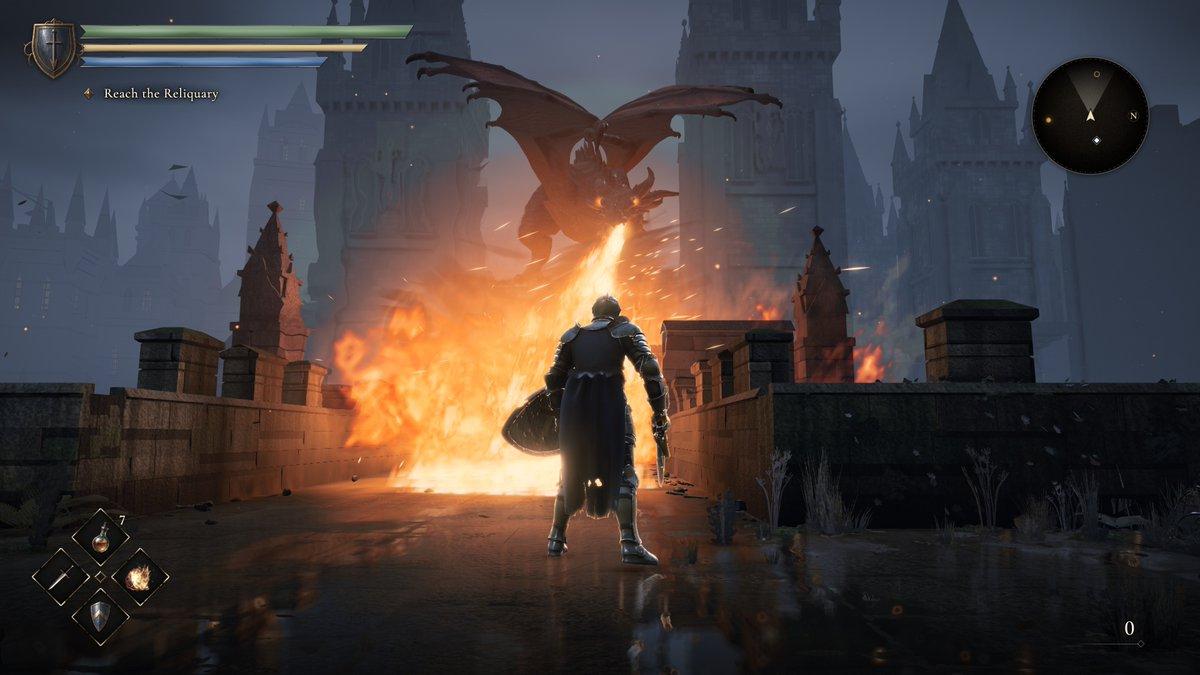
MengTo says he built a Dark Souls-inspired browser game in 3 days
MengTo reports building the Three.js game in three days with Fable 5.2, parallel Claude Code agents and generated 3D assets. He used blind screenshot judging, and the demo video shows a scripted bot rather than manual play.
TL;DR
- A Dark Souls-inspired Three.js demo took three days to build, according to MengTo, and runs in a browser without a build step.
- Up to nine coding threads worked in parallel, each owning its files, in his production workflow.
- Visual edits faced blind 4K comparisons; MengTo says full judging rounds used the lower of two scores.
- The showcase uses a scripted bot and staged scenes, MengTo disclosed, while strict judges still rated most of the work 5 to 6 out of 10.
The dream-loop repository even allows an agent to generate a better visual target after improving the scene. One of MengTo's actual prompts ends with a plea about the boss's attack effects: “come on please. i asked many times”.
Six hours to a playable boss
MengTo calls the result a playable demo. The first playable level and boss took six hours and 12 prompts, according to his account of the initial build.
That first instruction used three reusable skills:
dream-loop, by @anshuc.workflow-score-to-target.design-action-combat.
The latter two are in his public Skills repository.
Nine agents with separate files
Fable 5.2 coordinated up to nine Opus 5.5 side threads in Claude Code, each owning its files. Threads were assigned by area:
- Lighting.
- Effects.
- Characters.
- Props.
- UI.
- Sound.
29 models, agent-written rigs
The game's 29 generated models followed a three-step asset pipeline:
- Seedream 5.0 Pro generated a concept in a strict A-pose against grey.
- Tripo 3D converted the image into a GLB model.
- The agent wrote the rig and animations in code because the models arrived unrigged.
Every prompt and asset was recorded on a Fil canvas. The service currently lists access as invite-only.
Fixed-camera dream targets
Seedream repainted a game screenshot into a better-rendered target, preserving four things in MengTo's instructions:
- Camera.
- Framing.
- Layout.
- Pose.
The agents then worked toward that image. Environmental props also used free CC0 scans from Poly Haven.
Blind 4K comparisons
Every visual change faced a pleasingly unforgiving review loop:
- Capture 4K before-and-after images from the same camera.
- Shuffle them as X and Y for a fresh judge.
- Keep only wins or ties.
- For full rounds, use two judges and a rubric out of 10. Take the lower score, with a target of 9.
His published scoring skill also calls for scoring each item separately against a named benchmark.
Four UI prompts
MengTo published four prompts from the UI work:
- “Give me a UI concept for the bottom bars as well, for the entire UI of the game”
- “Build it”
- “use more border gradients/uneven/shadowy/noisy”
- “generate transparent pngs for these icons”
Seedream supplied the icons as transparent PNGs.
Sound from a library
Audio used his Seerveil library alongside Earshot, according to MengTo. Earshot runs locally on CPU and can rank candidate sounds against a written description.
He was less impressed with agents' synthetic procedural sound design.
Eight tries at walking and running
Walking and running took at least eight tries, MengTo said, speculating that using medium effort might have contributed.
Scripted video and demo limits
MengTo said strict judges still scored most of the work 5 to 6 out of 10. The showcase was driven by a scripted bot, with every scene set up.
- Loading: he reported waits longer than 10 seconds.
- Performance: he reported 60fps on an M5 Max.
- Demonstration: he also said he couldn't show a demo because his computer was “always busy creating”.
A sub-10 MB Sakura shooter
An earlier Three.js experiment became a Japanese-inspired FPS, as MengTo described in his earlier game thread:
- Package: an HTML file under 10 MB, with no image or model files.
- Build time: a few hours, he said.
- Foundation: his existing Sakura Valley scene; he said existing Three.js work could be reused.
His comment on realism was blunt: “not everything has to be ultra realistic”. His resource list also links ThreeUI, a Three.js component library.
The Japanese-inspired FPS built on the Sakura Valley scene
A 13-stage Blender cafe
Blender is becoming “a big part of my workflow”, MengTo said. He also shared Kamome Ashizawa's separate cafe-building workflow, using Opus 5.5 and Blender MCP:
- References: three images and a short backstory.
- Harness:
CLAUDE.mdplus subagents for planning, modeling, rendering and visual checks. - Construction: 13 stages, each rendered from the reference angle for comparison.
- Assets: no downloaded models, textures or HDRIs.
- Photoreal polish: light and color first, followed by materials, shapes and lived-in detail.
Ashizawa caught a cup clipping into a windowsill after the AI's visual inspector had reported no problem. Claude then checked 326 props and fixed 45 intersections, Ashizawa wrote.