
OpenClaw adds Discord thread cron nudges with lossless-claw memory settings
OpenClaw users shared Discord cron nudges, memory-role explanations, and a creator system for research, scripting, scheduling, and analytics. Try it if you want agent automation with tighter control over memory behavior.
TL;DR
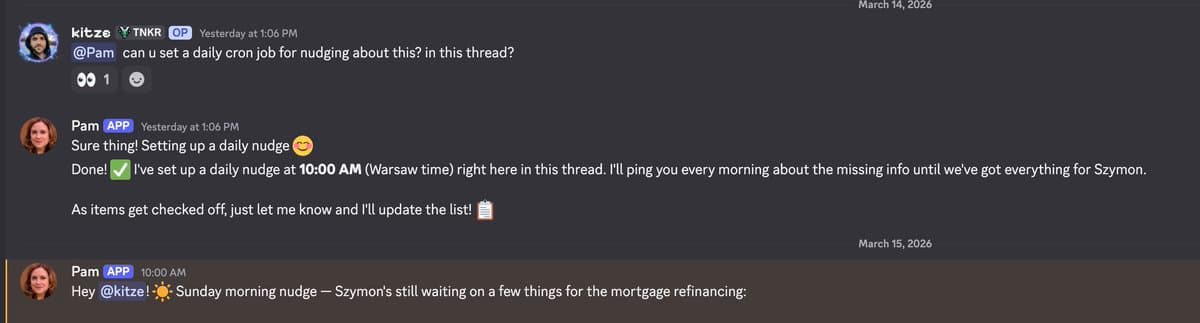
- OpenClaw users are showing a Discord setup that can route an agent’s scheduled message to the right server, channel, agent, and thread; the demo post shows a daily mortgage-refinancing nudge landing in-thread at the scheduled time.
- A second OpenClaw post clarifies the platform’s memory stack: according to the memory explainer,
lossless-clawhandles conversation recall, while QMD is for searching notes, files, and other knowledge sources. - One creator says an OpenClaw workflow now covers idea finding, research, script writing, scheduling, analytics, and feedback loops; the workflow post frames it as a system for keeping video production structured rather than fully hands-off.
- OpenClaw’s pitch is clearly shifting toward a friendlier layer on top of agent workflows: one reaction post contrasts its “grandma-friendly” UX with the terminal-heavy approach that teaches more but is harder to operate.
What shipped
The clearest new proof point is Discord-thread automation. In the demo post, a user says a cron job inside a multi-agent OpenClaw Discord setup correctly hit the intended server, channel, agent, and thread, then screenshots the result: an agent named Pam confirms a daily 10:00 AM Warsaw-time reminder and delivers it the next morning inside the same thread.
The more technical update is about memory behavior. The memory explainer separates two jobs that are easy to blur together: lossless-claw is the session context engine for “remember the conversation,” while QMD is the retrieval backend for searching notes and files. The recommended setup in that post is concrete: keep lossless-claw on, and if the goal is only better chat memory, turn off memory.qmd.sessions.enabled.
How creators are using it
A creator-focused use case is emerging around content operations. In the workflow post, Moritz Kremb describes an OpenClaw system for finding ideas, doing research, planning content, writing scripts, scheduling posts, reading analytics, and feeding those results back into the process. He claims it saves more than 12 hours a week and pairs the post with a service page offering OpenClaw-based implementations for businesses.
That positioning matches the broader reaction around the tool’s interface. One opinionated post argues that OpenClaw makes agent deployment dramatically easier than terminal-first tooling, even while criticizing that ease for hiding some of the underlying learning. For creative teams, that tension is the story: OpenClaw looks less like a raw coding environment and more like an orchestration layer for recurring, semi-structured production work.