
Seedance 2 supports Midjourney, GPT Image 2, and Agent One pipeline workflows
Creators shared repeatable pipelines pairing Seedance 2 with Midjourney, GPT Image 2, Nano Banana, custom editors, and Agent One for shorts, UGC, and story clips. The examples focus on shot planning, asset prep, and post steps, so creators can build finished outputs instead of one-off generations.
TL;DR
- Across this weekend's creator demos, Seedance 2 showed up less as a standalone generator and more as the motion layer in multi-tool stacks, with MayorKingAI's storyboard-to-short demo, ProperPrompter's Firefly workflow, and DavidmComfort's Agent One test all feeding it prebuilt assets or shot plans.
- The dominant pattern was image model first, video model second: Artedeingenio's short, 0xInk_'s knight piece, and Artedeingenio's Vampirella clip paired Midjourney with Seedance, while MayorKingAI and CharaspowerAI's 20-minute thread used GPT Image 2 to build boards, props, or scene references before animation.
- Several creators treated storyboards as the control layer, with ProperPrompter's thread arguing that lower-detail previs boards reduce inconsistency, while rainisto's BeatBandit experiment used blurred blocking, character refs, and auto-generated shot prompts to keep dialogue scenes manageable.
- Agent wrappers are already forming around the model: DavidmComfort's first Agent One post, a follow-up Agent One test, and The Last Bookshop clip all used InVideo's Agent One to generate or organize story structure around Seedance renders.
- The workflow is not frictionless yet, according to DavidmComfort's multi-shot note, DavizCF7777's queue-time complaint, and AllarHaltsonen's quality complaint, who separately flagged trouble with long multi-shot generations, 40-minute Runway queues, and weaker prompt adherence.
You can jump from Adobe's GPT Image 2 guide to Leonardo's app, watch a Mac editor route Seedance into DreamCut, and the workflow tweets keep converging on the same trick: use boards, references, and asset sheets to tell the video model what kind of scene it is supposed to finish.
Midjourney became the lookdev layer
The cleanest Seedance pattern in the evidence pool is Midjourney for style and Seedance for motion. Artedeingenio's stop-motion short, the tram animation, the later Vampirella clip, and an earlier Vampirella test all follow that template.
0xInk_'s thread makes the pipeline more explicit by showing static concept art alongside the final motion piece. The stills act like production art, then Seedance handles camera movement, action timing, and scene continuity.
Other creators pushed the same structure into fashion and character work. ai_artworkgen's Morning Physics post says the results came from building characters, outfits, and environments across image and video stages with Nano Banana Pro plus Seedance, and their earlier fashion thread adds a prompt tip for multi-angle tracking shots.
GPT Image 2 became the planning layer
The GPT Image 2 stack is more procedural. Instead of generating a hero frame and hoping the video model figures it out, creators are using image models to pre-bake scene grammar.
MayorKingAI's storyboard prompt lays out a 9-panel sheet with timecodes, shot types, camera moves, character sheet, and palette. the matching Seedance prompt then mirrors that board with a shot-by-shot timeline.
ProperPrompter's workflow breaks the same idea into reusable parts:
- Character turnaround sheet
- Loose storyboard with movement and camera choreography
- Claude-written shot list based on those images
- Seedance prompt with timings, framing, environment, and action beats
ProperPrompter's strongest claim is that less detailed storyboards work better. Their thread says minimal stick-figure previs led to fewer inconsistencies and gave the video model more room to adapt scene details.
Asset sheets turned prompts into production packets
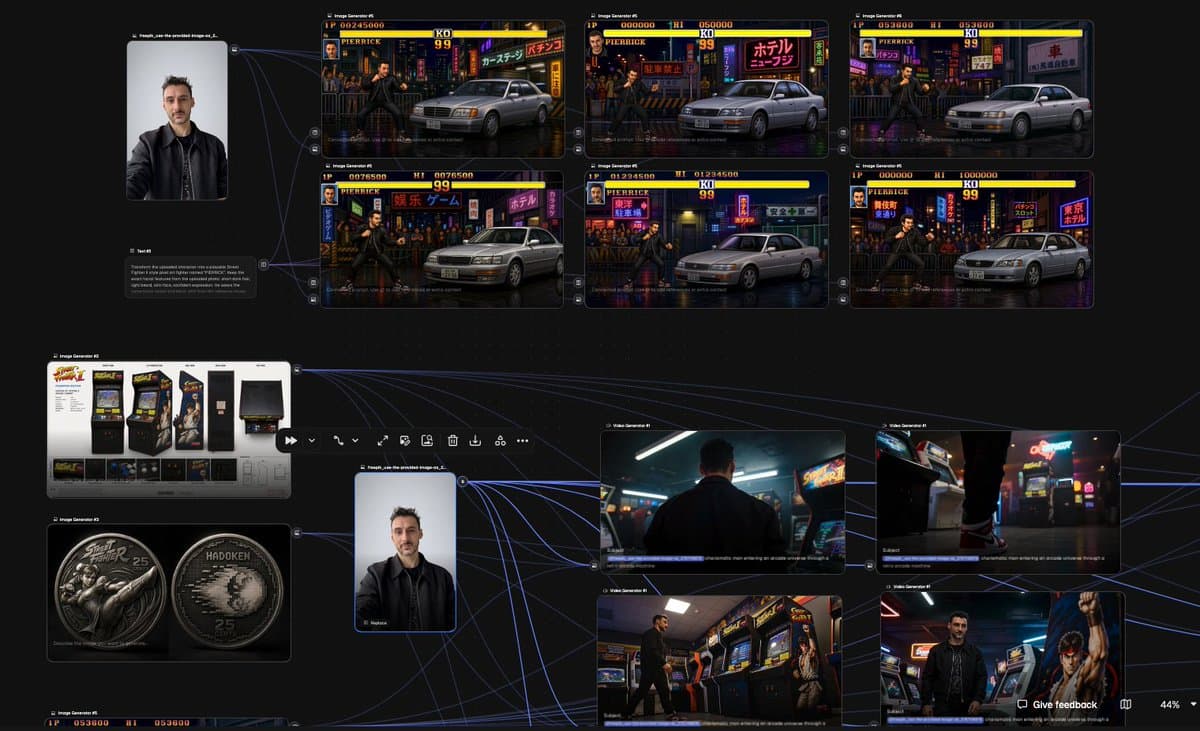
The most literal production pipeline in the evidence pool came from CharaspowerAI's thread, which treated Seedance as only one stage in a four-step packet:
- Create a workspace in Magnific to keep assets, prompts, generations, and references together.
- Generate the main object sheet in GPT Image 2, in this case a Street Fighter II arcade cabinet with multiple angles.
- Generate secondary props, here a themed coin.
- Build a final scene reference before sending the combined inputs to Seedance.
From there, the first Seedance pass animates the entrance into the arcade world, and the follow-up pass handles the bonus-stage fight scene. The wrap-up post says the value was keeping every asset and iteration inside one space with access to multiple image and video models.
That same packet logic shows up elsewhere. MayorKingAI's later post calls the first artifact a production plan sheet, then cuts to the cinematic output. MengTo's DreamCut demo routes Seedance footage into a Mac editor that auto-zooms, cleans audio, captions, and packages UGC-style videos.
Agent wrappers started doing the assembly
The next layer up is agent software that builds the scaffolding around Seedance. DavidmComfort's first Agent One post says InVideo's Agent One can create the storyboard and use it as guidance for a Seedance clip, which is the same manual process other creators were posting, but wrapped in one tool.
The follow-ups show how that behaves in practice. one Agent One test and another storyboard-driven dog clip keep the basic storyboard-plus-render loop, while The Last Bookshop turns it toward a short-film sequence instead of a single spectacle shot.
The useful part is the failure analysis. DavidmComfort's later note says asking Seedance for a whole multi-shot sequence in one generation was too much, so he shifted to a split structure:
- 3-second, 2-panel shot pairs for reveals, match cuts, and emotional beats
- 5 to 7-second, 3-panel flow generations for sections where camera continuity matters more than cut precision
That is the most concrete editing heuristic in the whole evidence set.
The prompts got more cinematic, and more modular
Many of the strongest posts read like shot lists, not descriptors. AllaAisling's nano-capsule prompt specifies trajectory continuity, connected camera perspectives, and a single motion path through an alien megastructure. the collapsing-bridge prompt does the same for forward-only action and a gap jump, and the cyber ronin prompt uses a match cut, slow-motion burst, and hard-cut final frame.
The structure repeats across creators:
- Subject or hero element
- Action arc
- Camera behavior
- Scene constraints
- Style reference
- Timeline broken into beats or seconds
AllaAisling's comparison post even turns one prompt into a model bake-off between Seedance 2 and HappyHorse. CharaspowerAI's lion prompt and the electric fighter prompt push the same modular format into effects-heavy action.
The friction points were already visible
Not every creator post was a victory lap. rainisto's Cold Comfort scene focuses on two people talking in a car, then the follow-up notes list unresolved problems: consistent voices, consistent color across shots, and believable backgrounds through car windows.
Distribution friction showed up too. DavizCF7777's Runway complaint says Seedance 2 queue times in Runway's unlimited mode were hitting about 40 minutes. AllarHaltsonen separately asked whether the model had been nerfed, citing worse prompt adherence and weaker motion, especially with real humans.
The custom-tool posts hint at the workaround. DreamCut, Agent One, BeatBandit, and Leonardo all exist to reduce the amount of raw prompting a creator has to do at once. Seedance is the renderer in those stacks, but the real story this weekend was the harness around it.