
Creators pair Seedream 5.0 Pro stills with Seedance 2.0 video
Higgsfield and other creators paired Seedream 5.0 Pro stills with Seedance 2.0 for anime, manga, motion design, and nostalgic film looks. Tests focus on color grading, subject reference, and storyboard-to-motion handoff.
TL;DR
- Creators are using Seedream 5.0 Pro as the still-image front end and Seedance 2.0 as the motion pass, with Higgsfield showing a manga-to-video pipeline in Higgsfield's pipeline clip.
- The practical Seedream upgrade is control: exact color values, coordinate edits, style transfer, transparent-background extraction, and 14-language in-image text show up across underwoodxie96's editing test and Magnific's availability post.
- The strongest Seedance workflows are stacks, not one-shot prompts: audio sync, storyboards, style references, upscaling, grain, and agentic preprocessing appear in techhalla's guitar workflow, DavidmComfort's lip-sync test, and hellorob's Comfy MCP run.
- Access broadened across creator tools, with Magnific's unlimited 1.5K offer in Magnific's post, Runway's rollout in Runway's post, Pika's MCP integration in Pika's post, and Seedance 2.0 Mini in Luma via Luma's post.
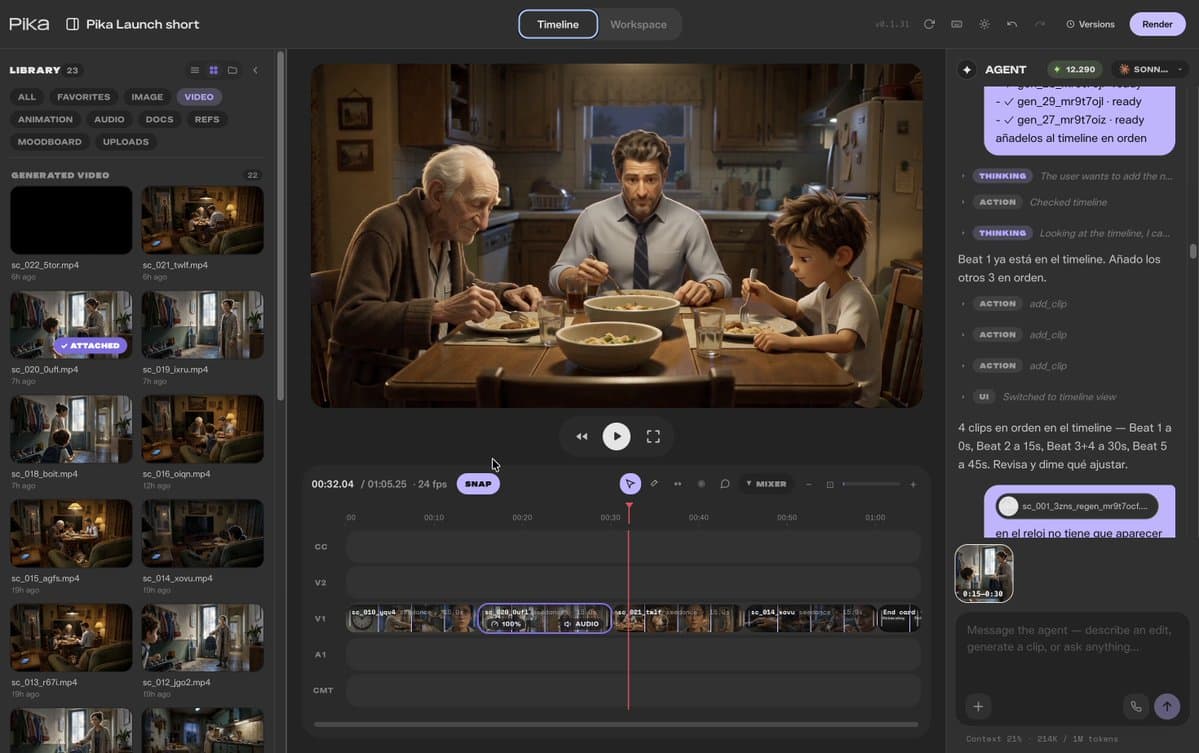
Magnific's availability post says Seedream 5.0 Pro is unlimited at 1.5K for a month, with 2K available through credits. underwoodxie96's editing test used the exact hex color #F67230 to change a shirt, then followed with transparent-background extraction. DavidmComfort priced a six-step filmic hero-shot chain at about $6.40 per 4-second shot in his pipeline breakdown. Pika's Director's Suite is piloted by a user's own Claude account, according to koldo2k's workflow screenshot.
Still-to-motion handoff
Seedream gives the frame, Seedance supplies the shot. That handoff is the useful creative pattern in the pile.
In Higgsfield's pipeline clip, the workflow is blunt: generate manga in Seedream 5.0 Pro, then upload the result to Seedance 2.0. Higgsfield repeated the same pairing for anime, calling Seedream plus Seedance a "perfect duo" in its motion-design post and showing another anime pass in its Higgsfield demo.
A separate Higgsfield comparison used Seedream 5.0 Pro and GPT Images 2.0 as competing inputs to Seedance 2.0. The test frames the still model as a casting and art-direction choice before motion begins.
Controllable stills
underwoodxie96's summary listed four upgrades that matter for design work:
- Precise edits with color values and coordinates.
- More realistic portrait generation.
- Stronger style transfer and reasoning.
- Layer separation with transparent-background output.
Magnific's availability post added three production-facing claims: native text in 14 languages, full infographics in one go, and precision editing inside a design workflow. Runway made a matching text claim in its rollout post, saying Seedream 5.0 Pro can generate detailed images from a prompt or reference with legible in-image text in up to 14 languages.
Reference control
Magnific used one Seedream generation to place a full-size subject and a 15cm clone in the same frame. In Magnific's follow-up, the details it called out were freckles, a bead necklace, a metro setting, and "zero identity drift."
Subject reference also became its own test surface. Chris First tested Seedream 5 Pro's Subject Reference inside Magnific in his subject-reference post, while HalimAlrasihi's reference note argued that Seedance 2 understands composition, blocking, and references well when creators prompt around specific keyframes.
Camcorder realism recipes
Creators kept reaching for fake archival footage because Seedance handles low-fi motion language well: shake, bad autofocus, exposure drift, blur, and ugly cuts.
- Giza: techhalla's pyramid prompt framed the build site as early-2000s DV footage, with workers hauling limestone blocks, dust, rope strain, and natural sound only.
- Wright brothers: techhalla's Kitty Hawk post used a shaky home-video setup with wind, spectators, sand, autofocus hunting, and no music.
- Second Temple: techhalla's prompt text staged the scene as chaotic handheld camcorder footage with Latin and Aramaic shouting, fires, collapsing stone, and uncontrolled framing.
- 1990s Spain: Magnific's memory prompt specified Hi8 and VHS-C,
PLAY,SP,AGO. 15, 1995, sun-faded tones, imperfect focus, and raw documentary realism.
The trick is period-specific camera failure. The prompts are not just asking for old footage, they are naming the defects that sell it.
Prompt templates
Magnific turned its 3D toy clips into two reusable structures.
For start images, Magnific's image structure used:
- Style.
- Character plus one defining detail.
- Pose.
- Setting.
For video, Magnific's animation structure used:
- Animate this glossy 3D toy character.
- One clear action.
- Facial expression.
- Camera movement.
- Style lock.
techhalla's train-yard action prompt used a stricter 15-second timeline: 0 to 3 seconds for a running derailment, 3 to 7 seconds for frozen destruction, and 7 to 15 seconds for motion resuming as the character escapes debris.
Audio and lip-sync stacks
techhalla's guitar workflow started with a 12-second clip, a song segment, and a guitarist image reference, then repeated the process across the rest of the song in his follow-up. The final assembly happened in an editor: clean the cuts, lock them to the beat, export the MP3, and send it into an AI music generator, according to his workflow wrap.
DavidmComfort's lip-sync conversation test used Seed Audio with Seedance 2.0, style transfer, and storyboards. His follow-up workflow breakdown says the workaround was necessary because Seedance was blocking photorealistic facial references on fal at the time.
The steps in DavidmComfort's breakdown were:
- Generate the conversation with Seed Audio using reference voices.
- Generate non-photorealistic character sheets.
- Build a rough cartoon storyboard for cuts.
- Generate a setting and style reference without characters.
- Put the pieces together in Seedance 2.0.
6.40 dollar hero shot chain
DavidmComfort's filmic stack was a six-link chain:
lit_photographtemplate for the look.- Nano Banana 2 at 2K for the frame, around $0.10.
- Downscale to 1920 so AuraSR does not fail.
- AuraSR to 4K for faithful super-resolution, around $0.02.
- Seedance 4K for motion, $6.22 per 4 seconds.
- Neutral grain and halation with ffmpeg.
The total was about $6.40 per hero shot in his cost breakdown. His later model-routing note said Kling obeyed camera instructions more consistently, while Seedance resolved detail better but tended to over-deliver camera movement as the style became more cinematic.
Agentic preproduction
hellorob's Comfy MCP workflow used Claude Fable to pull a shot from the web, detect scene cuts, trim the clip, run Depth Anything v3 plus OpenPose, select the sharpest frame, swap in a character with GPT Image 2, write Seedance 2.0 prompts, run generations, and stitch a comparison. The line that matters: preprocessing and prompt writing were most of the work, and the MCP handled it without touching a node.
Higgsfield's end-to-end music video post pushed the same direction at product level: Fable 5 planned choreography, helped with locations, cut the track, and prompted every shot for a Seedance 2.0 4K music video.
Pika's Director's Suite added a different agent layer. In koldo2k's workflow thread, the suite had context memory; his Claude screenshot said it runs through the user's own Claude account with custom skills; his timeline post said the workspace can generate with Seedance 2.0, inherit previous context, add captions and audio, and reroll clips on the timeline.
Where it is available
- Magnific said Seedream 5.0 Pro is available with unlimited 1.5K generation for a month and 2K through credits in its access follow-up, with the launch link at Magnific.
- Runway said Seedream 5.0 Pro is now in Runway for prompt or reference-based image generation in its rollout post, with the try link at Runway.
- Pika Labs said Seedream 5.0 Pro is available on the Pika MCP for editorial-grade photos in its MCP post, with its link at Pika MCP.
- Luma Labs said Seedance 2.0 Mini is now available in Luma for faster video generation in its Luma post, with its product link at Luma.