
Stages AI creators test GraphX and CUE workflows for reusable characters
Dustin Hollywood showed Stages AI workflows that reuse character sheets across GraphX, image/video generation, posters, and editors. Later posts previewed GraphX containers plus CUE motion, LUT, action, and batch-generation systems.
TL;DR
- Reusable character casting is the core Stages workflow: characters made in CASTING become selectable across GRAPHX, IMAGE/VIDEO Gen, VIDX, SIGNAL, and more, according to dustinhollywood's CASTING note.
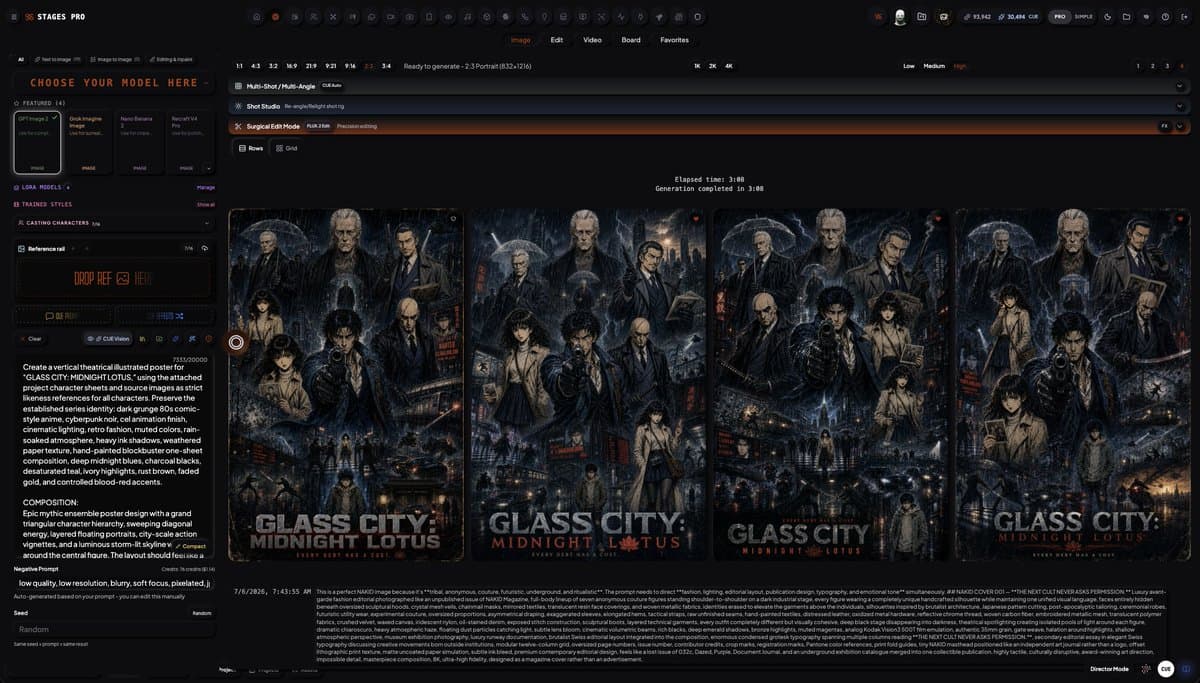
- CUE is being used as a prompt-writing partner, from a 7,000+ word Midnight Lotus poster prompt in dustinhollywood's poster workflow to a Countach commercial rewrite in dustinhollywood's CUE taste pass.
- GraphX is being pitched for batch character and reference work: dustinhollywood's GraphX post claims a model and editorial setup took 5 minutes, with containers that can split and parse up to 15 reference images.
- BLACK-MAMBA is the next power-user layer: dustinhollywood's BLACK MAMBA post describes agent streams injecting findings into one another and collaborating with sub-agents.
- STAGES is expanding into editing systems, not only generation: depth maps, reframing, v2v, LUTs, Adobe actions, TouchDesigner networks, and motion tools all appear in dustinhollywood's editor roadmap.
The most bookmarkable artifact is the full Midnight Lotus prompt in dustinhollywood's CUE prompt: a production-style poster bible with character placement, palette, scene vignettes, type treatment, and quality constraints. The weirdest line is CUE turning a safe car prompt into “Italian murder weapon in a fashion bunker” in the Countach prompt pass. The thread also ends with the try-it-today link dustinhollywood shared.
Character pods
The creator posting as dustinhollywood framed Stages as a reusable-character system: make a character once, then pull it into multiple tools and pages from the prompt and input panel. In his character-consistency thread, he claimed the workflow could handle double-digit casts without rebuilding context for each generation.
The CASTING mechanics are simple:
- Create the character in CASTING.
- Open the CASTING CHARACTER drawer inside attached generation tools.
- Select the characters needed for the current output.
- Change the character card's feature image for faster recognition.
Tools named in the CASTING drawer post include GRAPHX, IMAGE/VIDEO Gen, VIDX, SIGNAL, and more.
CUE prompt bibles
The poster workflow treats prompt fields like chats with the model, including ChatGPT and Nano banana 2. A filmmaker poster builder is described as coming soon, while the current workaround is using CUE chat with script context, prompts, assets, chat history, or pasted material from the project, according to dustinhollywood's poster workflow.
The Midnight Lotus prompt is structured like a mini art department packet:
- Strict likeness references from project character sheets and source images.
- Series identity: dark grunge 80s comic-style anime, cyberpunk noir, cel animation, rain, ink shadows, weathered paper.
- Composition: triangular hierarchy, layered floating portraits, city-scale vignettes.
- Character blocking: Kai, Aiko, Kenji, Ryu, Masaru, Akira, Julia, and Young Kai.
- World texture: mirrored skyscrapers, expressways, trains, assassins, corrupt police, sedans, rooftops, subway duels.
- Finish: chiaroscuro, halftone, rain streaks, neon bloom, fractured chrome, painterly gradients.
- Poster text: bottom title space for “GLASS CITY: MIDNIGHT LOTUS” and an optional tagline.
The useful pattern is CUE turning project context into a reusable production bible, then letting the same cast stay available across tools.
GraphX containers
GraphX is shown as a node mood-board tool with backend containers that split references. In dustinhollywood's GraphX post, he claimed he could make 100 to 150 models or characters in a day, then cast them into shorts, editorials, ads, or commercial campaigns.
The container workflow he described:
- Put multiple references in one container.
- Split those references on the backend.
- Parse them as prompts.
- Generate image, video, and edits from the references together.
- Connect them into one workflow or generate from them separately.
The example used two different-size references for a radio announcer and Buck Fuzz in the same container, then generated a fight scene image and video from them.
Writing node graph
AIwithSynthia described the broader workflow as “hundreds of nodes” passing context from one step to the next, with the agent building the chain from a story description in the connected-nodes post. In replies, AIwithSynthia also called it “the entire creative system” and told one user to “assemble the pipeline now” AIwithSynthia's system reply AIwithSynthia's pipeline reply.
Stages is also being framed as a writing surface. In dustinhollywood's writing graph reply, dustinhollywood called the writing node graph custom-built around mind maps, because that is how he writes.
CUE taste pass
The Countach example is the clearest taste-layer demo. CUE takes a safe one-shot car prompt and reframes it as a black-concrete luxury treatment in dustinhollywood's Countach prompt pass.
The rewrite keeps the core shot, a red Lamborghini Countach in a dark studio with raised glowing headlights and a slow low-angle push-in, then sharpens the direction:
- Weak version: “red car in studio, camera moves forward.”
- Stronger version: “a red Countach treated like a dangerous fashion object inside a black concrete showroom.”
- Style guardrails: no lifestyle fluff, no happy-road-driving gloss, more predatory fashion-object energy.
For creative teams, that is the CUE pitch in one screenshot: less blank-prompt assistant, more opinionated art director.
BLACK-MAMBA agent swarms
BLACK-MAMBA is the agent-swarm layer. In dustinhollywood's BLACK MAMBA post, dustinhollywood said each agent injects findings into other streams, collaborates with sub-agents, and is coming next for Stages power users.
The visible workspace splits the same commercial task across named streams:
- Builder: shot instructions, including “Shot 01” and “Shot 02” planning.
- Reviewer: critique against the attached Countach reference.
- Designer: cinematic shot prompts and visual treatment.
- Researcher: image-to-video refinements and prompt adjustments.
Motion editor templates
The editor roadmap widens STAGES beyond prompt generation. In dustinhollywood's editor roadmap, dustinhollywood said the current app can depth map, reframe, edit, v2v, and more, while he is building out a motion editor.
He also listed private systems being moved into the platform:
- Custom editing LUTs.
- Texturizers.
- Adobe actions and plugin workflows.
- TouchDesigner network builds.
- Motion graphics systems.
- Editing pipelines.
- Creative process templates.
The same roadmap says the e-learning portal will cover drawing, pre-vis, writing, planning, business collaboration, DOME visual work, immersive real-time art, data art, TouchDesigner, After Effects, Blender, and more.