
Agent Skills ecosystem ships handoff docs, htmx v4 packs, and Project Think support
Independent builders published reusable skills infrastructure across coding agents, including Project Think preview support, handoff docs, and an htmx v4 skill pack. That matters because skills are starting to work like portable workflow units instead of one-off prompt snippets inside a single tool.
TL;DR
- Agent Skills kept spreading across coding agents this week, with threepointone's Project Think preview adding skills support while nerdai's chapter announcement described the format as an open standard already adopted by Claude Code, Cursor, Gemini CLI, VS Code, GitHub Copilot, Codex, and others.
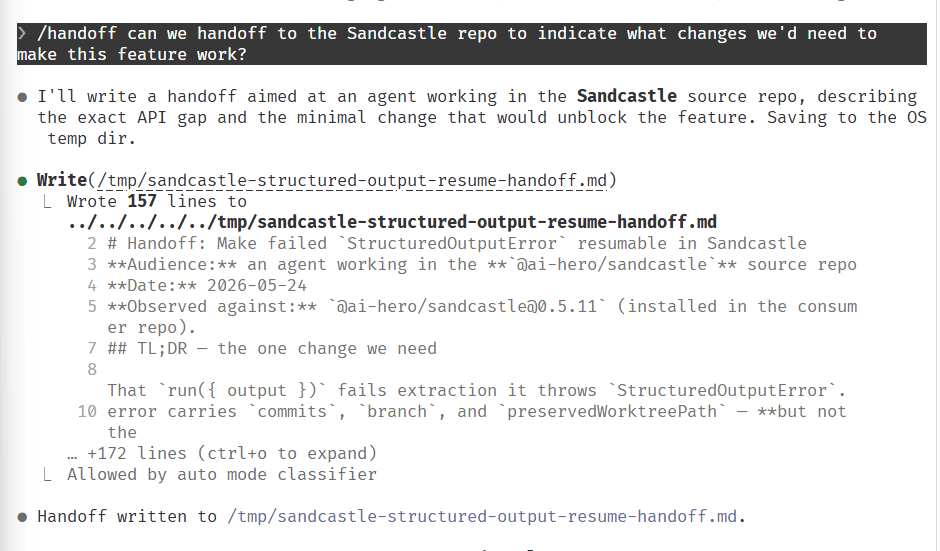
- mattpocockuk's handoff docs link and mattpocockuk's cross-repo handoff example turned skills into a way to package work for another agent session or even another repository, not just a reusable prompt.
- The most concrete skill pack in the evidence came from alonsonetwork's htmx post, which ships 93 htmx v4 beta annotations across seven reference files and installs with
npx skills add damusix/skills --skill htmx. - threepointone's Project Think preview also exposed the mechanics builders care about, including local or R2 skill loading, a configurable permission model, and workspace-accessible JS, Python, and Bash scripts.
- Distribution is starting to look real, not theoretical, because jxnlco's Codex tip pointed users to
openai/skills, while steipete's looped review skill and swyx's Kakuna thread showed opinionated skills getting shared as standalone repos.
You can browse the Agent Skills spec, read the new handoff docs, inspect Cloudflare's Project Think skills PR, and grab the htmx skill repo. There is also a second Cloudflare PR for scheduled tasks, plus a growing pile of public skill libraries such as openai/skills, swyxio/skills, and openclaw/agent-skills.
Agent Skills is turning into a portability layer
The headline change is not one repo. It is that multiple agent harnesses are starting to treat skills as portable workflow units.
According to nerdai's chapter announcement, the format started with Claude Code and is now used across Cursor, Gemini CLI, VS Code, GitHub Copilot, Codex, and other clients. mattpocockuk's design checklist boiled the emerging norm down to concise, single-purpose, composable, progressively disclosed, harness-agnostic skills, then mattpocockuk's follow-up and mattpocockuk's security add-on added portable, well-documented, and secure to the list.
That combination is why this feels bigger than prompt-library cosplay. The center of gravity is moving from one tool's slash commands to a format other tools can discover, install, and execute.
Handoff docs package work for another session
The most novel workflow in the evidence is /handoff, a doc format meant to package unfinished work for a later run.
The handoff docs are framed around passing context cleanly between agent sessions. mattpocockuk's cross-repo handoff example pushed that a step further by using /handoff to break out of the current project directory and dispatch work into another repo, including the awkward cases where a codebase should have been a monorepo but is not.
mattpocockuk's Sandcastle bug example adds the concrete pattern: discover a bug in one project, write a handoff doc, then let the next run operate with that packaged context instead of reconstructing it from scratch.
Project Think adds skills and scheduled runs
Cloudflare's Project Think preview is the strongest sign that skills are becoming runtime features, not just markdown conventions.
According to threepointone's Project Think preview, Think's implementation supports the spec, loads skills from the local filesystem or codebase and from R2, and is expected to add Git later. The same post says skills can include working JS, Python, and Bash with workspace and filesystem access, behind a configurable permission model.
The companion scheduled tasks PR, linked by threepointone's scheduled tasks post, adds cron patterns or a DSL for running a prompt on a schedule. Put together, the model is simple: skills package reusable behavior, then the runtime decides when and with what permissions to execute it.
The htmx v4 skill is what a serious pack looks like
The clearest example of a skill as compressed technical reference came from the htmx pack shared by alonsonetwork's htmx post.
The greatest htmx LLM skill on the internet, now updated for v4 beta
0 comments
Instead of a generic web-dev helper, the repo turns the htmx docs and migration guide into a targeted offline reference for agents. The post says the pack includes 93 annotations across seven reference files, with three annotation types:
[htmx 4]for v4-only features[htmx 4 change]for changed behavior[htmx 4 removed]for removed features
alonsonetwork's htmx post also itemized the coverage:
- All
hx-*attributes, values, modifiers, and edge cases - Swap strategies, out-of-band swaps, morphing, and view transitions
- Event reference with v2 and v4 name mappings
- JS API and config options, including v4 renames and removals
- Six official extensions plus the v4 bundled extension list
- Seventeen common UI patterns
- Request lifecycle, headers, CSRF, CORS, and caching
- Production gotchas around accessibility, testing, error handling, and SPA mixing
That is a better mental model for skills than "prompt snippets." It is a portable, task-shaped retrieval layer built from canonical docs, trimmed for agent use, and installable with one command.
Public skill repos are already getting opinionated
The ecosystem around the format is getting weird in the fun way, because people are publishing narrow, high-opinion skills instead of waiting for official catalogs.
jxnlco's Codex tip pointed Codex users at openai/skills and claimed Codex can already scan that repo and suggest relevant installs. On the other end of the spectrum, swyx's Kakuna thread described a codebase-hardening suite that leans on subagent parallelism and bakes in strong opinions about app, devops, and product workflows.
There are smaller single-purpose examples too. steipete's looped review skill shared a package that runs Codex /review in a loop until it stops finding issues, while badlogicgames's grill-me repost highlighted a tiny skill small enough to live in a global AGENTS.md. That spread, from giant reference packs to tiny personal utilities, is new information about where the format is actually landing.
Skills are now showing up inside agentic coding runs
One more useful detail surfaced in the surrounding posts: skills are already blending into broader agent workflows instead of living as a separate "skill mode."
In reach_vb's Codex training run, Codex used /goal, controlled a signed-in Chrome session, babysat a Colab training job for about 19 minutes, and then used subagents to audit the result. daniel_mac8's Codex follow-up said the repo-scanning tip produced eight recommended skills for active projects, especially when paired with persistent memory files.
That is a different shape of tool use than manually invoking a canned macro. Skills are starting to sit next to memory, goals, subagents, and browser control as one more reusable part of the coding-agent harness.