
Agent Skills supports Codex, Cursor, Gemini CLI, and VS Code through new libraries and plugins
New guides, plugins, and reusable libraries show the Agent Skills format moving beyond Claude Code into multiple coding-agent clients and runtimes. That matters because workflows are becoming portable artifacts instead of one-off prompts tied to a single harness.
TL;DR
- nerdai's MEAP chapter post says Anthropic's Agent Skills format now spans Claude Code, Cursor, Gemini CLI, VS Code, GitHub Copilot, Codex, and other clients, which turns a workflow artifact into something closer to a portable plugin than a saved prompt.
- emdashsh's v1.1.24 update shipped a reusable library for prompts, skills, and MCP servers, while jxnlco's Codex repo tip pointed users at OpenAI's
openai/skillsrepo, showing both harness vendors and model vendors treating skills as installable assets. - OpenAI's Codex Thursday thread and OpenAI's follow-up thread bundled goal mode, Appshots, advanced annotations, and locked-screen computer use into the same weekly rollout, which makes Codex look more like a host runtime for reusable workflows than a single chat surface.
- omarsar0's lesson-generator launch and pauliusztin_'s Obsidian skills writeup show what the format is becoming in practice: domain packages that teach agents specific objects, file types, and UI flows.
You can inspect the Obsidian skills repo, browse OpenAI's skills repository, and check the Codex locked-use docs. There is also a live plugin example in DAIR Academy plus the matching plugin repo, and Cursor is now pushing its own builder surface through the Cursor SDK docs.
Agent Skills
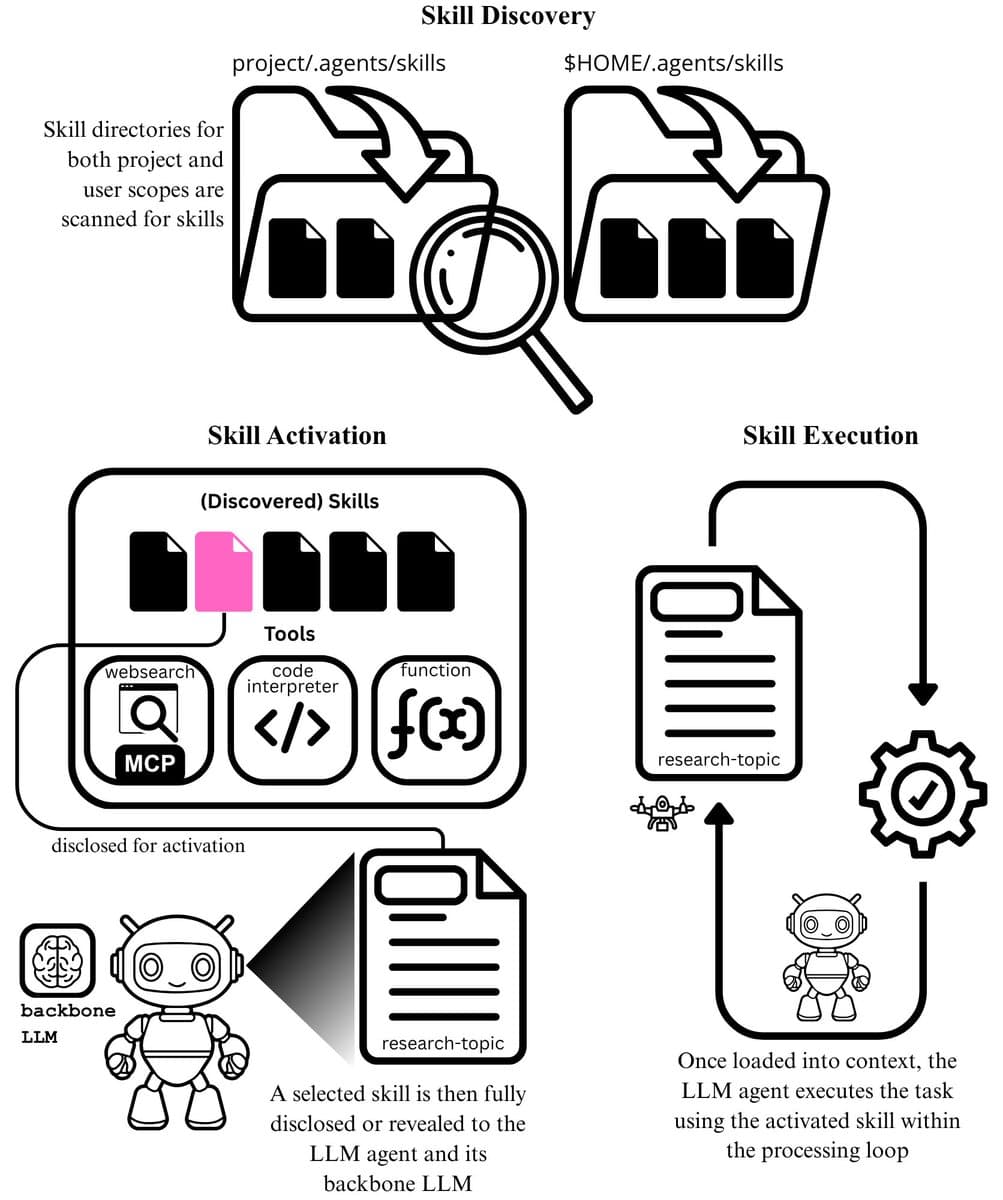
The clearest signal this week came from the teaching material, not a launch post. nerdai described Agent Skills as an open standard built for Claude Code and now adopted across Cursor, Gemini CLI, VS Code, GitHub Copilot, Codex, and others.
That matters because the unit of reuse changes. Instead of copying a system prompt between tools, a skill package can expose discovery, activation, and execution behavior that a compliant client knows how to load.
Libraries and installers
Two different distribution patterns showed up at the same time:
- Emdash added a reusable library for prompts, skills, and MCP servers in v1.1.24 emdashsh's release note tweet.
- Codex users were pointed to the
openai/skillsrepo, where the agent can inspect installable skills and help pick them jxnlco's Codex repo tip. - DAIR shipped
/lesson-generatoras an installable plugin with a live endpoint and GitHub repo, not just a demo prompt omarsar0's lesson-generator launch and omarsar0's follow-up links.
The pattern is simple: skills are getting package surfaces, install flows, and repos of their own.
Codex as a host runtime
OpenAI's weekly Codex rollout was nominally about product features, but the bundle reads like infrastructure for longer-running, more composable workflows.
- Locked-screen computer use lets Codex keep operating on a Mac from a phone, even when the screen is off and locked, according to OpenAI's launch thread and the linked Codex docs.
- Goal mode is now available in the app, IDE extension, and CLI, where OpenAI says it can work toward a milestone for hours or days OpenAI's feature roundup.
- Team plugin sharing lets business users distribute custom plugins across a workspace jxnlco's repost of the OpenAI Devs announcement.
- The Rust
v0.133.0release added permission profile inheritance, richer extension hooks, and easier plugin discovery, according to LLMpsycho's Codex release summary and the follow-up summary.
Once a client has goals, plugins, permissions, remote control, and long-running sessions, skills stop looking like a side feature. They look like the task layer sitting on top of the runtime.
Specialized skills
The interesting examples are already narrow.
/lesson-generatorcan build a course on any topic, call an image generator, and return the result as an HTML artifact omarsar0's launch post.- Steph Ango's Obsidian skills package teaches agents Obsidian-flavored Markdown,
.basefiles, JSON Canvas, CLI workflows, and Defuddle-based web extraction, according to pauliusztin_'s repo walkthrough. - swyx's Kakuna package is explicitly framed as a hardening suite with checklists, subagent parallelism, and strong opinions about codebase hygiene swyx's Kakuna thread.
autoreviewis already being used on large refactors, where steipete's report said it ran for five hours fixing issues, while steipete's scratch-log suggestion argued for persistent logs of agent decisions during bigger changes.
These are not generic "be better at coding" prompts. They encode domain objects, review habits, and multi-step workflows that travel between agent harnesses.
SDKs and shared memory
Portability is also spreading one layer below skills.
Cursor's SDK now exposes Composer 2.5 in Python and TypeScript, with Cursor linking its own /sdk skill as the on-ramp cursor_ai's SDK launch. In parallel, LLMpsycho's agentmemory post pitched persistent memory for Claude Code, Cursor, Codex CLI, Hermes, OpenCode, and any MCP client through a single project.
The bigger shift is that memory, SDKs, and skills are all being framed as cross-client building blocks at the same time. When that stack stabilizes, the harness matters less than the artifact you install into it.