
Anthropic cuts Claude subscription access for third-party harnesses in Apr. 4 rollout
Anthropic’s Apr. 4 cutoff for using Claude subscriptions through OpenClaw-class harnesses went live. Users report API-billing fallbacks, ACP workarounds, and restored Claude Code quota, while edge cases around claude -p and Agent SDK use remain unsettled. The change pushes heavy agent loops toward metered access.
TL;DR
- According to koltregaskes' summary and the email screenshot in moritzkremb's post, Anthropic began excluding OpenClaw-class third-party harnesses from Claude subscription coverage at 12 pm PT on April 4, while still allowing access through extra usage billing or API keys.
- bridgemindai's usage screenshot suggests the cutoff immediately eased Claude Code quota pressure for direct users, with session usage staying far below the levels people had reported earlier in the week.
- The policy line is narrower than a blanket ban, because dotta's Paperclip note says local single-user use of the
claudeharness still appears allowed, while Matt Pocock's thread shows that CI, distributed sandboxes, and open source wrappers remain murky. - OpenClaw users spent the day testing escape hatches: onusoz pointed to an ACP path built on Anthropic's Agent SDK overview, while moritzkremb posted a switch to OpenAI Codex and Liberate your OpenClaw pushed hosted or local open models.
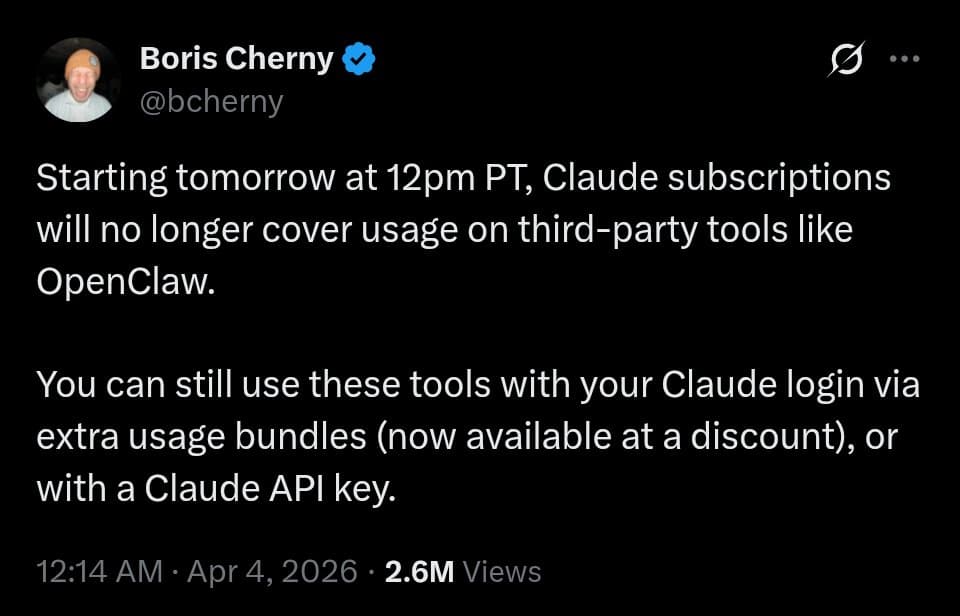
You can read Anthropic product lead Boris Cherny's Threads announcement, inspect the OpenClaw ACP docs, and compare that with Anthropic's own Agent SDK overview. The weird part is how quickly the ecosystem started routing around the cutoff: one post turns OpenClaw toward ChatGPT subscriptions, another tunnels Claude through ACP, and Hugging Face already had a migration guide for moving OpenClaw, Pi, or Open Code onto open models.
The cutoff landed as billing, not a hard shutdown
The clearest first-party wording came through user emails and Boris Cherny's public post. Subscription coverage ended for third-party harnesses first, not Claude access itself.
The email in moritzkremb's screenshot says Claude subscriptions would no longer cover OpenClaw and other third-party harnesses, that the policy would expand beyond OpenClaw, and that affected users would get a one-time extra-usage credit equal to their monthly plan price if they claimed it by April 17. Boris Cherny's Threads announcement matches the same shape: discounted extra-usage bundles, Claude API keys, and refunds instead of subscription-backed third-party traffic.
That distinction matters because Anthropic is not removing third-party integrations from the stack. It is moving them onto metered access.
Claude Code quotas snapped back the same day
The most concrete first-day effect was not a policy memo. It was a usage panel.
Discussion around Tell HN: Anthropic no longer allowing Claude Code subscriptions to use OpenClaw
Thread discussion highlights: - firloop on Policy distinction: OpenClaw was using Claude Code as the harness via `claude -p`, and the poster says Anthropic has made building products around `claude -p` disallowed, with concern that other tools like Conductor may be next. - davesque on Capacity justification: A commenter supports the move, arguing Anthropic sized capacity for native products and should not be expected to absorb the load from community tools that try to maximize usage windows. - mariopt on Token burn / abuse: Another commenter says coding plans are being ruined by people abusing OpenClaw, cites very large token consumption, and argues heavy 24/7 agent use should go through the API and be billed accordingly.
In bridgemindai's screenshot, a Max user reports 27 percent of session quota and 8 percent of weekly quota after a full morning on Claude Code, versus hitting 100 percent in under an hour three days earlier. The same panel shows a new line item for "$200 in extra usage for third-party apps," which is about as blunt as product telemetry gets.
That lines up with the capacity argument in one top Hacker News comment and the abuse complaints in another, both of which argued that Anthropic had been subsidizing always-on harness traffic with plans meant for native products.
The new boundary is product versus harness
Anthropic seems to be drawing the line around who owns the agent loop and where the workload runs.
Tell HN: Anthropic no longer allowing Claude Code subscriptions to use OpenClaw
Relevant to engineers building or using AI coding tools: Anthropic is drawing a line between first-party products and third-party harnesses, which affects how Claude subscriptions can be integrated into external agents/CLIs, how usage gets metered, and whether developers should expect API-style billing for heavy agent loops.
According to firloop's HN comment, OpenClaw was using Claude Code through claude -p, and Anthropic had decided that building products around that path was no longer allowed under subscriptions. But dotta's Paperclip post says Paperclip's local single-user default, which also uses the claude binary as a harness, does not appear affected.
That leaves a narrower rule than many people first assumed:
- Claude Code used directly by a subscriber is allowed.
- A local personal wrapper around the Claude harness may still be allowed.
- Team, commercial, or always-on third-party services are being pushed to API-style billing.
The HN argument in zmmmmm's reply is that this undercuts the idea of Claude as a platform. Anthropic's side, reflected in the email and the HN discussion, is that subscriptions were never supposed to underwrite industrial-scale agent loops outside first-party products.
Edge cases around `claude -p` and Agent SDK are still muddy
The loudest complaint by the end of the day was not the cutoff itself. It was the missing line around all the adjacent cases.
Matt Pocock's matrix in his thread is useful because it names the unresolved cases engineers actually care about: claude -p in CI, Agent SDK in CI, open source software that depends on claude -p, and distributed sandboxes launched by an individual user. His follow-up in the same thread's conclusion says he had asked Anthropic for clarification weeks earlier and still could not tell students what was safe to recommend.
Anthropic's own Agent SDK overview describes the SDK as "Claude Code as a library" for building production agents, which makes the subscription boundary even more confusing from the outside. If the product line is first-party versus third-party harness, developers now need a much more explicit map for where personal software ends and commercial orchestration begins.
ACP and open-model exits appeared within hours
The fastest response from the ecosystem was not outrage. It was rerouting.
In onusoz's workaround, OpenClaw users are told to bind a Telegram or Discord channel to Claude through ACP, which leans on Anthropic's Agent SDK instead of the blocked subscription path. OpenClaw's own ACP docs say ACP sessions can spawn Claude Code, Codex, Gemini CLI, and other external harnesses as background tasks, and that channel binding is part of the runtime.
Other posts skipped Claude entirely. moritzkremb shared a terminal login flow for OpenAI Codex inside OpenClaw, and Hugging Face's Liberate your OpenClaw laid out two replacement tracks: hosted open models through Inference Providers, or fully local models on your own hardware. That last guide explicitly calls out OpenClaw, Pi, and Open Code, which tells you how many agent shells were leaning on the same Anthropic subscription loophole.