
OpenAI launches Astra reset across Codex and ChatGPT Work
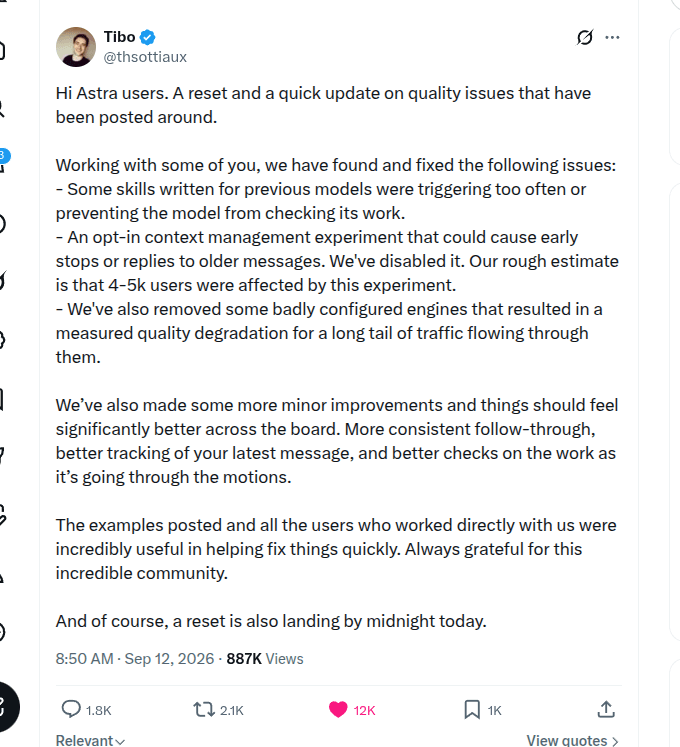
OpenAI says it fixed skill-triggering, context-management, and engine-configuration issues behind degraded Astra responses. The reset is now rolling out across Codex and ChatGPT Work.
TL;DR
- OpenAI says it disabled an opt-in context-management experiment that could end runs early or answer an older message, and removed badly configured engines that degraded a long tail of traffic, according to thsottiaux's quality update.
- The reset is rolling out to Codex and ChatGPT Work in reach_vb's rollout note, while reach_vb's follow-up says the latest Codex App or CLI is required.
- Astra's official harness guidance calls for leaner skills and less universal
AGENTS.mdscaffolding, as OpenAIDevs' migration guidance puts it. - SlopCodeBench's live chart puts Astra XHigh at a 16.3% strict checkpoint pass rate, ahead of GPT-5.6 Sol XHigh at 14.3%, in cedric_chee's benchmark post.
The official migration guide uses a telling bad example: a Postgres-migration skill whose description is broad enough to load for any database-related task. The SlopCodeBench repository tests whether agents can extend their own code as requirements evolve, rather than rewarding a one-shot solution. An OpenAI Developer Community rate-limit thread contains separate complaints about Astra and Sol consuming quota.
What shipped
- The reset targets Codex and ChatGPT Work, with an App or CLI update called out in reach_vb's follow-up.
- People with reproducible bad behavior are being directed to
/feedbackby pvncher's feedback request.
Context management
The opt-in experiment is the clearest root cause OpenAI disclosed. It could cause early stops or stale replies, and the company estimated that roughly 4,000 to 5,000 users were affected before it disabled the experiment.
The same update says the resulting service should track the latest message more consistently and follow through with more checks during a task.
Skills and AGENTS.md
Eric Provencher's developer guide says skill names and descriptions enter the model context, then get shortened when projects carry too many of them. Contradictory or overly expansive descriptions can therefore steer Astra into loading irrelevant guidance.
The configuration changes OpenAI describes are:
- Narrow skill triggers to the specific workflow.
- Use a minimal root
SKILL.mdas a router to task-specific material. - Replace unconditional
AGENTS.mdrules with contextual ones. - Tie verification to the behavior changed.
- Explicitly authorize bounded local work, such as disposable-fixture tests and fixes to failures caused by the requested change.
- Define completion beyond the first implementation, including running, inspecting, and fixing relevant failures.
Benchmarks that moved
First-party
Instead of a benchmark rerun, thsottiaux's update gives operational estimates and a list of fixes.
Third-party evaluators
- Strict checkpoint pass rate: GPT-5.6 Sol XHigh 14.3% → GPT-6 Astra XHigh 16.3%, +2.0 points, in cedric_chee's chart.
- Strict checkpoint pass rate: GLM 5.3 Max 12.5% → GPT-6 Astra XHigh 16.3%, +3.8 points, in cedric_chee's chart.
- Strict checkpoint pass rate: GPT-5.5's V2 paper result 14.8% → Astra's live campaign 16.3%, +1.5 points, though cedric_chee's chart labels the paper and live results as separate sets.
Customer-reported
No customer-reported benchmark score in the supplied evidence uses a shared task set and prior-model baseline. The controlled quota comparison appears below.
Where it regressed
OpenAI said misconfigured engines caused measured degradation for a long tail of traffic, and that it removed them. The company also tied early termination and stale replies to the disabled experiment.
Reports around the rollout still describe incomplete work. raunakdoesdev's post says Astra had begun stopping randomly enough to require /goal, while dexhorthy's report found mixed coding quality and more erratic behavior.
Vibe Check
- pvncher's hands-on report calls Astra an oracle or advisor, and highlights computer use, 3D asset assembly, and design work.
- chetaslua said Astra recreated a motion-design video as interactive HTML in one shot, without MCP, tools, or skills, in chetaslua's demo.
- koltregaskes' account describes Astra as a worker and expert, while preferring Sol at higher reasoning effort for orchestration.
Quota pressure
kunchenguid's 419-run comparison used the same prompts across eight open-source repositories at medium reasoning. The study reported:
- API-priced work per 1% of weekly quota: $13.26 for Astra and $15.34 for Sol.
- Median wall-clock time per task: 41 seconds for Astra and 59 seconds for Sol.
- Weekly quota consumed per task: 0.024% for Astra and 0.017% for Sol.
- Weekly quota consumed per hour of continuous agent work: 2.10% for Astra and 1.02% for Sol.
The author estimates the usage-meter measurement uncertainty at about ±15%. Separately, nptacek's reply reported having three banked resets on the $200 plan.
Compaction
mattlam_ described an Astra-specific compaction path that replaces a server-returned encrypted summary with recoverable working notes. The account says the flow is:
- Save state with
notes.write_file. - Start a
new_context. - Request a
thread_hintto locate notes. - Read previous notes files or history tool calls.
- Return recovered content as tool results, then continue with new messages.
The analysis says this path applies to Astra rather than Sol or other models.