
OpenRouter, OpenCode, and 5 others add Claude Fable 5 on launch day
OpenRouter, OpenCode, Lovable, Cline, Browser Use Terminal, Nous Portal, and Venice all added Fable 5 within hours of launch. The rollouts put the model into gateways, coding agents, browser agents, and chat clients on day one.
TL;DR
- OpenRouter's launch post, opencode's rollout note, Lovable's support post, cline's announcement, browser_use's demo, NousResearch's Portal post, and AskVenice's launch post show seven separate Claude Fable 5 integrations landing within hours of Anthropic's June 9 launch.
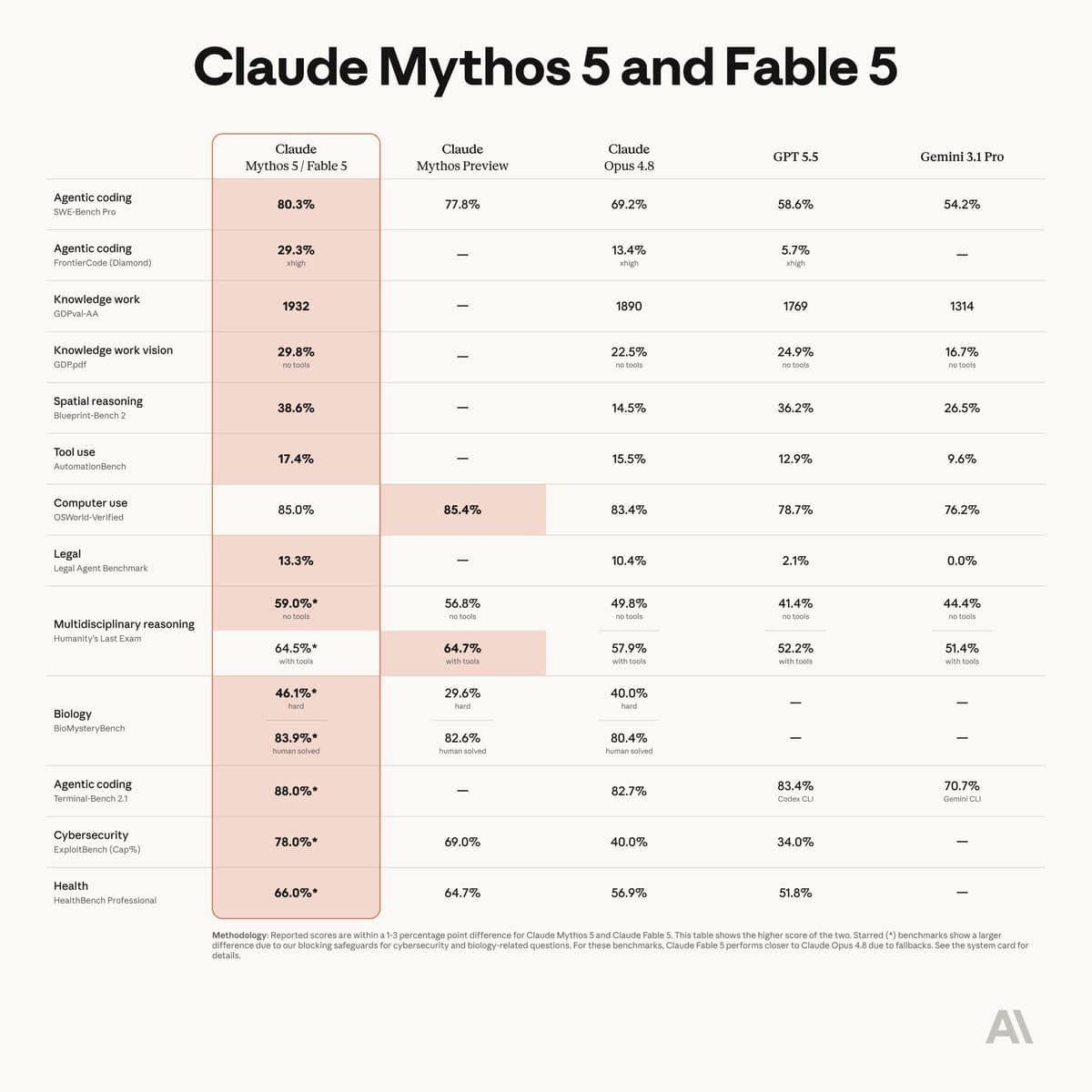
- Anthropic positioned Fable 5 as its public Mythos-class coding and knowledge-work model, with a 1M token context window, $10 per million input tokens, and $50 per million output tokens, while OpenRouter's model page mirrored the same long-running task pitch.
- The launch-day spread covered three different access layers at once: gateway routing via OpenRouter's launch post, coding agents via opencode's rollout note and cline's announcement, and browser or chat surfaces via browser_use's demo, NousResearch's Portal post, and AskVenice's launch post.
- cline's announcement added the only concrete performance claim in the evidence pool, saying Fable 5 hit 88.0% on Terminal-Bench 2.1 and that Anthropic routes dangerous requests to Opus 4.8 in under 5% of sessions.
Anthropic's own launch post framed Fable 5 as a model for long, ambiguous work, while OpenRouter's model page translated that into a same-day API target. You can also see the model show up inside Browser Use Terminal docs, on Cline's product site, and in a direct Venice chat route. The weird bit is not any single integration, it is how quickly Fable 5 appeared across gateways, IDE agents, browser agents, and anonymous chat.
Gateways and app builders
Anthropic shipped Fable 5 as a general-use version of its Mythos-class model, and the first public distribution wave hit products that sit between users and raw model APIs.
OpenRouter exposed Fable 5 immediately through its unified API and model catalog, where the model page lists text, image, and file input support plus a 1M token context window. Lovable added the model on the same day, putting it into a builder workflow rather than a raw playground.
That split matters because the two products serve different jobs:
- OpenRouter is the routing layer, the place teams hit when they want one API surface for many providers.
- Lovable is the app-building layer, where model quality shows up as fewer turns and better planning inside a product workflow.
Coding agents
The densest cluster was coding tooling. Fable 5 landed in opencode, Cline, and Hermes Agent through Nous Portal on launch day.
opencode kept it short, just confirming availability. Cline attached a benchmark and a deployment detail, saying Fable 5 ranked first on Terminal-Bench 2.1 at 88.0%, ahead of GPT 5.5 by 4.6 points, and that dangerous requests can be routed to Opus 4.8.
NousResearch placed Fable 5 inside Hermes Agent through Nous Portal, with a one-month Plus promotion for the first 500 new users.
Taken together, the coding-agent rollout covered three distinct surfaces:
- Terminal-native open source agent, via Cline, which pitches one agent across editor, terminal, and SDK surfaces.
- Open source coding agent UI, via opencode.
- Multi-agent operator stack, via Hermes Agent on Nous Portal.
That is a broader launch pattern than a typical "now in one IDE" model drop. Fable 5 showed up in products that already assume long-running sessions, tool calls, and delegated work.
Browser agents
Browser Use Terminal was the clearest example of Fable 5 getting dropped into an agent harness instead of a chat box.
The product's docs describe it as a Codex-style assistant for browser automation, with a full browser environment, screenshots, page inspection, JavaScript execution, secrets handling, and resumable history. The launch post's gum coupon demo is a tiny task, but the more useful signal is the surface itself: Fable 5 was available inside a browser agent runtime on day one.
That puts the model into a different evaluation loop than plain chat. Instead of answering a prompt, it can burn tokens navigating, retrying, inspecting pages, and spending money on mistakes, which is exactly what the $7.21 coupon anecdote surfaced.
Anonymous access on Venice
Venice added a different distribution angle: no-code, anonymous access through a direct chat route.
Venice's linked page opens straight into a Claude Fable 5 chat session. That makes it the simplest path in the evidence pool, compared with API gateways, coding agents, or browser runtimes.
The launch-day stack therefore broke down four ways:
- API gateway: OpenRouter.
- App builder: Lovable.
- Agent runtimes: opencode, Cline, Browser Use Terminal, Hermes Agent.
- Consumer chat: Venice.
For one day's worth of integrations, that is unusually complete coverage of the AI product stack.