
Developers report Claude Opus 5 reliability tradeoffs despite ProgramBench win
Claude Opus 5 combined benchmark wins with coding-agent reliability complaints. It led ProgramBench and Arena frontend rankings, while users reported overbuilding, missed intent, and switches back to Fable.
TL;DR
- Opus 5 shipped as a same-price Opus 4.8 replacement, with Anthropic pricing
claude-opus-5at $5 per million input tokens and $25 per million output tokens while chetaslua's API sighting caught the model string appearing in the wild. - The benchmark sheet is genuinely strong: scaling01's ProgramBench screenshot put Opus 5 at 41.5% accuracy, and arena's leaderboard post put Opus 5 Max at No. 1 in both Frontend Code Arena and Text Arena with factuality on.
- Agentic workload economics split hard by benchmark: Opus beat its own predecessor on several leaderboards, while composio's benchmark summary had GPT-5.6 Sol passing 96% of 23 tasks versus Opus 5's 87% at roughly half the suite cost.
- The reliability complaint was specific, not vague vibes: theo's follow-up said Opus 5 treats every comment like a P0, davis7's usage notes said it overcomplicates and does extra work, and doodlestein's agent report said Opus agents damaged projects.
- Anthropic's own docs describe several of the sharp edges: the official prompting guide says Opus 5 verifies itself, can expand task scope, delegates more readily, and needs explicit controls for response length, while the prompt-injection note flagged a buried security win.
Anthropic's prompting guide says legacy verification instructions can now cause over-verification. The system card says the largest agentic-safety gains were in prompt-injection robustness. ProgramBench tests whether models can rebuild command-line programs from a binary and behavioral spec, while ReactBench focuses on production React issues that test-pass benchmarks miss.
What shipped
- Claude Opus 5 launched July 24 across Anthropic surfaces, and Anthropic's launch post says it is the default model on Claude Max and the strongest model on Claude Pro.
- The API model ID is
claude-opus-5, which chetaslua's API sighting showed before the broader rollout. - List price stayed flat versus Opus 4.8 at $5 per million input tokens and $25 per million output tokens, according to Anthropic's launch post.
- Fast mode runs around 2.5 times default speed at twice the base price on Claude Platform and through Claude Code credits, according to Anthropic's launch post.
- Anthropic also shipped beta mid-conversation tool changes and automatic fallbacks on the API, with safety-flagged Opus 5 or Fable 5 requests able to route to another model by default in the launch post.
- elder_plinius's system-prompt leak listed Opus 5 alongside Fable 5, Sonnet 5, and Haiku 4.5, and included a Fable safeguards routing block that can redirect some Fable requests to Opus 5.
Benchmarks that moved
First-party
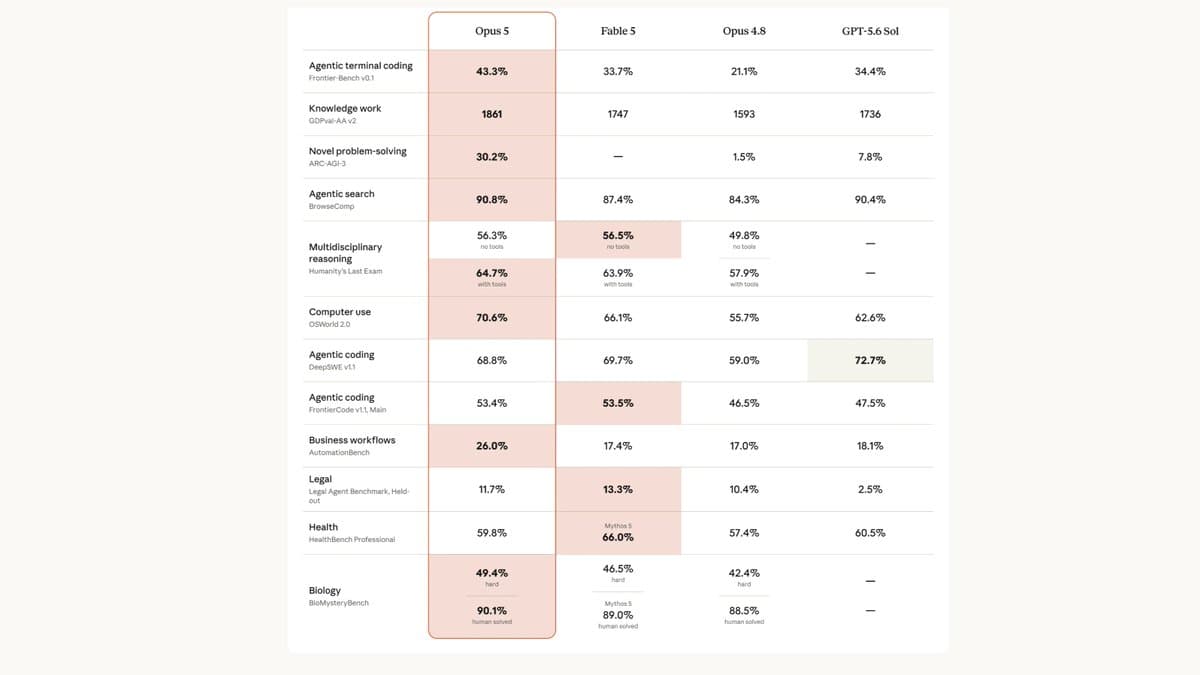
- Frontier-Bench v0.1 agentic terminal coding: 21.1% on Opus 4.8 → 43.3% on Opus 5, +22.2 points, in WesRoth's benchmark table and Anthropic's launch post.
- ARC-AGI-3 novel problem-solving: 1.5% on Opus 4.8 → 30.2% on Opus 5, +28.7 points, in WesRoth's benchmark table, while haider1's ARC table put Opus 5 high at 30.16%.
- OSWorld 2.0 computer use: 55.7% on Opus 4.8 → 70.6% on Opus 5, +14.9 points, in WesRoth's benchmark table.
- AutomationBench business workflows: 17.0% on Opus 4.8 → 26.0% on Opus 5, +9.0 points, in WesRoth's benchmark table.
Third-party evaluators
- ProgramBench rebuild-from-binary accuracy: 15.5% on Opus 4.8 → 41.5% on Opus 5, +26.0 points, in scaling01's ProgramBench screenshot.
- Frontend Code Arena: 1,629 for Fable 5 → 1,725 for Opus 5 Max, +96 Arena points, in arena's leaderboard post.
- Text Arena with factuality on: 1,494 for Fable 5 High → 1,512 for Opus 5 Max, +18 Arena points, in arena's leaderboard post.
- AlmanBench: 74.8% on Opus 4.8 max → 94.5% on Opus 5 max, +19.7 points, in onusoz's AlmanBench screenshot.
- Extended NYT Connections at xhigh: 91.1 on Opus 4.8 → 94.3 on Opus 5, +3.2 points, according to LechMazur's Connections benchmark.
- DeepSWE max pass@1: 59% on Opus 4.8 → 74% on Opus 5, +15 points, in haider1's DeepSWE table.
- Creative short-story writing: 3.23 for Fable 5 high → 4.28 for Opus 5 xhigh, +1.05 comparison-score points, according to LechMazur's writing benchmark.
Customer-reported
- Lovable hard agentic coding evals: Opus 4.7 baseline → Opus 5, +22%, according to Anthropic's customer quotes.
- Box enterprise-content workflows: Opus 4.8 baseline → Opus 5, +8% overall, according to Anthropic's customer quotes.
- Box data analysis workflows: Opus 4.8 baseline → Opus 5, +11%, according to Anthropic's customer quotes.
- Financial-modeling customer tasks: Opus 4.8 baseline → Opus 5, +9 accuracy points, according to Anthropic's customer quotes.
Where it regressed
Composio's 23-task agentic suite cut against the launch chart. GPT-5.6 Sol passed 22 of 23 tasks, while Opus 5 passed 20 of 23, a -9 point pass-rate gap for Opus in composio's benchmark summary.
The same run made the cost gap concrete:
- Average tokens per task: 377k on Sol vs. 699k on Opus, according to composio's benchmark summary.
- Average time per task: 111 seconds on Sol vs. 147 seconds on Opus, according to composio's benchmark summary.
- Full suite cost: about $43 on Sol vs. about $80 on Opus, according to composio's cost breakdown.
The failures were not symmetric. composio's failure examples said Opus labeled only 1 of 28 Gmail messages in one task and, on a refund ledger task, logged two chargeback orders it had been told to skip before emailing those customers.
The overbuilding complaint matches Anthropic's own prompting guide. The official Opus 5 prompting guide says the model verifies its own work without being told to, can expand task scope, delegates to subagents more readily, and often writes longer user-facing responses and files.
In nrehiew_'s over-editing post, a high-effort Opus 5 edit turned a one-line bug fix into a 34-line refactor. That is the bug report coding-agent nerds recognize immediately: the model is correct, but the diff is the damage.
Under the hood
Anthropic's prompting guide says Opus 5 has a 1M-token context window and that instruction following, tool calling, and reasoning stay consistent through the window. doodlestein's context-rot note reported a different hands-on pattern: sharp deterioration after roughly 500k tokens.
The effort dial has a buried gotcha. skirano's system-card screenshot showed FrontierCode peaking at medium effort for Opus 5, 53.4% on the main set and 63.6% on the extended set, before declining at higher effort settings.
The docs also flag two thinking-disabled artifacts:
- Tool calls can appear as visible text instead of structured
tool_useblocks, according to Anthropic's prompting guide. - Internal XML tags can leak into visible responses when thinking is disabled, according to Anthropic's prompting guide.
Prompt injection is the cleaner security story. Boris Cherny, quoted in the prompt-injection note, called Opus 5 Anthropic's least prompt-injectable model yet, and the system card says the largest agentic-safety gains came across coding, computer use, and browser-use prompt injection robustness.
Vibe Check
The hands-on reports converged on a narrow behavioral shape: strong code, too much initiative, and surprising misses.
- Steve_Yegge switched back to Fable and called Opus 5 "blustering and often wrong" in Steve_Yegge's hands-on report.
- theo said Opus 5 writes good code but treats every comment as a P0 issue that needs thousands of lines, in theo's follow-up.
- davis7 listed real positives, including code he liked, good questions, fast usage, and deep understanding, then listed the failure modes: overcomplication, missed intent, extra work, bad stopping behavior, and literal instruction following in davis7's usage notes.
- doodlestein first called Opus 5 an ultimate workhorse, then doodlestein's later update said it was meaningfully worse than Fable when work got tricky.
- kunchenguid's first-day take called Opus 5 a solid daily driver with a tight leash, and kunchenguid's first-day notes said the model made technical mistakes that became visible only after being pointed at more evidence.
- Jeremy Howard switched back to Fable after a day, according to jeremyphoward's reply.
There was also a positive orchestration pattern. daniel_mac8's fable-advisor post moved an advisor workflow to Opus 5 as the orchestrator, with Medium reasoning effort, while Fable stayed in the expensive review and high-complexity lanes.
The visual demos were louder than the reliability complaints. mattshumer_'s game demo showed a custom-code browser game with no external assets, Lentils80's procedural world showed a single-file painterly grass simulation, and ai_for_success's Cursor game showed Aether Ascent built with Opus 5 inside Cursor.
Where it shows up
- Claude API access is live under
claude-opus-5, which chetaslua's API sighting showed before Anthropic's launch post named the model ID. - Pi 0.82.1 bundled Opus 5 model data, added Anthropic and Bedrock support details, and improved bearer-token handling, according to pidotdev's Pi release note and the Pi changelog.
- OpenRouter's Discover page put Opus 5 at the overall frontier lead while listing GPT-5.6 Sol as the coding leader, according to OpenRouter's Discover post.
- MagicPath added Opus 5 to its model selector and said it looked stronger than Fable on consistency across screens and layouts in MagicPathAI's model-selector note.
- Fable Advisor moved to an Opus-orchestrated architecture where Opus owns requirements, decomposition, specs, and verification, while Fable handles high-complexity implementation and review, according to daniel_mac8's fable-advisor post.
- Kilo Code listed Opus 5 among four new models in its weekly model roundup, with "Fable-level intelligence at half the cost" in kilocode's model roundup.