
Microsoft launches MAI-Cyber-1-Flash with 95.95% CyberGym score
Microsoft said MAI-Cyber-1-Flash inside the MDASH multi-agent security harness scored 95.95% on CyberGym. The system routes harder tasks to GPT-5.4 and coordinates more than 100 specialist agents.
TL;DR
- Microsoft shipped MAI-Cyber-1-Flash inside MDASH, reporting 95.95% (rounded to 96%) on CyberGym, 12 points above Mythos, with half-cost economics as described by the launch thread and shown in TheRundownAI's chart.
- The cost move is routing: MAI-Cyber-1-Flash handles up to 90% of vulnerability detection and patching tasks, while GPT-5.4 gets the hardest 10%, according to the routing note.
- MDASH is the orchestration layer: WesRoth's agent summary says it coordinates 100+ agents across search, investigation, debate, deduping, exploitability tests, and evidence generation.
- Access is gated through MDASH: the sign-up post points teams to Microsoft’s access flow, and the model card says Azure AI Foundry Private Preview is solely for MDASH.
Microsoft’s model card has the nerd candy: sparse MoE, 137B total parameters, 5B active parameters, 256k context, and a CyberGym jump from 88.4% to 95.95% after replacing 80% of existing MDASH models. The CyberGym paper says the benchmark spans 1,507 real vulnerabilities across 188 projects; the Microsoft security blog adds a broader Project Perception system with red, blue, and green agent teams entering public preview on Aug. 3.
CyberGym score
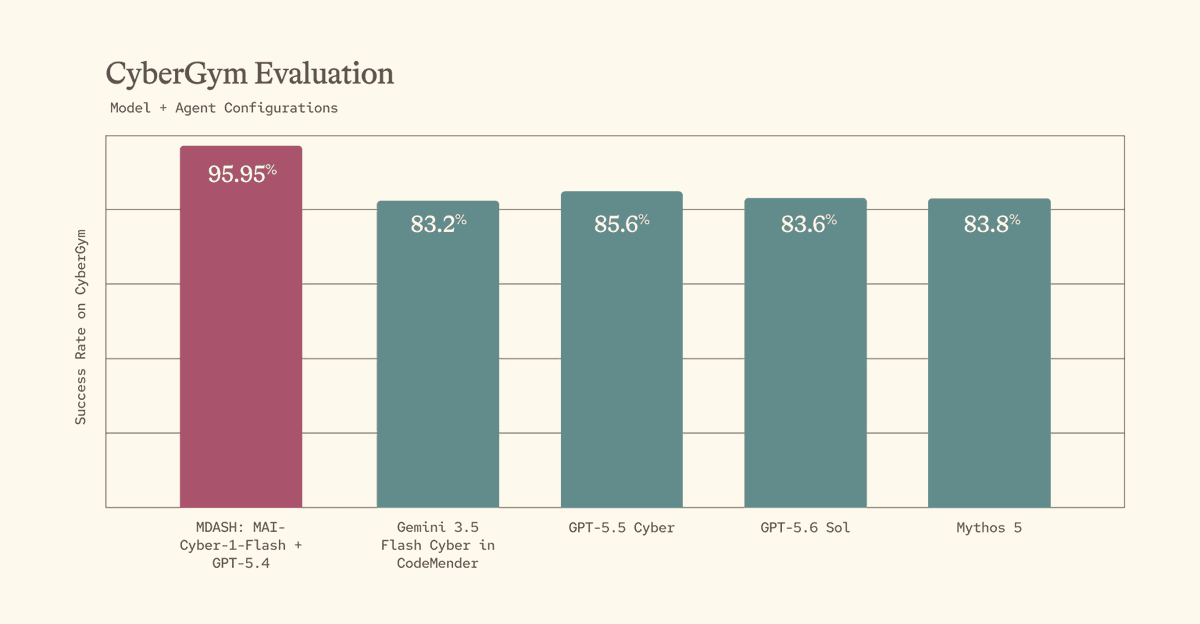
Microsoft’s public claim is a system score: MAI-Cyber-1-Flash plus MDASH, with GPT-5.4 in the configuration, reached 95.95% on CyberGym, according to Microsoft’s launch post. The screenshot in TheRundownAI's chart shows the comparison set:
- MDASH: MAI-Cyber-1-Flash + GPT-5.4: 95.95%.
- GPT-5.5 Cyber: 85.6%.
- Mythos 5: 83.8%.
- GPT-5.6 Sol: 83.6%.
- Gemini 3.5 Flash Cyber in CodeMender: 83.2%.
Microsoft’s launch post rounds the result to 96%, calls it +12 points above Mythos, and says the configuration produces a 50% cost saving against Microsoft’s current best MDASH offering: GPT-5.4 + 5.4 mini + 5.3 codex.
CyberGym got the community “benchmark to watch” treatment from testingcatalog's benchmark note. The same launch item also spread through TheRundownAI's daily roundup and TheRundownAI's follow-on thread, both carrying the benchmark framing.
CyberGym benchmark
CyberGym is a dynamic PoC benchmark for real-world vulnerability analysis. The CyberGym paper describes tasks where an agent gets a vulnerability description and codebase, then generates a proof-of-concept test that reproduces the vulnerability in pre-patch, patched, and post-patch contexts.
The benchmark’s scale, per the paper and the CyberGym repo:
- 1,507 benchmark instances.
- 188 real-world software projects.
- OSS-Fuzz-derived vulnerability tasks.
- Full server data around 10TB, with a small subset available for practical evaluation.
- Original reported top systems around 20% success.
Microsoft’s model card frames 95.95% as an in-MDASH configuration result and separately lists model-only terminal-harness scores. rohanpaul_ai's breakdown put the plain-English benchmark target as whether agents can reproduce real software vulnerabilities from code.
90/10 model routing
Token cost is the constraint for always-on defense, according to the cost note. Microsoft’s answer is a tiered model path: MAI-Cyber-1-Flash handles up to 90% of MDASH vulnerability detection and patching tasks, then GPT-5.4 handles the hardest 10%.
The official post ties the economics to task allocation. Microsoft’s launch post says MAI-Cyber-1-Flash lets MDASH reserve the largest, most costly models for exceptional tasks, while the model card says replacing 80% of existing MDASH models with MAI-Cyber-1 improved CyberGym performance from 88.4% to 95.95%.
MDASH agent harness
MDASH coordinates more than 100 specialized agents with different roles, tools, prompts, and stopping rules, according to rohanpaul_ai's breakdown. Microsoft’s post describes the harness as the layer that finds, validates, and remediates vulnerabilities using multiple leading models.
The agent loop in WesRoth's agent summary breaks into six jobs:
- Search the code.
- Investigate possible vulnerabilities.
- Debate whether findings are real.
- Remove duplicate findings.
- Test whether issues can be exploited.
- Produce evidence before reporting.
Satya Nadella’s framing, quoted by cramforce's harness quote, was that Microsoft keeps the harness, context, signals, and action space separate from one model family. That is the cleanest mental model for the launch: the expensive model is replaceable, the security workflow is the product.
Model card
Microsoft’s model card gives the launch’s most concrete model details:
- Lineage: cybersecurity-specialized fine-tune of MAI-Code-1-Flash.
- Architecture: transformer with self-attention and sparse Mixture-of-Experts layers.
- Size: 137B total parameters, 5B active parameters.
- Context length: 256k.
- Modalities: text input, text output.
- MDASH result: replacing 80% of existing MDASH models with MAI-Cyber-1 moved CyberGym from 88.4% to 95.95%.
- Model-only CVEBench: 0.314.
- Model-only CyberSecEval4: Threat Intel 0.553, Malware Analysis 0.33.
- Model-only CRSBench: 0.651 (POV=1200).
- Model-only ExploitGym: Kernel 0, Userspace 0, Browser 0.
The headline number belongs to the MDASH system configuration. The standalone benchmark table is much more mixed, which is exactly why the harness is the story.
Project Perception
Microsoft’s broader security blog puts MDASH inside Project Perception, a public-preview agentic security system starting Aug. 3. The sign-up CTA in the sign-up post points to Microsoft’s MDASH access flow.
Perception splits security agents into three classes:
- Red team agents identify potential paths to compromise.
- Blue team agents investigate context and determine meaningful risk.
- Green team agents take corrective actions and strengthen defenses.
The same Microsoft blog describes a Cyber Stack made of signals and sensors, security context, models, harness, agents, and actuators. It also says Microsoft sees more than 100 trillion security signals daily and has operational insight from 1.6 million customers, a data advantage rohanpaul_ai's breakdown also singled out.
Access and guardrails
MAI-Cyber-1-Flash is restricted to select MDASH customers. Microsoft’s model card says Azure AI Foundry Private Preview access is solely for use within MDASH and subject to additional approval because advanced cybersecurity capability is dual-use.
Microsoft’s launch post says MDASH wraps the model with role-based controls, tenant isolation, encryption, auditability, and sandboxed execution environments with no internet access. The model card says Microsoft used its AI Red Team, automated adversarial testing via PyRIT using more than one million multi-turn jailbreak conversations, hands-on security expert review, and an independent third-party assessment that found no critical-severity issues.
The model card also lists two deployment caveats: MAI-Cyber-1-Flash was primarily trained and tested on English-language data and benchmarks, and generated text or code may be inaccurate, incomplete, or incorrect.