
Researchers propose a closed-model perplexity proxy based on real and generated completions
A proposed perplexity proxy asks models to choose real completions over generated distractors. Aidan Clark challenges its validity and offers withheld perplexities for released OpenAI models to test its predictions.
TL;DR
- A proposed proxy uses real-versus-generated continuation choices to estimate closed-model perplexity, as eliebakouch explained.
- Post-training scores cannot safely recover pretraining perplexity, GPT-4o pretraining lead Aidan Clark argued in his response.
- A blind test is on offer: Clark requested predictions for released OpenAI models whose perplexities had not been published.
The published ANPI protocol asks for a full ranking of eight continuations and reports evaluating 105 endpoints for $119.42. Its repository includes raw traces and scripts for replaying the audit locally.
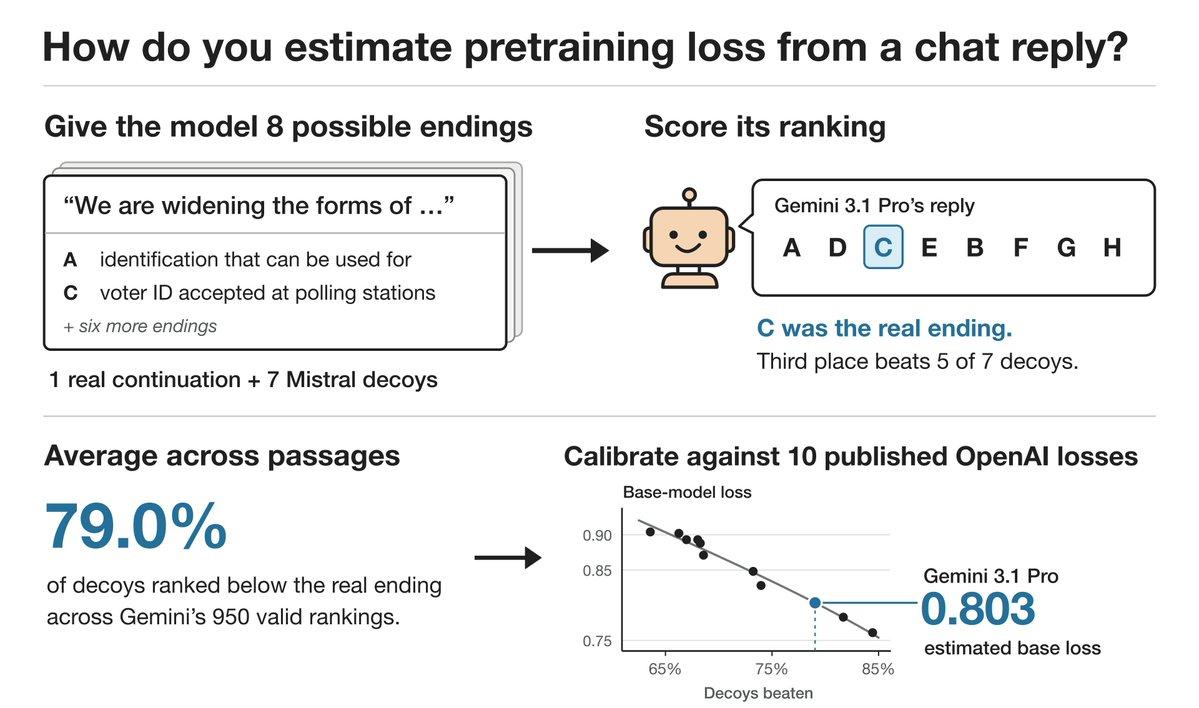
Eight-way continuation ranking
The Anpaure Pretraining Index, or ANPI, runs the following procedure, according to its November 27 technical write-up:
- Collect authentic continuations. Use 954 November 2026 items from 908 source URLs, spanning news and speeches, research papers, essays, new Wikipedia articles, and code.
- Generate seven distractors. Sample alternative continuations from
mistral-small-24b-instruct-2501at temperature 1.0. - Request a complete ranking. Shuffle the authentic continuation and seven decoys into slots A through H. Ask the evaluated model to return all eight letters in likelihood order, with reasoning suppressed.
- Score pairwise wins. For the authentic continuation’s mean rank
r, calculateAUC = (8 − r) / 7. Random ordering gives an expected 0.5; consistently ranking the authentic continuation first gives 1.0.
Keeping the losing ranks is the clever part: the author reports that an authentic continuation’s position after a first-place miss retains independent signal about pretraining loss.
Calibration errors and family offsets
ANPI’s calibration analysis transforms AUC into discriminability, d′ = √2 × Φ⁻¹(AUC), then fits mappings to published OpenAI losses and independently measured open-model bits per byte.
The author reports:
- Within OpenAI: 0.85% leave-one-model-out prediction error across 10 models with published losses.
- Upward extrapolation: 1.44% error when fitting earlier OpenAI models and predicting newer ones.
- Across laboratories: 3.41% leave-one-lab-out error across 14 native-chat open models from seven labs.
Across labs, the author attributes about 84% of residual variance to structural mismatch, including differences in domain mixtures and post-training styles. Reported family-level offsets are roughly 1% to 5%.
The write-up explicitly requires empirical anchors to convert rankings into absolute loss estimates. Its proposed robustness to globally monotone probability sharpening preserves candidate order, without identifying the underlying probabilities.
Post-training and reasoning leakage
OpenAI’s reported target is log-perplexity on a fixed snapshot of its internal codebase. In the original post, Jakub Pachocki, OpenAI’s chief scientist, notes that chain-of-thought can raise capabilities without lowering that pretraining loss.
Suppressing reasoning reduced o3’s AUC by 0.0203 in the ANPI author’s ablations. The author also reports a 0.071 AUC cold-start penalty associated with zero-think completion templates used for mandatory-reasoning open models.
Multiple-choice accuracy introduces its own measurement effects. In a comparison with MMLU, eliebakouch argued that correct-answer log-probability provides a smoother signal and is less susceptible to answer-format optimization; ANPI attempts the reverse mapping, from choices toward a probability-based metric.
Distillation could further lift downstream benchmark performance beyond what base-model perplexity predicts, he suggested:
Clark’s withheld-model test
Clark proposed a test with three constraints:
- Pick two already released OpenAI models.
- Use models whose perplexities OpenAI had not disclosed.
- Ideally, choose models with similar post-trained performance.
After receiving the predictions, Clark offered to share the underlying perplexities. That pairing would directly test whether the proxy distinguishes pretraining losses when downstream performance is similar.
No outcome for this challenge is reported in the November 27 technical write-up.