
SemiAnalysis reports TPU and Trainium deliver 1.5–2.5× more inference performance per dollar than NVIDIA GPUs
SemiAnalysis reports Google TPU and Amazon Trainium delivered 1.5–2.5 times the performance per dollar of equivalent NVIDIA GPUs at release. Their results joined the InferenceX benchmark this week.
TL;DR
- Google TPU and Amazon Trainium delivered 1.5–2.5× the inference performance per dollar of release-equivalent NVIDIA GPUs, according to SemiAnalysis's report.
- Trainium3's first AgentX submission claimed a 2.28× advantage over GB300 NVL72, B300 and MI355-class GPUs in SemiAnalysis's announcement.
- Generation matters: Trainium3 compares with Blackwell Ultra, SemiAnalysis clarified, while its deep dive puts newer Vera Rubin ahead.
- First-token latency remains a weakness: Trainium3 trails GB300 in some p90 TTFT cases in SemiAnalysis's analysis.
SemiAnalysis even recreated Alysa Liu's Olympic skating performance inside Trainium's hardware profiler. The AgentX corpus reconstructs coding traffic with synthetic tokens while preserving cache-sharing patterns. The holiday posts also brought a Silicon Supply merch launch and a Bremsstrahlung animation.
TPU and Trainium results
SemiAnalysis initially quoted 1.2–2.5×, then used 1.5–2.5× with the qualifiers “at release” and “equivalent NVIDIA GPUs.”
NVIDIA CEO Jensen Huang had said “TPU won't come, Trainium won't come” in the clip SemiAnalysis resurfaced from seven months earlier. InferenceX previously operated under the InferenceMAX name.
TPUv7 already has results across multiple models, and TPUv8 benchmarking is planned, according to SemiAnalysis's reply.
Ownership-cost assumptions
Amazon's first Trainium3 UltraServer submission used wide expert parallelism, which SemiAnalysis credited for the 2.28× result in its submission thread. The tested model was GLM-5.3 744B, served in FP4 with vLLM.
At the headline operating point, the figures reproduced by Codema's analysis were:
- P90 interactivity: approximately 246 tokens/s/user.
- Total throughput: about 9,266 tokens/s/chip for Trainium3 versus 8,942 for GB300, roughly a 4% advantage.
- Modeled chip-hour cost: $1.05 for Trainium3 versus $2.31 for GB300.
The cost model does most of the work in that 2.28× headline.
Trainium3's default modeled cost is $0.83/chip-hour in the live GLM comparison, against $2.31 for GB300. That page labels its basis large-hyperscaler-volume ownership TCO and, at an interpolated 216 tokens/s/user, reports $0.018 versus $0.062 per million total tokens, a 71% reduction.
A separate margin calculation gives Trainium3/vLLM 73.5% against GB300/SGLang's 53% at 135 p90 tokens/s/user. Its assumptions are three-year rental prices, Z.ai's list token prices and 60% hardware fleet utilization.
Codema also reported that the initial Trainium3 API rows lacked linked public GitHub Actions logs.
AgentX session replay
AgentX's public v1.0 dataset contains 393 opt-in Claude Code sessions. Median requests contain 142,000 input tokens and 444 output tokens; 44% of sessions include subagents.
SemiAnalysis identifies four workload properties:
- Multi-turn: tens or hundreds of interactions within a session.
- Long context: system prompts, tool definitions and accumulated conversation history.
- High prefix reuse: each turn carries forward the preceding conversation.
- Subagent bursts: short-lived child agents create bursty KV-cache demand.
Private prompts, code and tool payloads are removed. Inputs become session-scoped chained hashes in 64-token blocks, which AIPerf fills with deterministic synthetic coding and tool-use tokens.
The reconstruction preserves request lengths, prefix relationships, branching and timing. AgentX measures serving-system performance; its synthetic payloads support no model-quality evaluation.
Prefill and 128-way expert parallelism
Trainium3's serving layout puts prefill and decode on separate nodes. Both phases use 16-chip nodes, but the microarchitecture breakdown describes different mappings:
- Prefill: 16 pipeline stages, one chip per stage. Each chip's eight NeuronCores divide a prompt chunk, keeping the stage's tensor and expert parallelism on-chip.
- Decode: one model copy spans all 128 NeuronCores. Each physical core becomes a separate rank under
LNC=1; multi-user GLM-5.3 assigns two routed experts per core. - Collectives: smaller exchanges use nested local groups. Activation gathering and expert-output reduction span all 128 cores and cross the switch on every layer.
AWS separately documents a disaggregated vLLM inference path in which a proxy dispatches requests and the decode worker pulls prefill's KV cache through NIXL RDMA READ.
Official Neuron support in vLLM shipped in April 2024, following its first RFC at Thanksgiving 2023, according to the vLLM project. Anthropic uses Trainium at massive scale for Claude production inference, SemiAnalysis said.
Descriptor generation
SemiAnalysis's UBenchX tests isolate three ways to generate descriptors for HBM-to-scratchpad DMA transfers. These measurements are per NeuronCore:
- Static descriptors: compiled ahead of time. At 64 KiB, loads reached 492 GB/s and stores 544 GB/s, approximately 80% and 88.8% utilization.
- Hardware DGE: generates addresses in hardware. At 64 KiB, loads reached 398 GB/s and stores 476 GB/s; performance matched static mode beyond roughly 256 KiB.
- Software DGE: performed substantially worse. NKI routes indirect gather/scatter accesses through this mode, exposing a weak spot for irregular memory access.
First-token latency
Trainium3's p90 TTFT trails GB300 in some cases in the deep dive. The authors attribute this to compute-bound prefill and a pipeline favoring throughput: Trainium3 has 2,517 theoretical FP4 TFLOPS against Blackwell Ultra's 15,000, approximately 17% as much.
At the approximately 246 tokens/s/user point reconstructed by Codema, p90 TTFT was 4.5 seconds for Trainium3 versus 1.8 seconds for GB300.
InferenceX distinguishes two rates in its metric definitions:
- Interactivity: approximately
1 / inter-token latency, measuring streaming speed after generation begins. - E2E normalized interactivity:
output tokens / end-to-end latency, incorporating the first-token wait.
Vera Rubin interactivity
SemiAnalysis separately compared Vera Rubin NVL72 with GB300 NVL72 using the same TokenSpeed engine. Its chart shows Rubin's tokens-per-dollar advantage widening as the interactivity target rises.
Trainium4 will be the corresponding generation to benchmark against Vera Rubin, according to SemiAnalysis's clarification.
MI355X on TokenSpeed
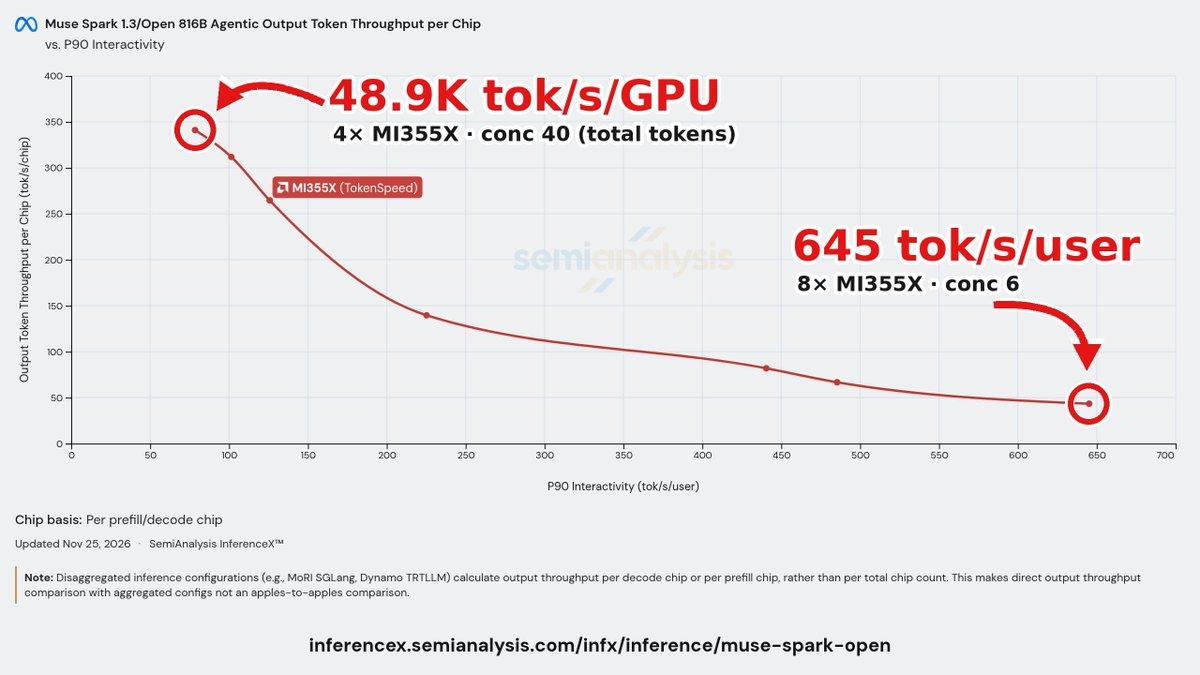
AMD's MI355X also received a TokenSpeed AgentX result for Muse Spark Open, with separate operating points at each end of the curve:
- Latency end: 645 tokens/s/user p90 interactivity.
- Throughput end: 48,900 total tokens/s/GPU at concurrency 40 on four MI355X GPUs.
SemiAnalysis credited work built openly on Triton/Gluon and Iris and upstreamed into TokenSpeed.