
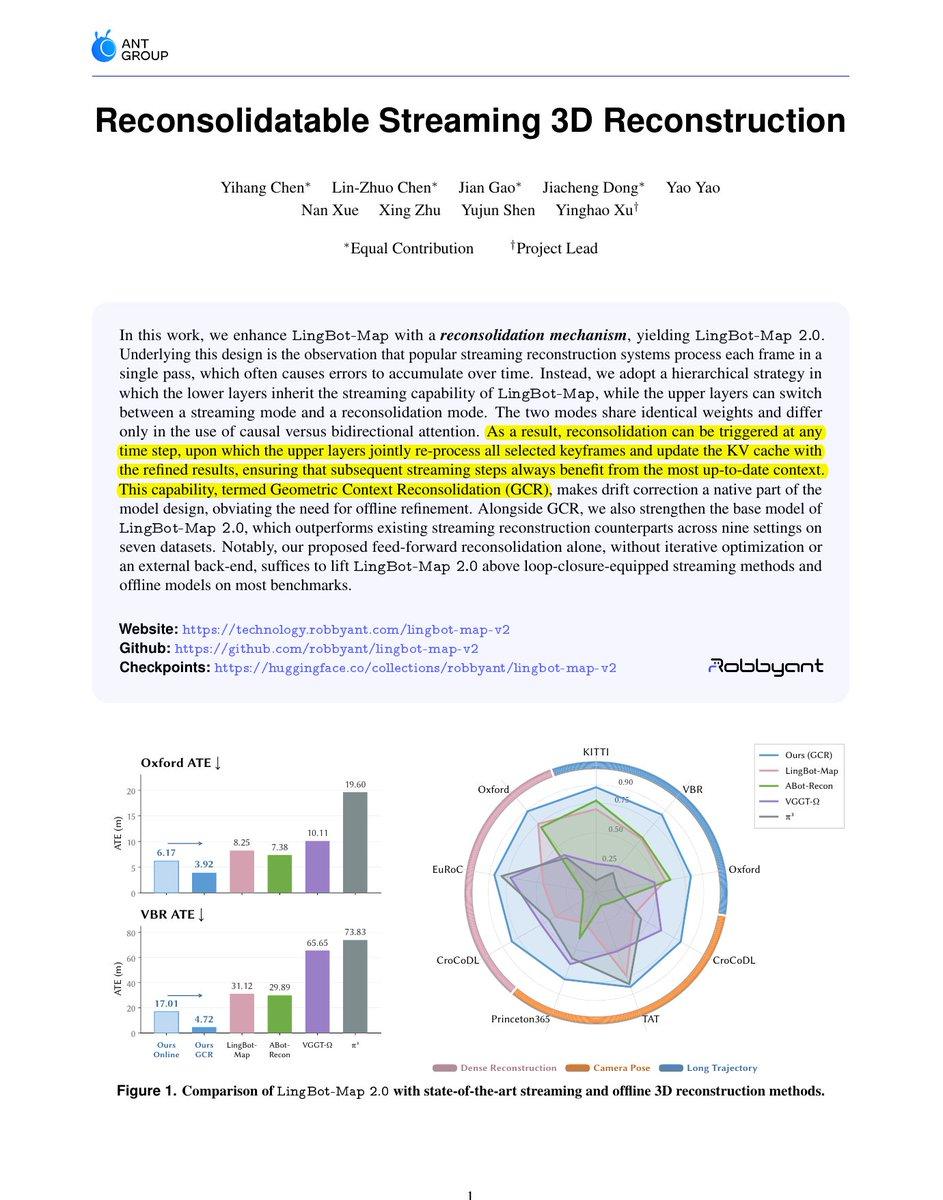
LingBot-Map 2.0 Refine reportedly cuts VBR trajectory error to 4.72 m
LingBot-Map 2.0's Refine component reportedly cuts VBR trajectory error from 31.12 m to 4.72 m. Public code and weights cover the Streaming version, not Refine.
TL;DR
- VBR trajectory error drops from 31.12 m for LingBot-Map 1.0 to 4.72 m for 2.0 with Refine, according to kimmonismus's report.
- Refine reuses cached keyframe features and recomputes only the upper 12 of 24 transformer layers, as rohanpaul_ai explains.
- Released code and weights cover causal Streaming; Refine is excluded, as kimmonismus clarifies.
The technical report makes streaming and reconsolidation share weights, switching between causal and bidirectional attention. The browser viewer can replay saved reconstructions without loading a model or using CUDA.
Refine rewrites the KV cache
Robbyant, Ant Group's embodied-AI company, calls the mechanism Geometric Context Reconsolidation (GCR). Its clever bit is cache writeback: corrected history becomes the spatial reference for subsequent frames, as rohanpaul_ai describes.
The report divides the correction into three operations:
- Reuse layers 1–12. Their causal features remain fixed. Stored tokens let the model skip image re-encoding and rerunning those layers.
- Recompute layers 13–24. The upper layers process selected historical keyframes with bidirectional attention in one forward pass.
- Rewrite memory and predictions. Shared camera and depth heads revise earlier estimates, while the upper-layer KV cache and camera-head cache are refreshed.
Robbyant's project page says reconsolidation can be triggered at any time, without loop detection, pose-graph optimization or post-processing.
VBR trajectory error
Robbyant's benchmark chart separates improvements to the streaming base model from the additional correction:
- LingBot-Map 1.0: 31.12 m absolute trajectory error (ATE).
- LingBot-Map 2.0, Online Streaming: 17.01 m ATE.
- LingBot-Map 2.0, with GCR/Refine: 4.72 m ATE.
The full 1.0-to-2.0-with-Refine reduction is about 85%. Within 2.0, adding Refine reduces the streaming result by about 72%.
Evaluation covers seven VBR trajectories using Sim(3)-aligned ATE, according to the benchmark guide. That alignment fits rotation, translation and scale to ground truth.
Streaming API
The released Python interface is stream.online(frame, persistent=is_keyframe), documented in the repository README. Its integration details include:
- Eight-frame initialization: the first seven calls return
None; the eighth returns predictions for the initial prefix. Subsequent calls return the current frame's prediction. - Selective persistence: initialization frames must be keyframes. Later non-keyframes produce predictions without changing persistent KV memory, camera state or the committed clock.
- Geometric outputs: camera-to-world poses, intrinsics, depth and confidence. Depth and translation have arbitrary scene scale.
- Frame identifiers:
frame_indicestracks committed positions, which non-keyframes can reuse. The CLI separately records original input IDs asraw_indices. - Runtime requirements: a BF16-capable CUDA GPU, PyTorch 2.8 or newer, and FlashInfer.
Code, weights and license
The model card explicitly identifies the released checkpoint as pure causal Streaming, distinct from the mixed-mode GCR checkpoint.
Robbyant licenses its original code and Base Streaming weights under CC BY-NC 4.0, restricting them to noncommercial use. The download instructions also require authentication while the model repository is private.