
SlopCodeBench tests find an ownership prompt cuts duplication in Fable 5.2 outputs
Early SlopCodeBench tests found an ownership prompt reduced duplication in Fable 5.2 outputs. One challenge improved from 4/8 to 8/8 passes, but costs rose and another run locked in bad behavior.
TL;DR
- An ownership prompt reduced duplication and increased test-writing in early Fable 5.2 runs, according to dexhorthy’s results.
- One easy challenge improved from 4/8 to 8/8 passes, but token cost and duration rose at every checkpoint reported in the follow-up.
- Extra tests sometimes preserved mistakes: in dexhorthy’s account, one run locked in bad behavior and performed worse over time than the stock prompt.
Anthropic’s own small-task tests put duplicate-code consolidation at under 10% without ownership wording and about 75% with it. One ownership-prompted solution expanded from one program file to 52, alongside 10,188 test lines, in the comparison shared in the thread.
The ownership prompt
The experiment compared Fable 5.2 at xhigh under a stock feature-building prompt against an owner variant using this sentence from Anthropic’s prompting guide:
You are the owner and long-term maintainer of this codebase, and its design is up to you.
SlopCodeBench makes agents extend their own previous solutions through successive specification updates. Its design notes describe black-box evaluation against external CLI or API contracts, leaving internal architecture to the agent; the benchmark code is public.
Duplication across six problems
Cloned lines fell in all six reported comparisons. The table separates program code from agent-written tests.
The table’s “slop hits per 100 lines” measure nevertheless worsened in two comparisons. SlopCodeBench’s authors limit their quality claims to surface-level verbosity and structural erosion, rather than treating the measurements as a comprehensive quality score.
Eight passes at a higher cost
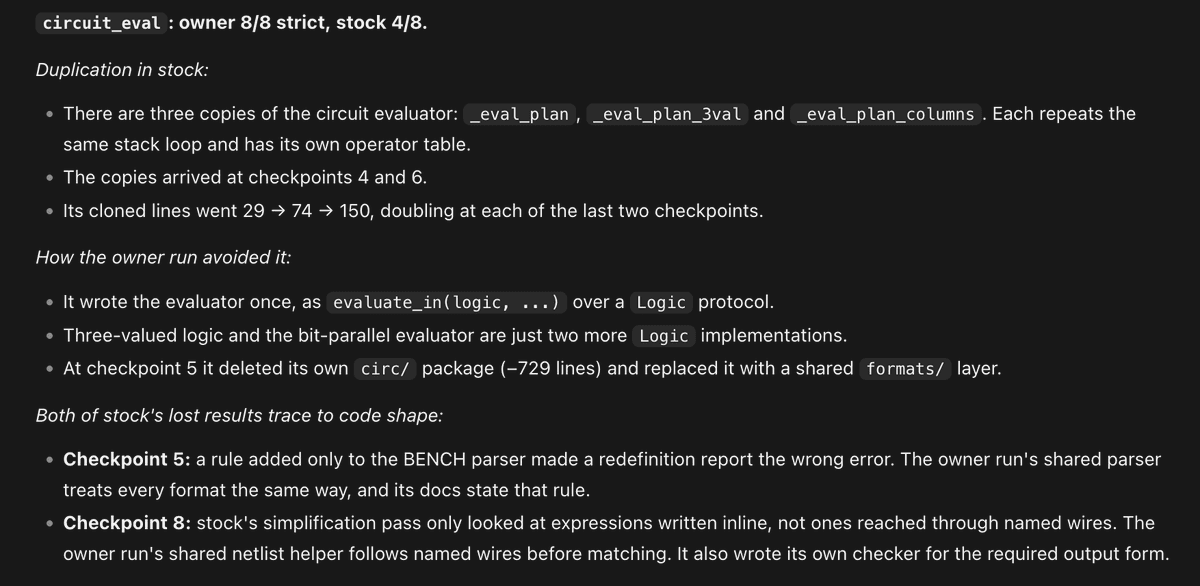
On the easier challenge described in dexhorthy’s follow-up, the runs diverged on correctness, architecture and spend:
- Pass rate: 4/8 with the stock prompt → 8/8 with ownership wording.
- Duplication: the stock run produced three implementations of the same function.
- Abstraction: the owner run introduced a reusable
Logicinterface and deleted a large module in favor of a better abstraction, according to dexhorthy. - Cost and duration: both were higher for the owner run at every checkpoint reported so far.
Tests that lock in mistakes
The nastiest result was an owner run whose early tests locked in bad behavior, leaving it performing worse over time than stock, according to dexhorthy.
The benchmark does not expose its test suite to the agent. Agent-authored tests therefore sit apart from the evaluator’s correctness checks.
Architecture complaints
- Premature decisions: iso_morph raised models jumping to concrete choices too early in a discussion about using Fable 5.2 for architecture work.
- ML experiments: yacinelearning joked about Opus 5.5’s “stochastic parrots” leading an experiment astray with a parrot meme.
Scope limits and omitted changes
Anthropic’s ownership-prompt experiments exposed additional side effects:
- Output tokens rose about 70–80% in its small-task tests.
- The model made unrequested changes, including new tests and documentation; some runs changed existing feature behavior.
- Closing PR summaries often omitted small changes.
- Even with “No drive-by refactors, renames or cleanups” earlier in the same prompt, the model still consolidated duplicated code in more than half of runs.