
OpenAI makes Codex Automations GA with scheduled runs and per-task model settings
OpenAI made Codex Automations generally available and also added theme import and sharing in the desktop app. Use scheduled runs and isolated worktrees to move Codex from interactive coding into background workflow execution.
TL;DR
- OpenAI moved Codex Automations to general availability, with scheduled recurring runs aimed at repo briefings, issue triage, and PR follow-up according to the launch thread.
- The GA release adds per-run controls that matter operationally: OpenAI says you can pick the model, set the reasoning level, and choose whether work happens in a worktree or an existing branch the launch thread.
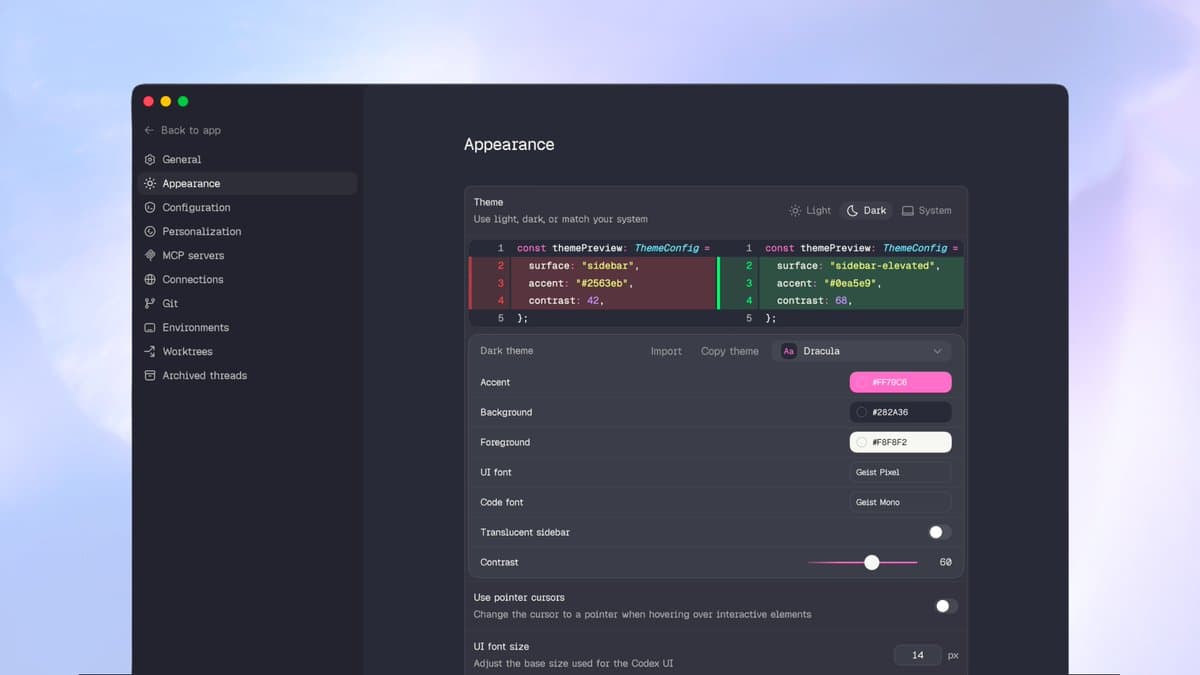
- A parallel desktop update adds theme import and sharing, and the Codex screenshots show custom appearance settings exposed alongside other app configuration panels.
- Practitioner summaries frame the big shift as moving Codex from an interactive assistant to unattended background workflow execution, with one demo thread calling out dedicated worktrees as the key isolation mechanism.
What does Automations GA actually change?
OpenAI's launch thread says Automations are now GA and can be reused with templates, which turns one-off prompts into repeatable tasks. The concrete examples are recurring engineering chores: "daily repo briefings," "issue triage," and "PR comment follow-up," all run on a schedule rather than from an active chat.
The implementation details are more useful than the marketing label. Per OpenAI, each run can now specify the model and "reasoning level," and the execution target can be either an isolated worktree or an existing branch launch thread. In a practitioner write-up, the demo thread describes the mechanism as a "dedicated Git worktree in the background," so the main branch stays untouched while the agent works in parallel.
That makes Automations closer to a lightweight agent runner than a desktop convenience feature. The automation demo shows a recurring task configured in the Codex app while a terminal view runs Git operations in the background, reinforcing that the product is now aimed at unattended repo maintenance, not just interactive coding.
How do theme import and sharing work?
The same release adds theme personalization to the Codex desktop app. OpenAI says users can "import themes you like or share your own," and the screenshots in the update post show editable appearance fields for accent, background, foreground, fonts, contrast, and sidebar translucency.
The theme system appears to be portable as structured config, not just point-and-click presets. In a shared theme example, a user posts a full codex-theme-v1 blob with keys for codeThemeId, accent, contrast, fonts, semantic diff colors, and surface/background values. That suggests teams can pass around exact appearance configs as text, which is more useful than local-only UI customization.
The third-party screenshots also show these appearance controls living alongside MCP servers, Git, environments, and worktrees in the desktop app's settings. Themes are cosmetic, but the release packages them with the more substantive automation rollout, signaling that Codex desktop is being developed as a daily-use engineering client rather than a narrow demo surface.