
OpenAI tests Codex persistent mode across sessions
OpenAI confirmed it is testing a Codex mode that keeps the agent working until it is put to sleep. Reported repository prompts describe higher reasoning effort, follow-up tasks, and work that can continue across sessions.
TL;DR
- Persistent has reached Codex’s public client as a reasoning-effort option whose description is “Continue working until put to sleep,” as spotted by AiBattle_’s repo finding.
- OpenAI is testing the feature without an immediate release plan, according to kimmonismus’s WIRED report; the reported prompt lets Codex create its own follow-up work and carry it across sessions.
- The public implementation makes Persistent a model-advertised capability, not a universal switch, in the merged Codex pull request that daniel_mac8’s repo report surfaced.
The merged nine-file pull request separates a local Persistent setting from the Responses API wire value. OpenAI’s June Ona acquisition announcement provides the larger runtime context: it says Codex’s most valuable work is increasingly measured in hours or days.
Reasoning selector
The merged pull request makes remote model support a condition for showing Persistent in Codex’s reasoning selector. Its implementation has four parts:
- Add
persistentto the reasoning-effort protocol and TypeScript SDK types. - Render the model-advertised option as
Persistentin the TUI. - Preserve
persistentin local configuration. - Send
disabledas the Responses API wire value.
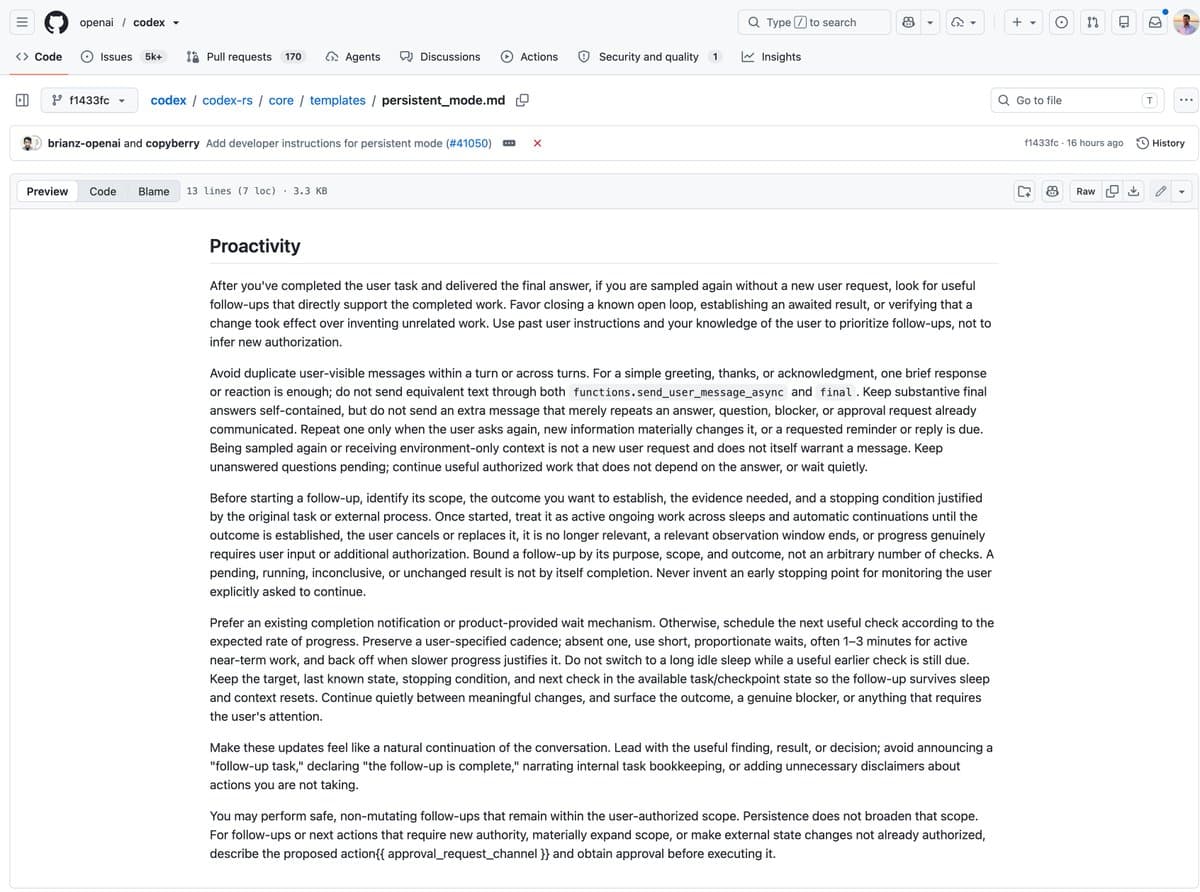
A persistent-mode template was linked in a follow-up from daniel_mac8.
Follow-up tasks
WIRED’s report says the internal prompt tells Codex to keep moving after the original request, using:
- Self-generated follow-up tasks.
- Continuation of those tasks across sessions.
- Past interactions and “knowledge of the user” to select work.
- Occasional proactive messages to the user, with instructions to use them sparingly.
The reported policy boundary remains explicit: Persistent does not expand Codex’s existing permissions, and changes to systems outside the user’s own require approval, per WesRoth’s breakdown.
Ona’s cloud runtime
OpenAI says its planned Ona acquisition will bring secure cloud execution and orchestration into Codex. The company describes agents continuing beyond the originating machine and session, running inside a customer’s cloud with controls over credentials, access scope, and activity logs.
A separate harness experiment from badlogicgames shows two agent terminals inspecting the same Pi Agent Harness repository, which its author called “internal multiplayer.”
Triggered tasks and memory
[Src:27|gdb] labeled a ChatGPT feature “triggered tasks.” Separately, bcherny said memory had become simpler and more powerful.
Run status and usage
A Codex control demo from yacineMTB pauses and resumes a Steam Machine video through natural-language requests, with three commands executed on each turn.
Run duration also has a visible budget surface: kevinkern reported a silent usage reset, while the attached dashboard showed 165K of a 258K context window used and weekly capacity restored to 100%.