
Developers report under-10% unattended completion for coding agents
Robert C. Martin argued tangled code confuses agents and promoted agent-led refactoring with tests. Other reports cited high Sol spend, under-10% unattended completion, and failures once bugs or complexity appear.
TL;DR
- Unattended coding still looks fragile: zeeg put his successful no-intervention task rate below 10% in zeeg's reply, while a Reddit complaint said Codex starts well and then goes off the rails once bugs or complexity appear.
- Robert C. Martin's workflow moved review pressure into constraints: unclebobmartin's post listed unit tests, Gherkin tests, QA procedures, quality metrics, mutation testing, and coverage instead of reading agent-written code.
- Code review is being renegotiated, not deleted: GergelyOrosz said one experienced engineer stopped reviewing Fable output except for key parts, while GergelyOrosz added that review agents are common but usually do not validate by running code.
- The cost math is biting heavy users: zeeg reported a $2,000 Sol day for an estimated 50% output lift in zeeg's spend post, and willdepue said $400 in Codex credits disappeared in four hours while running four xhigh agents.
O'Reilly's Clean AI page frames Martin's agent work as disciplines, workflows, and tools for speed without sacrificing code structure. The SwarmForge repo shows the mechanical version: roles like coder, cleaner, architect, hardener, and QA. The SlopCodeBench paper gives the skeptical counterweight, 36 problems, 196 checkpoints, and no agent fully solving any problem end-to-end. GitHub's Copilot token post shows the platform side of the same pressure, with context caching, tool search, and model routing built to spend fewer tokens per useful turn.
The no-code-reading gauntlet
Robert C. Martin, described by O'Reilly as a programmer since 1970 on its Clean AI course page, said he does not read code written by his agents because that is the only way he can keep the productivity gain.
His replacement stack was concrete:
- Unit tests
- Gherkin tests
- QA procedures
- Quality metrics
- Mutation testing
- Test coverage
- Other project-specific constraints
The testing split is not fully lights-off. Martin said agents write unit tests he does not read, while he reviews or spot-checks Gherkin tests and QA procedures, then runs exploratory tests manually in unclebobmartin's testing split.
He also kept accountability with the human. In unclebobmartin's reply, Martin said he remains the engineer because he is accountable.
Clean code for agents
Martin's quality checklist is measurement-heavy:
- Cyclomatic complexity thresholds
- Test coverage
- Dependencies
- Cohesion
- Coupling
- Information hiding
Agents write some of the measuring tools too. According to unclebobmartin, the agents produce small deterministic programs that check code quality, coverage, or mutation-style errors.
Clean code stays in the loop because messy code breaks agents as well as humans. Martin said agents can get tangled when the code is tangled in unclebobmartin, and unclebobmartin said he had seen agents wrangle with their own messes until he stepped in.
Code review without code review
Gergely Orosz said a very experienced engineer who had always reviewed code was stopping routine review of Fable-written output, except for key product areas. The reason, according to GergelyOrosz, was that the code met that engineer's standards for style and correctness.
Orosz narrowed the claim afterward: the case was about Fable, not Opus 5, and GergelyOrosz said Opus 5 was not as good as Fable for writing code.
Review agents are already common, but validation is a separate thing. Orosz said code review agents can catch some issues, while GergelyOrosz noted that they usually are not running the code.
Matt Pocock hit the customization wall from the other side. A generic review skill is hard because it needs project standards, mattpocockuk argued, and mattpocockuk said his /code-review mostly delegates to local coding standards and spec compliance.
The under-10% unattended number
The strongest cost complaint came from zeeg: one day of Sol use cost roughly $2,000 for an estimated 50% output increase over his peak coding output.
He put the unattended ceiling lower than the hype cycle does:
- Less than 10% of tasks reached production quality without intervention or human-in-the-loop cycles, according to zeeg's reply.
- Heavy use implied roughly $520,000 per year and rising in zeeg's spend post.
- Some engineers were spending $5,000 or more in a week, zeeg said in zeeg's cost reply.
- The raw spend was not mostly an OpenRouter service fee, according to zeeg.
Other users reported the same burn pattern from the consumer side. willdepue said $400 in added credits ran out in four hours with four xhigh agents, and a Reddit rate-limit post claimed 15.1 billion tokens from running four to five Sol Ultra workspaces plus Codex.
Long-horizon code rot
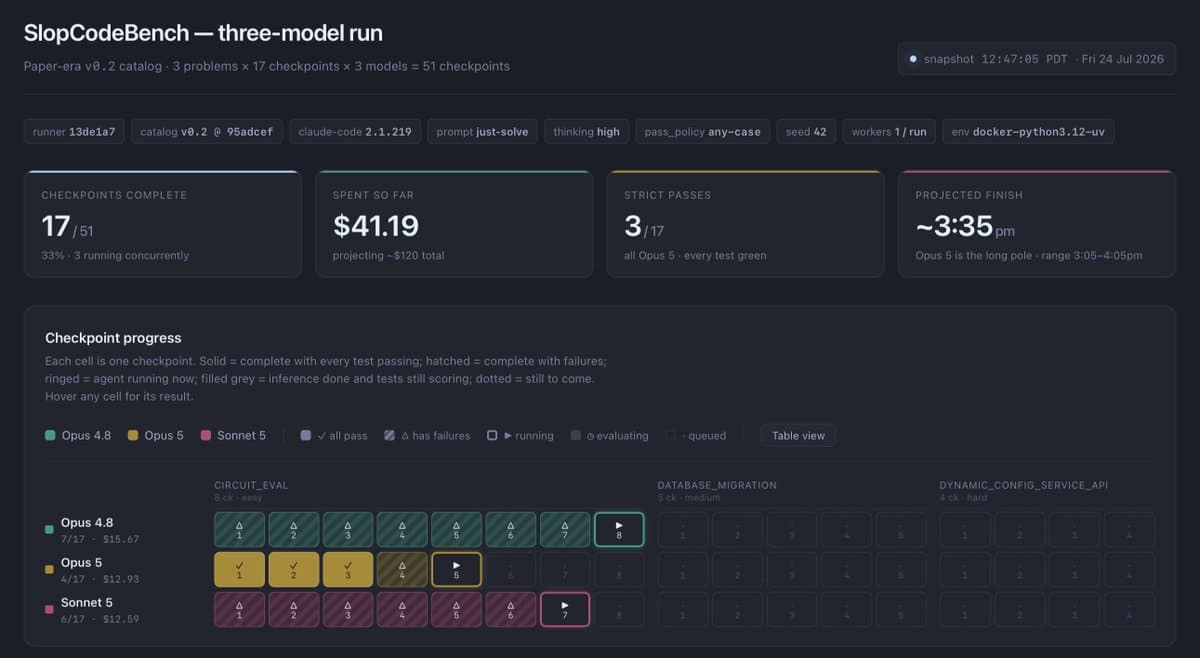
The SlopCodeBench paper evaluates agents on iterative extension, where each checkpoint changes the spec and the agent has to extend its own previous solution. The paper measures structural erosion and verbosity, then reports that none of 15 evaluated agents fully solved any of the 36 problems end-to-end.
Dex Horthy's live subset turned that into a current-model stress test. On the first problem, dexhorthy's update said Opus 5 ended with 2 open defects, Sonnet 5 with 7, and Opus 4.8 with 12, but Opus 5 cost about $44 versus Sonnet's $24.
The same thread showed why single results are slippery. Database migration flipped the ranking, with Opus 4.8 at 15 open defects and Sonnet 5 at 26 while Opus 5 was still running in dexhorthy's update.
The user reports rhyme with the benchmark. the Reddit complaint said Codex duplicated work, ignored instructions, and randomly re-architected an app during a six-hour session, even with two agents reviewing the work.
Software factories
Paulius Ztin's Squid workflow splits the agent factory into three stages:
- Planning: grill a rough feature idea for missing requirements, weak assumptions, architecture gaps, and edge cases.
- Implementation: run a software engineer role against a tester role until the task is complete.
- Review: review the PR diff, then run CI, formatting, linting, integration tests, and regression checks.
Dex Horthy's Why Software Factories Fail puts the bottleneck in the same place: code creation gets cheaper first, then review, testing, and architecture become the limiting factors. The Hacker News thread had 383 points and 265 comments when Exa read it.
Thoughtworks' essay on designing code for humans described the split as specs and deterministic checks versus human-readable implementation. It also noted the failure mode: green builds can still leave humans debugging behavior they do not understand.
Issue tracker slop
The maintainer-side version of agentic code shows up as issue triage. Mario Zechner said he spends more than an hour per day manually triaging 30-plus issues, including weekends, and badlogicgames said only 4 of 34 issues passed a low bar that day.
The screenshots in badlogicgames' thread show duplicated session-affinity issues and a CONTRIBUTING.md warning that agent-generated issue spam can get accounts blocked. Zechner said the specific fix was to set compat, and badlogicgames pointed gateway authors toward a custom provider extension that handles auth, the model catalog, and compatibility.
The ugly detail is that some slop is valid. Zechner said it cannot be identified automatically in badlogicgames, which leaves humans reading enough of the queue to separate bad automation from useful reports.