
Cursor reports input tokens make up 70% of coding-agent costs
Cursor's Developer Habits Report says input tokens account for about 70% of price-equivalent coding-agent costs as agents read more context. The report also says auto-accepted code is up 5x since the start of the year, so teams should watch context usage and review rates.
TL;DR
- Cursor says its new Developer Habits Report is built from "the most comprehensive dataset on AI coding in the world, across all model families," according to cursor_ai's launch post.
- In one of the report's headline charts, input tokens account for about 70% of price-equivalent coding-agent costs as agents pull in more context, per cursor_ai's cost chart post.
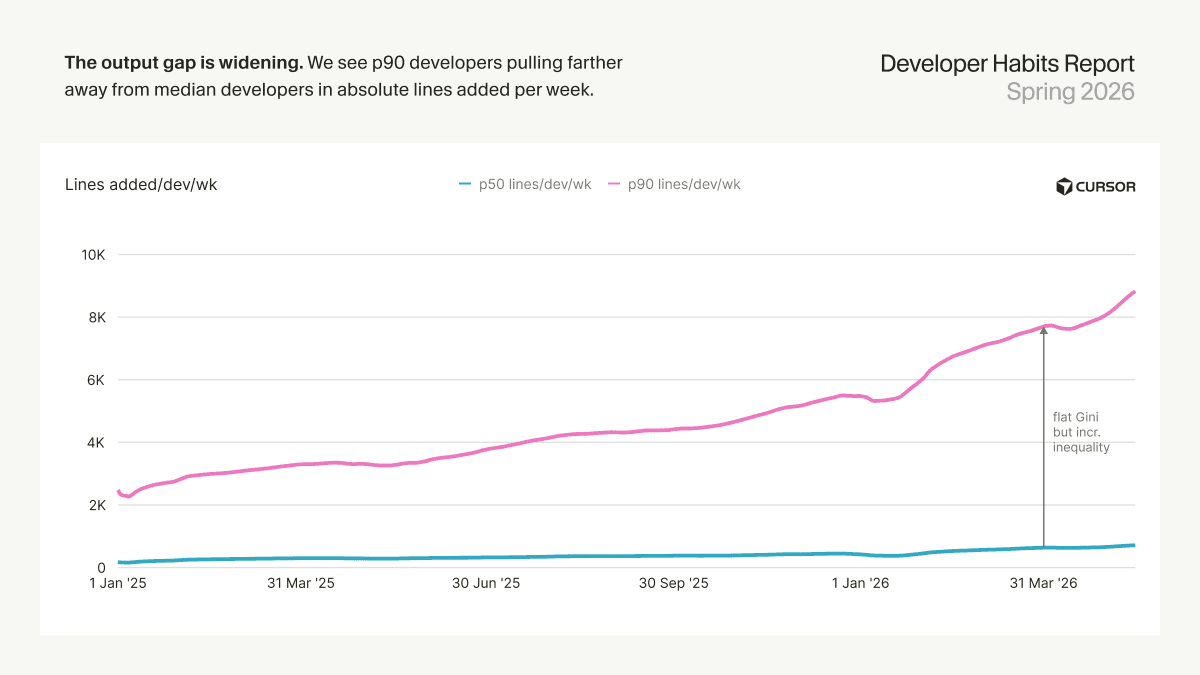
- Cursor also says power users are taking a bigger share of total AI activity, and cursor_ai's usage-distribution post frames that gap as widening.
- A chart highlighted by nrehiew_'s post says the amount of auto-accepted code has increased 5x since the start of 2026.
- nrehiew_'s model-cost summary adds a useful wrinkle: Opus 4.7 agent requests looked almost twice as expensive as GPT 5.5 requests in raw cost, but the gap narrowed after normalizing for accepted lines.
According to Cursor's launch thread, the report spans all model families, not just Cursor's own stack. Another chart from the same thread says the biggest users are concentrating more of the total activity, while a follow-up reaction points to a separate curve moving just as fast: more code is getting accepted without edits.
Cursor's dataset
The main claim in cursor_ai's announcement is scope. Cursor says the report draws from a cross-model dataset large enough to describe how AI coding usage is changing at industry scale.
That matters for one reason: the company is framing these charts as behavior data, not a single-model benchmark. The post does not break out methodology details in the tweet itself, but it does make the dataset breadth part of the pitch.
Power users pull away
Cursor's power-user chart says heavy users already account for a large share of AI activity and that their share is still increasing. nrehiew_'s read of the report puts numbers on the spread: the median developer is adding about 800 lines per week, while the p90 developer is around 7,000.
That is a wide enough gap to make "average developer" stats less useful on their own. The report's distribution view looks more like a market of distinct usage tiers than a single rising baseline.
Input-token economics
The cleanest finding in the report is cost composition. Cursor's chart post says input tokens are now the majority of price-equivalent token costs for coding agents, landing around 70% as agents consume more context.
That is a notable inversion of the older intuition that output generation is the expensive part. In Cursor's framing, the bill is increasingly tied to how much code, history, and retrieved context the agent reads before it writes.
Auto-acceptance and model mix
nrehiew_'s chart share says auto-accepted code has increased 5x since the start of the year. The tweet adds a skeptical aside, but the chart itself is the more important signal: developers are letting more model output land directly.
The same commenter also pulls out a model-level comparison from the report. Opus 4.7 agent requests appeared almost twice as expensive as GPT 5.5 requests on raw cost, despite GPT 5.5 carrying a higher output price, but the two models looked similar once cost was normalized by the percentage of lines accepted. That implies the raw token bill and the accepted-code yield are diverging enough to change the ranking, depending on which denominator you use.