
Cursor publishes CursorBench to compare coding models on intelligence and token efficiency
Cursor published its internal benchmarking approach and reported wider separation between coding models than SWE-bench-style leaderboards show. Use it as a reference for production routing decisions, but validate results against your own online traffic and task mix.
TL;DR
- Cursor published a new scoring method for agentic coding tasks and said it combines offline benchmarks with online evals so results stay useful as public coding benchmarks get saturated. The blog post frames it as a benchmark built from real Cursor sessions rather than a pure leaderboard exercise.
- In CursorBench's comparison chart, model gaps widen versus SWE-bench Verified: several models cluster around 75-81 on SWE-bench, but spread from roughly 29 to 58 on CursorBench, suggesting stronger discrimination on multi-step coding work.
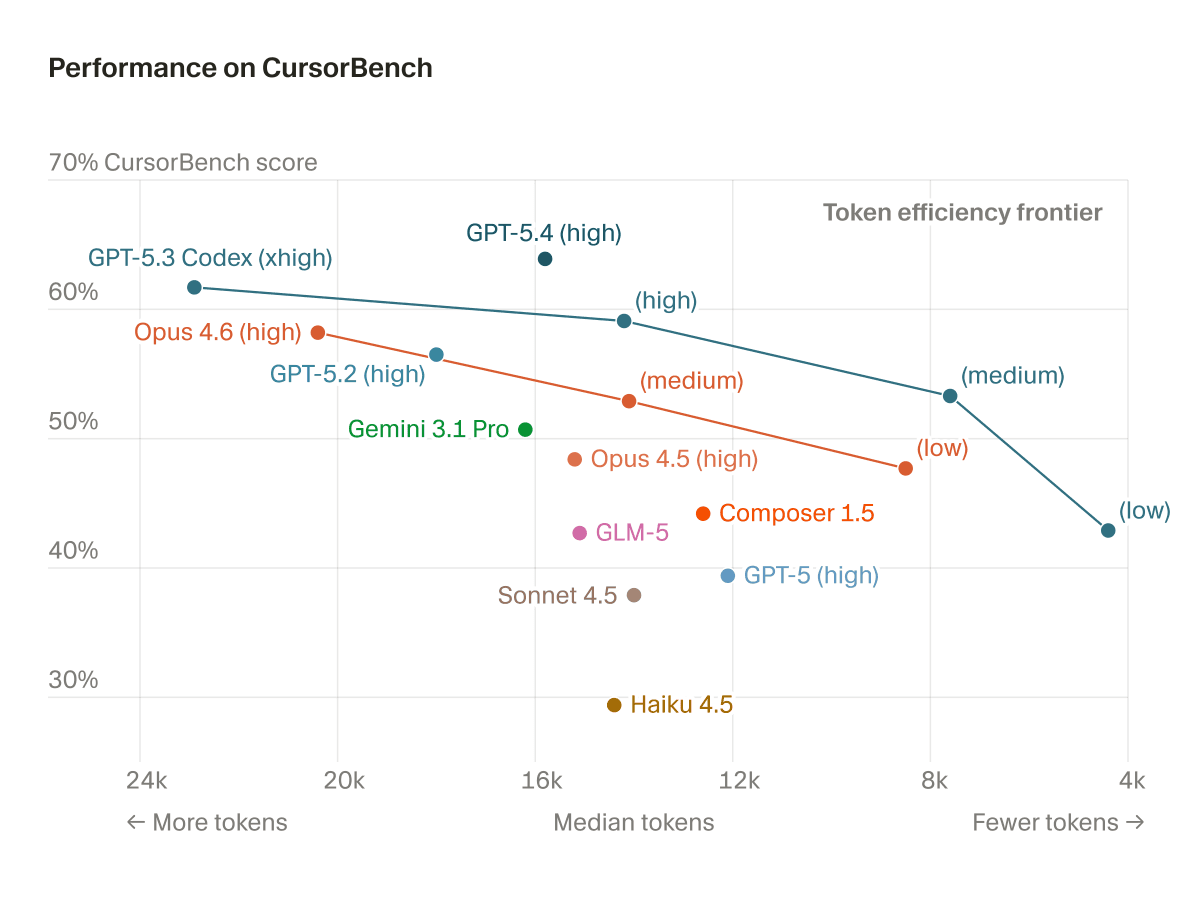
- Cursor's efficiency plot puts score and token usage on the same axis: GPT-5.4 appears on the efficiency frontier around 16k tokens, while higher-scoring settings like GPT-5.3 Codex xhigh use substantially more tokens.
- Cursor says in its methodology writeup that it evaluates correctness, code quality, efficiency, and interaction behavior from real engineering tasks; Cursor cofounder Jediah Katz called the release "much more transparency" than the company had shared before.
What CursorBench measures differently
Cursor's methodology post says CursorBench is drawn from real sessions from its own engineering team, with tasks meant to reflect multi-file, multi-step development work instead of isolated puzzle-style prompts. The company says scoring is not limited to binary correctness; it also tracks code quality, efficiency, and interaction behavior, then checks online traffic for regressions so offline wins still match actual developer experience. The launch thread summarizes that as a mix of "offline benchmarks and online evals."
That matters because Cursor is arguing public benchmarks are getting less decision-useful for routing and model selection. In Katz's post, he says the team had been "coy for a while about the actual scores" and is now publishing more of the underlying evaluation logic and results.
What the first results show
The first charts make two claims. First, the benchmark comparison shows much larger separation than SWE-bench Verified: Opus 4.6, GPT-5.2, and Gemini 3.1 all sit within about a point of each other on SWE-bench, but spread more clearly on CursorBench, where Opus 4.6 leads at 58.2 and Haiku 4.5 lands at 29.4. That supports Cursor's case that benchmark saturation can hide practical differences between coding models.
Second, the token-efficiency chart makes cost-performance tradeoffs visible instead of reporting one score per model. GPT-5.3 Codex xhigh sits near the top score band but at roughly 24k tokens, while GPT-5.4 high lands slightly lower on score at about 16k tokens and is presented as part of the efficiency frontier. A brief OpenAI developer account reaction distilled that as "leads CursorBench on correctness with efficient token usage", though the underlying chart is more specific: it highlights frontier placement, not a single universal winner across every operating point.